A company owned by a friend of Orbán transported money intended for Ukraine through Hungary for years, and this was no secret to the authorities
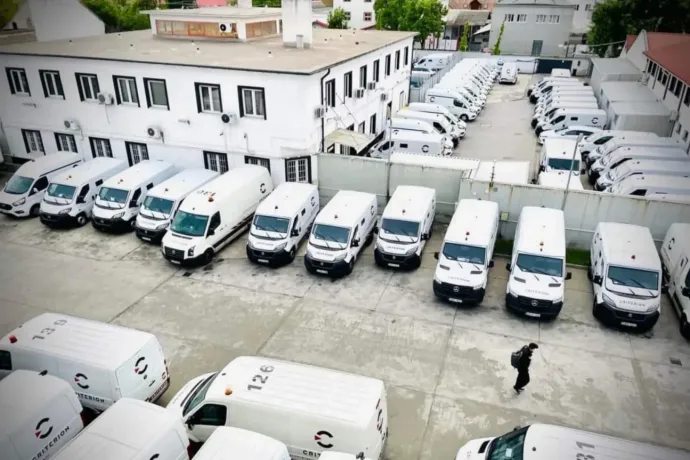



For many years, since the 2022 outbreak of the war, Criterion, a cash logistics company owned by István Garancsi (part of the the inner economic circle with close connections to Fidesz’s governing elite, and a friend of Viktor Orbán) has been transporting money sent to Ukraine from Austrian financial institutions, according to information obtained by Telex and confirmed by several independent sources. The Hungarian authorities, including the police and the National Tax and Customs Administration (NAV) were aware of these shipments, and the company's experts regularly consulted with the relevant authorities, resulting in many such consultations.
We sent questions to Criterion, but the company has not yet responded.
It was revealed on March 6 that two cash transport vehicles with Ukrainian license plates had been intercepted by Hungarian authorities at a rest stop on the M0 ring road near Budapest. The same day, the National Tax and Customs Administration (NAV) announced that it was conducting criminal proceedings on suspicion of money laundering in the case of Ukrainian cash transports detained in Hungary. A few days later, the government decreed that the legal status of the seized assets of the Ukrainian cash-in-transit shipment could not be verified at the scene. However, Ukraine's state-owned Oschadbank and Austria's Raiffeisen claim that this was a completely legal, documented interbank transfer of funds from Austria to Kyiv. According to the two banks, since Ukraine's airspace has been closed, they had no choice but to transport the cash by road through Hungary.
It used to be routine, now it's suspicious
Shipments of this kind have indeed been passing through Hungary by road on a regular basis since the outbreak of the war, but it was also done before that: in 2021, more than €4.3 billion worth of currency reached Ukraine this way, and in 2024 and 2025, the figure rose to nearly €15 billion and €13 billion, respectively. This year alone, $900 million, €450 million, and 146 kilograms of gold have passed through Hungary in this manner, according to NAV data.
As we have learned, Criterion has been regularly transporting high-value cash shipments from Vienna to the Hungarian-Ukrainian border. This was usually done on a weekly basis, but sometimes several times a week – all with the knowledge and even the cooperation of the police and the National Tax and Customs Administration (NAV). According to our information, the money transported by the company was flown from the United States to Vienna in accordance with interbank transport guidelines.
"Criterion employees usually arrived at the financial institution in Vienna at dawn. They loaded the cars, then came to Budapest and transferred the money into other vehicles at the company's headquarters, after which they took it to Záhony at the border with Ukraine. The Ukrainians would meet them there and transfer the money at a secure location before heading with it to Kyiv," a source familiar with the details of the transport told Telex.
According to sources with knowledge about the transports, these operations were completely legal; otherwise, the company and the individuals involved would not have been able to carry out such activities.
At least two cash transport vehicles participated in each shipment, but in some cases there were as many as four or five. Everyone who organized the shipment and of course the authorities as well, knew that this money was going to Ukraine
– our source explained.
These regular shipments were transported under extremely strict security protocols. Each shipment was secured by armed guards and professional observers as well. This is because the cargo was of high-value and could potentially attract the attention of local or international organized crime groups, so the company's experts had to keep an eye out for any suspicious cars during the journey.
Garancsi's company has been a major player in the sector
On occasion, they even had to call on the Austrian police for assistance with the security arrangements, but there were frequent consultations between Criterion's special unit, the police, and the National Tax and Customs Administration. This is another indication that a lot of money has passed through Hungary this way over the years, otherwise there would be no need for such special security measures for each trip. Sources close to the company told Telex that since the authorities were aware of the shipments, they would find it surprising if the government did not know about them.
In addition, Criterion Készpénzlogisztikai Kft. is one of the largest cash logistics companies in Hungary, and is owned by István Garancsi, who belongs to the inner economic circle of NER. Garancsi is also a friend of Viktor Orbán. Until 2018, when Garancsi purchased it, Criterion belonged to the international group G4S. Although the company sold its remote surveillance division, Criterion Biztonsági Szolgáltatások Zrt., in 2024, it is important to note that the cash logistics part of the company continues to be owned by Garancsi. In fact, Criterion's revenue has grown steadily in recent years: it boasted sales of HUF 17 billion in 2022, HUF 19.2 billion in 2023, and HUF 21.6 billion in 2024.
Garancsi's other interests include one of the country's biggest construction companies, Market Építő Zrt., which built the Mol Tower, the MVM Dome, and the athletics stadium in Budapest, as well as Mobiladat Kft., which is a major player in data traffic for online cash registers.

It is unclear why – if Criterion provides such services and has been doing so reliably for years -it was not this company, but the Ukrainians who were transporting the shipment intercepted on the M0 motorway.
According to sources familiar with the sector, when it comes to transporting cash, some banks prefer to always work with the same company in a specific region or country, while others are less particular about this. (This certainly has an influence on what insurance guarantees can be enforced if the transport does not go smoothly.) It is possible that Raiffeisen did not have an exclusive contractor, which is why an alternative solution may have been considered for transporting the assets, and this is how vehicles with Ukrainian license plates came into the picture. These were then commissioned by Oschadbank, and set up with a seven-member crew, one of whom was retired Major General Gennady Kuznetsov, a former officer of the Ukrainian Security Service (SBU) who had previously held a senior position in the field of counterterrorism.
The topic was also discussed by the Hungarian Parliament on Tuesday. The chairman of the National Security Committee, Jobbik's Zoltán Sas, called it "extremely unusual" for former secret service officers to transport "such large amounts of cash and gold" on the territory of another country. According to Sas, it is possible that this is a completely legal procedure, but it does "raise a lot of questions." Gergely Arató, a politician from the Democratic Coalition pointed out the discrepancy in NAV investigating alleged money laundering while the state deported the Ukrainians. In response to this, Örs Farkas, State Secretary for Civil National Security Services, said that the NAV investigation into money laundering was ordered by the prosecutor's office, and that TEK was called in by the NAV because they assumed that there were armed escorts guarding the shipment. The state secretary also said that the reason why the Ukrainians involved in transporting the funds were only questioned as witnesses is because, when it comes to money laundering, it is not the moving of the money that constitutes a crime. However, his comments also made it clear that, irrespective of the NAV investigation, the services are still working on the case.
A profitable sector could become crippled
The decree signed by Viktor Orbán also states that "information has come to light" that there have been previous instances when money was transported by "presumably Ukrainian citizens," clearly suggesting that the Ukrainians acted improperly. According to the Ukrainian state bank, the cargo was handled in accordance with international transport regulations and European customs procedures, and the bank has a valid international transport license.
"It is likely that for quite some time, no cash shipments heading to Ukraine will be passing through Hungary. Banks that have taken advantage of this opportunity until now will certainly look for other routes in the future," a Ukrainian source who requested anonymity told Telex. This also means that the otherwise well-established legal cash and gold transportation businesses will suffer losses, and those involved in them will lose out on potential revenue. Ukraine, which has been defending itself against Russian aggression for four years, can only obtain euros and dollars in cash by land, so it has been a particularly important customer for the cash transport sector.
Since both Oschadbank and other commercial banking institutions are convinced that the seized shipment was transported to Ukraine completely legally, it is likely that – whether or not prompted by the Ukrainian foreign minister's suggestion – they will refrain from transporting shipments essential to securing Ukraine's currency needs through Hungary.
Regardless of what actually took place, both sides are committed to their own version of events
However, it is difficult to see clearly in this matter. Bilateral relations between Hungary and Ukraine have been in crisis for more than ten years. The Orbán government dates the beginning of this situation to the Ukrainian education law, which would have also affected the use of the Hungarian language in schools. For a time, the Ukrainian leadership did not take the Hungarian government's concerns seriously enough, and although the law still has not yet come into force, the Hungarian side still considers the situation to be unsatisfactory. With Russia launching its war against Ukraine in 2022, the stakes of this dispute have shifted to a whole new level. The Hungarian government's refusal to provide financial support and to assist in strengthening Ukraine's defense capabilities now carries much greater implications for Ukraine than the dispute ever did prior to 2022.
The case of the seized cash shipment cannot be separated from this situation – nor is the Hungarian government attempting to do so. In fact, Minister of Construction and Transport János Lázár even went so far as to say that the seized money cannot be returned to Ukraine until the Ukrainian side resumes the transport of Russian crude oil through the Friendship pipeline, which runs from Russia through Ukraine to Hungary and Slovakia. Indeed, his statement lends credence to the Ukrainian assumption that the legality of the shipment was never really disputed, but that it was simply taken hostage as part of the ongoing political dispute. Moreover, his statement contradicts the government's claim that it is not the money's transfer that is being questioned in this case, but rather its origin.
As for the Friendship pipeline, Ukraine claims that it was damaged by a Russian drone attack, but according to the Hungarian government, even if this was the case, it could have been repaired long ago, so it is now entirely dependent on Kyiv's political decision to allow the transport to resume. President Volodymyr Zelensky reinforced these accusations when he said that if it were up to him, they would not even repair it, as Russian oil exports are fueling the Russian war machine.
Given the above situation, however, both sides are keen to emphasize their own version of events: according to the Ukrainian government, the Hungarian government created a conflict out of nothing over a completely legitimate transaction, while according to the Hungarian side, the purity and origin of the Ukrainian shipment are questionable – though no convincing evidence has been published to date.
For more quick, accurate and impartial news from and about Hungary, subscribe to the Telex English newsletter!