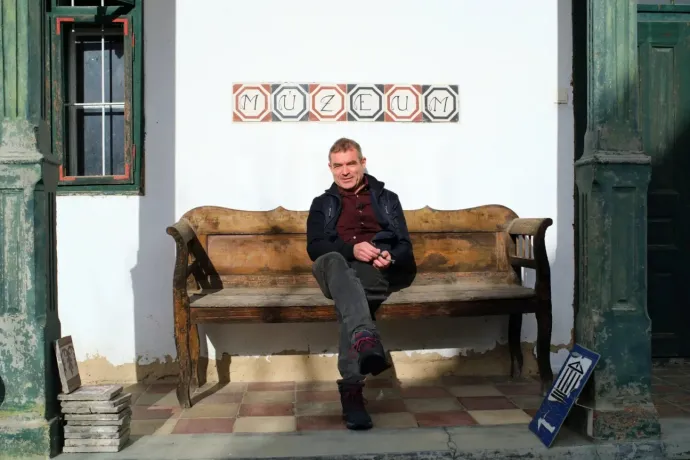

"At first, everyone laughed and thought that the other person was so gullible and thought that they had made a great deal. But then it turned out that I was right", Simon Wintermans recounted as we headed from Pécs to the Cementlap Museum (Cement tile museum) in the nearby village of Erzsébet. He founded an industrial history museum in the small Baranya county village after realizing that he had transitioned from merchant to collector.
Simon Wintermans is one of the best-known foreigners living in Pécs, and has been involved in the city’s cultural, community, and public life for decades. During the previous term of the Fidesz-led city government, he organized a tulip planting campaign, a cycling activists’ movement, and protests against the local government’s propaganda. But this time we didn't visit the Dutch art historian to talk about these things; instead, we wanted to know more about his collection of antique cement tiles. To do this, we had to start by looking further back in his story.
Wintermans first came into contact with Hungary and Pécs at a young age, but he only stayed for a short while when he visited as a university student. "I first came here in 1986, when I was 21. From a Dutch perspective, this was the least terrible country in the Eastern Bloc. I visited Budapest, the Danube Bend, and Lake Balaton, and we hitchhiked to Pécs because we had heard that it was a really beautiful city. But that wasn't my first impression. Everything was gray and black," Wintermans said, but added that he already took a liking to the main square during that two-day visit. A year later, he became the photographer for a Hungarian Teleki Sámuel memorial expedition in Africa, as the only foreigner in the group. “Knowing that we would be spending several months together and would be relying on each other, I felt that I had to learn at least some of this exotic language. I taught myself a bit ahead of the trip, in the Netherlands, and then I improved a lot during the expedition.” One of the organizers of the expedition, György Suha, the former consul general of Gambia, also mentioned this in a study he published about it.
Once he had learned Hungarian, he could no longer keep his mind off the country. He returned to Pécs as an exchange student after the regime change and soon after – quite “by chance” – got a job at the university teaching Dutch. “That year I learned Hungarian properly, but then I went back to Amsterdam and got a job at the Van Gogh Museum after graduating. In 1996, I married a girl from Pécs, and we settled here. I had to figure out what to do, and I came across cement tiles by chance," said Wintermans.
After university, he bought a farmhouse in a village in Baranya County to make it easier to stay in touch with his Hungarian acquaintances. One of the rooms had beautiful cement tiles, and he wanted to use the same ones in the bedroom when renovating the house. "I asked the neighbors if anyone had any for sale. They did. And we were left with a thousand extra pieces after the renovation. At that time, I was still living in the Netherlands and was giving Hungarian lessons to an antique dealer. I showed him a cement tile, and he asked me how much it cost. I named a crazy amount of money, and he said okay," Wintermans recalled. This deal enabled him to pay off a third of the loan he had taken out on the house.
"I recalled this excellent cement tile business a few years later, and that's when I bought the cottage in Erzsébet. I started bringing all the tiles here, basically to save them, and it was here that I worked on cleaning and restoring them." He then exported the tiles – which he had bought extremely cheaply, practically as demolition debris – to the Netherlands and Germany. He searched for potential sellers through classified ads and planned one-day acquisition rounds, and by the end of each, he had filled the platform of an old truck to capacity. Back then it was easy, but now it's becoming harder and harder to find new sources. One could say it's a rescue mission, because nowadays these tiles are often no longer used for their intended purpose, but as paving stones for yards and in gardens," he added.
When he first started buying and selling them, he noticed that there were some very unusual and extremely varied patterns. He began to set aside a few pieces from each batch until he realized that he had amassed a serious collection. At the same time, Wintermans immersed himself in the history of cement tile manufacturing in Hungary. He learnt that the technology began its global conquest in the mid-19th century in Great Britain, then spread to southern France and Catalonia. The tiles are formed using patterned metal templates, colored cement, and hydraulic presses. After drying, the tiles were sanded and became highly wear-resistant. At the turn of the 19th and 20th centuries, they were manufactured on an industrial scale worldwide, but today they are mainly produced in small workshops.
The most famous and biggest factory in Hungary was founded by József Walla. Cement tiles not only became popular for use in stairwells and kitchens in Budapest and other big cities, but there were also lots of smaller factories in the countryside. "Two years ago, it turned out that Cecília Müller's (former Hungarian surgeon general) grandfather had a factory in Tolna, for example. I wrote to Cecília to ask whether she would like to buy some of her grandfather's cement tiles, but I never received a reply," says Wintermans.
Being an art historian, he started cataloguing his collection, researching the manufacturers and getting hold of contemporary sales catalogs. It was then that he decided to make what he had salvaged available to the public, accessible by appointment. The attic of the farmhouse in Erzsébet took on a new function, and the museum has been operating here for more than twenty years now. There is no admission fee, but visitors can support the museum with donations.
Wintermans admits that the cold attic is not exactly an ideal location for his collection, but there has never been any damage to the exhibited tiles. The collection is rarely updated these days, but it remains exciting enough. The diversity is striking, and the curator is knowledgeable. There do remain some workshop secrets and customer requirements that even Wintermans was unable to decipher. But there are also tiles which are interesting because of their flaws. The diversity is further enhanced by the fact that some pieces can be assembled into different patterns, so the same cement tile could look different in the kitchen or on the porch.
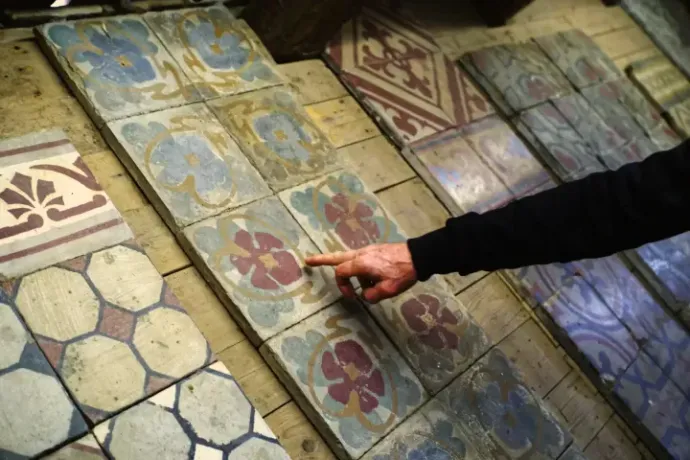
"I have templates, a press machine, and a filter, so theoretically, I could even manufacture cement tiles myself. We managed to salvage the complete equipment of a factory in Orosháza," said Wintermans, who also contacted the Museum of Applied Arts. More than a decade ago, they made it to signing a letter of intent on cooperation. Wintermans believes it would be worthwhile to showcase his collection at the national level, as to his knowledge, there is nothing else like it out there. It seems that, although not quite to the extent previously promised, some cooperation did take place after all. On February 19, Wintermans was one of the speakers and invited panelists at an event entitled Cement Tiles in Turn-of-the-Century Architecture at the Museum of Applied Arts at the Petőfi Literary Museum in Budapest.
Wintermans says that the heyday of trading in vintage cement tiles is over. Cleaning them is a difficult and meticulous task, and labor, transportation, and demolished cement tiles have all become much more expensive. He does not advertise his stock, nor has he ever done so, because most of his buyers have found him through acquaintances. "To everyone's satisfaction," he adds, making sure to note that most people show him the new home of the cement tiles – if not always in person, but photos of bathrooms and kitchens do find their way back to him. As he sees it, everyone benefits from this process because old treasures are given a new life and the most interesting pieces are available for all to see.
For more quick, accurate and impartial news from and about Hungary, subscribe to the Telex English newsletter!