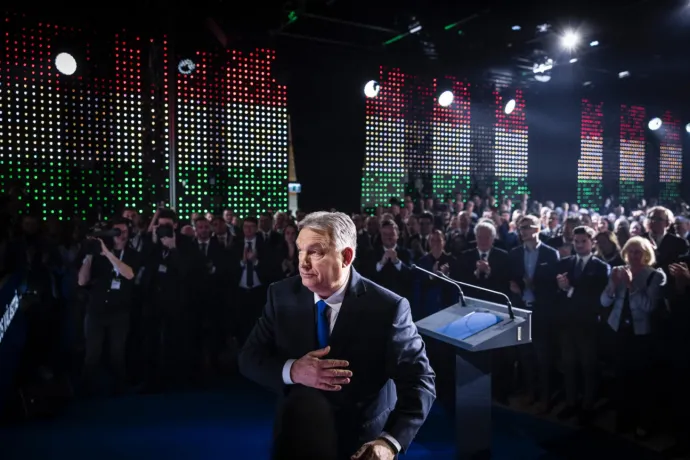

Hungarian Prime Minister Viktor Orbán took to the stage amidst roaring applause at Budapest’s Várkert Bazár on Saturday. The audience, filled with government politicians, artists, businessmen and others from Fidesz’s orbit, had gathered to hear him deliver his annual speech on the state of the nation. In these speeches Orbán traditionally evaluates the year that has passed, and lays out the plans for the season ahead.
When the applause subsided a bit, he started out by saying: "Everyone is wondering what will happen here in 2026. Myself included," but added that he first needs to talk about how things went in 2025.
He recalled that last year he promised some "rock and roll in domestic politics" and committed to “forcing out the forces restricting Hungary’s sovereignty from the country”, but admitted that they’ve “only finished half the job". The Prime Minister promised, however, that after April, these media outlets and NGOs would be "done away with."
"Pseudo-NGOs, paid-off journalists, courts, algorithms, bureaucrats, and millions of euros rolling in for them"
– according to Orbán, this is what Brussels stands for today. He said that some may find this statement harsh, but he does not, because the US Congress has recently also released a report confirming this. He said that according to the report, “the European Commission has tried to censor content ahead of national elections in several European countries” in the past few years.
"Constantly bringing up Putin is primitive and frivolous," Orbán said, because in his opinion, Brussels is the real threat at the moment.
We should appreciate America's friendship, because he believes that the United States is currently exposing the European Commission's "censorship."
Orbán then summarized the various recently introduced policies targeting the youth and the pensioners. He spoke about the 11-percent increase in the minimum wage and listed the various ways in which they helped young people purchase their first home (through state-subsidized loans), as well as the two extra months’ worth of pensions the government is paying out these days.
“The national government is a government of action, not promises," he said, adding that they have always done what they had committed to. He explained that they are thinking in the long term and plan to create more jobs.
According to him, the Tisza Party was created by the Germans, and the global forces have been exposed.
"What's new is that the global financial capital has also joined the party," Orbán said: "There are no more masks, no more costumes, we now have the international financial powers openly standing right here, before us." The Prime Minister finally concluded that it was time for Hungary to realize what is going on, because there are powerful forces (including oil-companies and banks) working in the background, and "once again, it's all about money, our money".
“The biggest winner of the war in Ukraine is Shell”
Orbán then went on an elaborate train of thought to explain that Shell and Erste Bank are “the tax collectors of death". According to this, Shell and Erste Bank are both profiting significantly from the Russian-Ukrainian war. Of course, they are not participating in the fighting, Orbán said, but are merely watching Ukraine's suffering from afar.
"The main winner of the war is Shell," and the company has already made tens of billions of dollars from the Russian-Ukrainian war, according to him. He believes that European green parties are also representing Shell's interests. This is something Orbán has never brought up in the four years since the war in Ukraine has been going on, and it is certainly noteworthy that he did so a few weeks after his party’s challenger, the Tisza party enlisted István Kapitány, Shell’s former Global Executive Vice President.
Orbán then went on to say that some banks are also profiting from the war. He arrived at this conclusion after learning that András Kármán, a former state secretary in Orbán's second government who has also worked at Erste, had joined the Tisza Party. So – as Orbán explained – after Shell, Erste has now also "delegated someone" because they want the EU to take out loans.
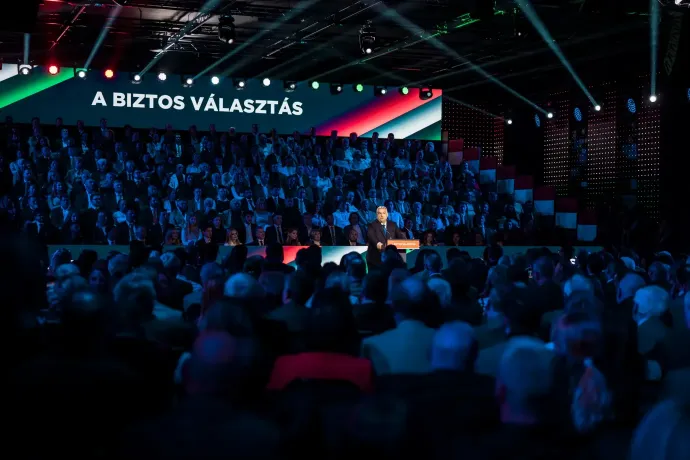
Making Hungary Great Again
According to Orbán, their opponents are indeed planning a regime change, which he believes would jeopardize everything the past sixteen years of Fidesz governance have achieved. "The feeling of déjà vu is no coincidence. We have seen this movie before," he said. Unfortunately, half the country did not listen to him when he warned against the Socialists in 2002, he said, recalling the austerity measures introduced by the MSZP governments in the eight years that followed.
"Hungarians get used to the good life fast" Orbán said, then quoted a passage from Dante's Divine Comedy, in which Hungarians are warned not to allow themselves to be misled – which is what would happen if they didn't vote for Fidesz in the upcoming elections.
According to him, his community is not just a community, but is about a certain calling, and the essence of this calling is that not wanting to do something is not an option. "A calling means that you are doing something even when no one is paying you for it," he said, "and protecting our sovereignty is such a calling".
In closing, he recalled the times when he and his college friends founded Fidesz and said that they did not go into politics to become prime ministers and big shots, but to change the fate of Hungary. He said that historically, Hungary's opponents had always forced it to be small, but Orbán said this will not be the case anymore.
As he said, Fidesz wants to "Make Hungary great and rich again," but "this work is not yet finished," which is why he believes they must win in April. "2026 will be the year of victory," the Prime Minister concluded his speech.
For more quick, accurate and impartial news from and about Hungary, subscribe to the Telex English newsletter!