They removed the main scorpion from the scorpion's den
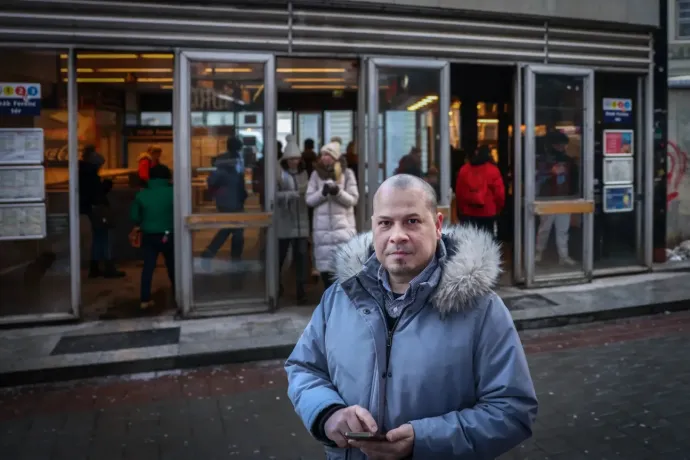

"Many people think that we didn't do everything we could to oust the government by peaceful means," Ferenc Ortiz Nagy told Telex. Thanks to his Hungarian grandfather, he was able to move to Hungary from Venezuela with the first group participating in the Orbán government's 2018 repatriation program. In Venezuela, he worked as a lawyer and actively participated in anti-government demonstrations. During the protests in the second half of the 2010s, he taught legal philosophy at Andrés Bello Catholic University in Caracas.
"We regularly went to the protests with our law students to explain to them that we were not living under the rule of law, and to tell them how one could protest against this. Then the law enforcement agencies serving Maduro's regime and the urban guerrillas working for them shot two hundred protesters.
Two hundred people, including young girls and boys, lay dead in the streets.”
Ferenc Ortiz Nagy wasn’t the only one we spoke with. We also met with other Hungarians from Venezuela, all of whom told us that they were happy about the American military intervention because they believe it has opened up the possibility for Venezuela to become a rich and free country again. However, many of them already consider Hungary their home and would not return even if the political, economic situation and public safety in the Latin-American country were to improve.
On January 3, the United States launched a large-scale military operation against Venezuela. As part of the operation, Nicolás Maduro, the former president and his wife were captured and taken to the United States to stand trial. According to the indictment, Maduro and his wife "had ordered kidnappings, assaults, and murders against individuals who owed them money obtained from drug trafficking or who attempted to undermine their drug business." Both pleaded not guilty in a New York court on Monday.
Many Venezuelans fled the country during the 2010’s to escape Maduro's oppressive regime. According to the UN High Commissioner for Refugees, nearly eight million people were forced to leave their homeland. Most of them are in Latin America or the Caribbean, but thousands have also fled to Hungary. For many, this was possible thanks to the Hungarian government's repatriation program.
It was revealed in 2019 that the Hungarian government had evacuated hundreds of Venezuelans of Hungarian descent from Venezuela through the Hungarian Maltese Charity Service. They were given free plane tickets to Budapest, Hungarian and English language courses, and the state also covered their accommodation for one year. No knowledge of Hungarian was required to qualify for this, only proof that they had at least one Hungarian ancestor.
A sigh of relief
37-year-old Ferenc Ortiz Nagy was among those able to come to Hungary because he had Hungarian ancestors. His maternal grandfather, Antal Nagy, fled to Venezuela from Hajdúböszörmény after World War II. Ferenc Ortiz Nagy's Hungarian identity was important to him while growing up in Venezuela. He regularly visited the Hungarian House in Caracas, a place known for its vibrant community of Venezuelans of Hungarian descent.
He has been living in Budapest since 2018. He has a job here, is learning Hungarian, and has already obtained citizenship. He meets with the descendants of his maternal grandfather's siblings several times a year. He said that when he moved to Hungary, they held a huge family reunion. "It was a real blessing to meet them all, many cried and talked about their parents and grandparents." He is very proud to be Hungarian and has no plans to return to Venezuela, even if the political situation were to stabilize.
“In Hungary, I was given the opportunities that I had lost in Venezuela. I know that the political situation here is also interesting, but at least it is a safe country. You can be out on the street without your life being in danger.”
We asked him what he thought in 2023 when an all-smiles Hungarian Foreign Minister Péter Szijjártó shook hands with Maduro. He said it was "a little upsetting" to see, but he felt that the foreign minister was representing Hungarian economic interests when he visited Venezuela, as Venezuela has vast oil reserves. It was no coincidence that representatives of Mol accompanied Szijjártó on that trip.
"The Hungarian community in Venezuela breathed a sigh of relief when justice was finally served to the country, because Maduro was the illegitimate president of a narco-state. However, the task is not yet complete, because the crackdown has intensified as a result of the intervention, Ortiz Nagy said. Several of his friends were imprisoned after urban guerrillas serving the regime, who are not even professional law enforcement officers, found pro-American messages on their phones. According to him, this also proves that “there is no rule of law in Venezuela.” He also mentioned that he keeps in touch with family members and acquaintances who still live in Venezuela via WhatsApp. Although WhatsApp is available in the country, the authorities are censoring the internet so heavily that he often finds himself informing those still there about the latest news concerning Venezuela – from Hungary.
Alice Diegoné Fedor, one of the founders and former president of the Association of Venezuelan Hungarians, was in Rome with her grandson when she heard the news of the president's abduction. She said it was particularly interesting to discuss the US military intervention with a fifteen-year-old boy. According to the former president of the Association of Venezuelan Hungarians, despite the intervention being controversial from an international legal perspective, members of the Hungarian community still living in Venezuela, Venezuelans of Hungarian descent living in Hungary, and Venezuelans without Hungarian roots were all pleased with what had happened. "The country had been praying for this for a very long time, because the disastrous situation had to be brought to an end somehow," said Alice Diegoné Fedor. In her opinion, it was obvious to everyone that only the Americans would be able to bring about change in Venezuela through external intervention.
"I am one of the nearly eight million Venezuelans who were forced into exile, but fortunately, I was able to return to my homeland with my family." Alice Diegoné Fedor was born in Hungary in 1948 to Hungarian parents. She was one and a half years old when her parents fled to Venezuela, leaving her to be raised by her grandparents in Hungary until she was almost eight years old. She had to wait for an exit visa and a family reunification permit during the Rákosi era. “I had no concept of what a mother or father was. I only got to know my parents when, along with my paternal grandmother, we left from Keleti railway station and arrived by ship at the coast of Venezuela via Genoa.”
Her "emotional mother tongue" is Hungarian, but she spent most of her life in Venezuela, where she worked as a university professor of English and German. She retired with the title of professor after a thirty-year-long academic career. She felt it was important to note that due to the devaluation of the Venezuelan currency, the bolívar, her pension is currently worth less than five US dollars, or less than two thousand forints.
They were forced to leave their homeland because of the worsening conditions brought about by the socialist ideology of Hugo Chávez, who had been president for more than a decade before Maduro, but mainly because the future in Venezuela looked bleak for their two newly graduated children. She and her husband decided to move to Hungary in 2010, well before the government's repatriation program, in 2010.
Kubazuela
„In the good old days, Venezuela was called Saudi Venezuela, now it's called Kubazuela,” Alice Diegoné Fedor said, referring to how Chávez and then Maduro's dictatorship had plunged Venezuelans from relative prosperity into destitution in recent decades. She has friends who used to hold prestigious intellectual positions and were respected members of the community, but are now forced to ask their acquaintances scattered around the world via social media to help them with a few dollars so they can afford housing and food.
The former president of the Association of Venezuelan Hungarians said that Chávez, who was elected in 1998 and was responsible for Venezuela's socialist turn, convinced her and most of the intelligentsia with his appealing, grandiose promises. “He said that if, one year after his election, there were still children begging on the streets, he would voluntarily resign from his post. Nothing came of this; in fact, quite the opposite happened.”
She said that, during Chávez's and Maduro's time in power, a perverse system had developed in which members of the nomenclature lived in incredible luxury and extravagance, while 90 percent of the Venezuelan people lived in poverty. This was one of the reasons why she and her family also took to the streets to protest back in the day.
It is no coincidence that almost all Venezuelan Hungarians consider the US intervention and Maduro's capture to be a positive development for the future of Venezuela. According to Alice Diegoné Fedor,
“Maduro was the epitome of ignorance, a symbol of unculturedness, a cynical, malicious man.”
She believes there is a good chance that the Venezuelan economy could rebound if the Americans resume their involvement in oil production there, just as they did before Chávez came to power. "They were the ones who organized and made the oil industry productive there, starting in the 1920s," said Alice Diegoné Fedor, noting that experts from Hungary had also worked in the Venezuelan oil industry in the past. Overall, she is optimistic about Venezuela's future, but adds that unfortunately, civil war cannot be ruled out because although Maduro has been removed from the country, "many of his supporters are still in power." She also pointed out that, according to Venezuelan non-governmental organisations, 900 people are still being held in Venezuelan prisons for political reasons.
Similarly to Ferenc Ortiz Nagy, she no longer wants to return to Venezuela. Although she is no longer president of the very active Association of Venezuelan Hungarians, which she co-founded, she continues to participate in organizing many of its programs. The association holds monthly lectures on Hungarian culture, history, its people and language. She believes that these lectures are essential for helping Venezuelans moving to Hungary, whether they are of Hungarian descent or not, integrate into Hungarian society, which is the main goal of the association.
Elizabeth Tarlós, who is in her late fifties and speaks perfect Hungarian, would definitely like to move back to the Latin American country. It was her mother's grandparents who emigrated to Venezuela, where she spent most of her life. She regularly frequented the local Hungarian community's meetings and participated in events at the Hungarian House in Caracas on several occasions. She said that when she was a child, her mother considered it very important for her daughter to connect with her Hungarian heritage. She completely forbade her to speak Spanish at home, and after school, she was required to study Hungarian geography and history, among other subjects.
She has been in Budapest for eleven years, having moved to Hungary before the government's repatriation program because, unlike many others, she managed to save up the money to do so. “I came home to Hungary with my family—my daughter and my husband—using my own money.”
"I do long to go back, as that is where I built my life," she said when asked if she would move back to Venezuela if the country were safe again. "We have apartments, cars, and business properties there, while here I only have a small car in my name. Plus a job that keeps me from starving," she said. In contrast, they were able to earn thousands of dollars a month from their businesses and rental properties in Venezuela.
She says she moved back home at the urging of her mother, who was very worried about her because she was actively involved in opposition protests and often had to run from tear gas during street demonstrations against Maduro. "My family and I, and I believe 90 percent of Venezuelans, have been waiting for this for 20 years."
"We were very happy that they took these people away, and we continue to pray that the rest of the members of this cartel will also be arrested. Yes, they removed the main scorpion – the mother scorpion – from the scorpion's den, but all the others are still there, and they will continue to do their thing unless they are sent to prison," Elizabeth Tarlós said of the president's arrest.
For more quick, accurate and impartial news from and about Hungary, subscribe to the Telex English newsletter!