Szijjártó's all smiles photo with Maduro perfectly illustrates Fidesz's view of foreign policy
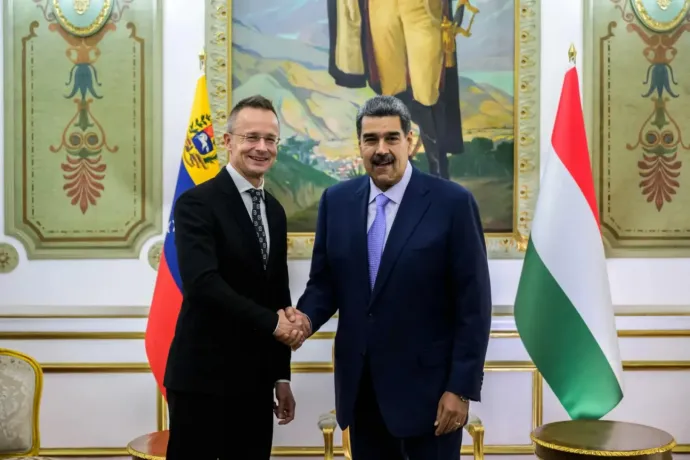


On 10 November 2023, Hungarian Foreign Minister Péter Szijjártó travelled to Caracas, the capital of Venezuela. His visit came 31 years after the last time a Hungarian foreign affairs delegation had visited the country. Szijjártó justified the visit with “the changed international context”. He met with president Nicolás Maduro, Minister of Oil Pedro Rafael Tellechea and Foreign Minister Yván Gil. Gil and Szijjártó even signed an agreement between the two countries.
Based on the communiqué about the visit and Szijjártó’s posts from the time, the Foreign Minister had high hopes concerning Venezuela. For example, he posted a photo of himself and Maduro, commenting that they agreed that “amidst the current changes in global politics, the main responsibility of elected officials is to defend their country’s sovereignty and to resist external attempts at interference. According to another one of his posts, “Venezuela is opening up to the world, and the Western world is also opening to Venezuela. Whoever is here first will reap the benefits”.
The communication of the Ministry of Foreign Affairs published at the time was even more specific. They wrote about Venezuela’s vast oil reserves and its gas extraction, which is why the representatives of MOL and MVM (Hungary’s two energy giants) also accompanied Szijjártó. According to the statement, they started negotiations about the possibility of importing natural gas from Venezuela, while Szijjártó argued for the easing of the sanctions which were in place against the country.
This could easily make one believe that Venezuela is an important ally of Hungary and the Hungarian government, and with which agreements about important issues were made in 2023. Although many have now recalled that in 2024, Hungary vetoed a joint EU statement on the disputed results of the Venezuelan elections, the truth is that it joined the initiative with a delay. But following Maduro’s kidnapping by US forces on 3 January this year, only 26 of the EU’s 27 member states called “for calm and restraint by all actors, to avoid escalation and to ensure a peaceful solution to the crisis". There was one country which did not support this: Hungary.
It would therefore seem logical to think that Hungary stood up for its partner with whom it had sought an intensive economic relationship, but the comments coming from the government are telling an entirely different story. Balázs Orbán, the Prime Minister’s Political Director, for example wrote that “the hundreds of Hungarians evacuated from Venezuela have told us about the oppressive dictatorship that had been established there”. And pro-government Mandiner’s journalist, Mátyás Kohán was quick to present the insignificant data relating to the trade between the two countries. He wrote: “Here, you can see proof of the friendly relationship and the huge deals between Péter Szijjártó and his “buddy”. This, as you see, equals zero. There has never been any strategic agreement, gigantic deal about energy resources, no BFF or anything of the sort.”
For days after the American intervention, Szijjártó only posted about the Hungarians in the country, and at his press conference on Monday, Orbán said that “the fall of any narco-state is welcome news, and I will not shed a single tear over it”.
So are we then Maduro’s friends or not? And if we aren’t, then what was Szijjártó doing in Caracas and what is included in the agreement with the Venezuelans?
Until 2021, Venezuela was more developed than Hungary
Although in recent years, the primary news from Venezuela in both international and Hungarian news reports had to do with the deep poverty and adversity its population was facing, it is worth noting that due to its oil revenues, between World War II and the 1970’s, it was one of the wealthiest countries of South America. At times, it was actually the richest of them all.
In the 1950’s and 1960’s, its GDP measured in terms of purchasing power standards per capita was twice that of Hungary’s. Thus, it is no wonder that thousands of Hungarians fled to Venezuela, both after World War II and following the 1956 revolution.
In 2001, Hungary overtook Venezuela in GDP per capita, but the indicator between the two countries only separated permanently in 2013: As a member of the EU, Hungary's development, which began after the change of regime, continued, while Venezuela's economic performance fell to less than a third of what it was before. The reasons for the latter are complex, but suffice it to say that while Venezuela somehow managed to get by on its oil revenues until Hugo Chávez's death in 2013, once Nicolás Maduro came to power, they were put on a completely unsustainable path, accompanied by hyperinflation.
Maduro tried to handle the poor economic situation by using increasingly harsh dictatorial solutions and an ever-increasing crackdown against the opposition, which is why both the United States and the European Union imposed sanctions on Venezuela in the second half of the 2010s. Due to its aging infrastructure, Venezuela’s ability to produce oil kept decreasing, and due to the sanctions, it was able to sell it for less and less. At the same time, Maduro's rule led to poverty and became more and more unbearable, resulting in the emigration of millions of its citizens.
Venezuelans of Hungarian descent had to be evacuated
The subject of Venezuela first came up in Hungary in 2018, when State Secretary Miklós Soltész mentioned that Hungary had taken in several Hungarian families from the country in crisis. Later, in 2019, it was revealed that the Hungarian government had taken in, or rather, evacuated several hundred Venezuelans with Hungarian ancestry with the help of the Hungarian Charity Service of the Order of Malta. The government provided them with free tickets to Budapest, free English- and Hungarian language courses, and free housing for a year.
Speaking Hungarian was not a requirement for qualifying, they only needed to prove that they had at least one Hungarian ancestor. This shows that at the time, the Hungarian government considered Venezuela a dictatorship, from the grips of which those with Hungarian ancestry needed to be rescued. As Balázs Orbán put it in 2019: “Hungary will protect every Hungarian, regardless of where they may live in the world; this is especially true if Hungarians are forced to flee an oppressive, communist leadership, which is destroying its country.”
At this time, it still seemed that the Hungarian government supported the Venezuelan opposition: for example, in 2019, when opposition leader Juan Guaidó tried to take over leading the country, Péter Szijjártó said that Hungary supported him against Maduro. In 2020, the country held parliamentary elections, and the results were not recognized by either the US or the EU, and the Hungarian government was in no hurry to form a different opinion.
There was a time when Maduro seemed willing to compromise
During this period, the United States and the European Union were trying to force Maduro to stand for democratic elections by imposing sanctions. In 2019, during Trump's first presidency, the US introduced much tougher sanctions against Venezuela, bringing the country's oil exports to a standstill by 2020. From then on, Maduro sometimes appeared accommodating and pretended to agree to hold fair and honest elections, but then later backed out of these promises.
At the end of 2022, representatives of Venezuela's ruling parties and opposition leaders began negotiations in Mexico, prompting the United States to minimally ease sanctions. The talks remained fruitless for a long time, until October 17, 2023, when an agreement was reached in Barbados to hold elections in the second half of 2024 in which the opposition could participate without restrictions and which could be monitored by international observers.
The agreement was widely seen as a breakthrough, and the following day, Joe Biden's administration decided to suspend most of the sanctions against Venezuela, on the condition that Venezuela release hundreds of political prisoners within a short period of time.
Shortly after the agreement with the government was signed, on October 23, 2023, the Venezuelan opposition held a primary election to select their candidate for the 2024 presidential election. The turnout was much higher than expected, and María Corina Machado was chosen as the joint candidate with more than 90 percent of the votes. A few days later, on October 30, however, the Venezuelan Supreme Court annulled the results of the primary election and banned Machado from running in the election on the grounds that she had not disclosed her food vouchers in her asset declaration. At the same time, the organizers of the primary election were accused of conspiracy.
Szijjártó went to Venezuela at the worst possible time
The Hungarian Foreign Minister arrived in Venezuela on November 10, 2023, less than three weeks after the Venezuelan Supreme Court's decision. By then, US sanctions had been lifted, and despite warnings from representatives of the United States that they could be reintroduced, Szijjártó clearly did not believe this would happen. As he put it, he wanted to be the first to open a relationship with Venezuela because "whoever comes first will reap the benefits."
At that time, the EU leadership had not yet decided whether to lift its sanctions against Venezuela. According to Szijjártó's statement at the time, "we would like global politics to be about mutual respect rather than sanctions in the coming period " – in other words, he was working to get the EU to suspend the sanctions as well. What had been achieved by then was that the review period for this had been reduced from one year to six months.
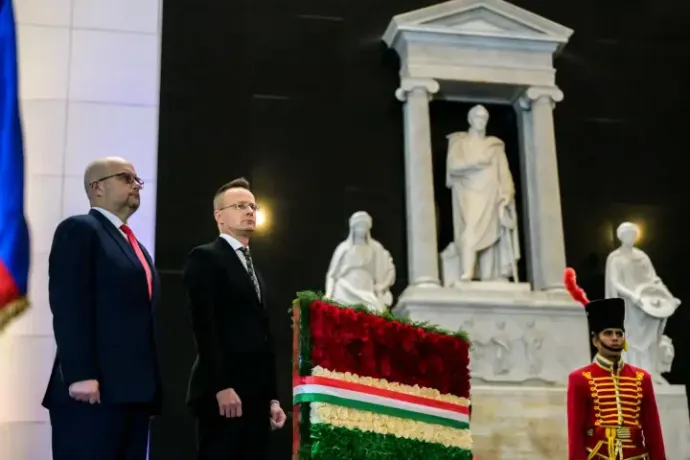
All that was disclosed about the agreement signed with the Venezuelan foreign minister was that Hungarian universities would accept 25 Venezuelan students starting in 2024. The details of the agreement were never made public, and when Szabolcs Panyi, a journalist of Direkt36, submitted a public interest data request about this last year, his request was denied on the grounds that it would threaten "the assertion of Hungary's foreign policy and foreign economic interests without undue external influence, as well as its national security interests."
What is certain is that there is no sign of any substantive economic agreement between the two countries. As G7 reported, Hungary has imported only a few tens of millions of forints worth of products from Venezuela in the past two years, and these were not crude oil or natural gas, but mainly food and alcohol.
Maduro's meekness didn’t last long
A few days after Szijjártó's visit to Caracas, the Council of the European Union extended its sanctions against Venezuela and made it clear that it would only discuss lifting them if the country released political prisoners and held democratic elections.
Maduro, however, set off in the opposite direction and on December 3, held national consultation-style referendum in which participants voted to annex two-thirds of neighboring Guyana, or approximately 159,000 square kilometers, to Venezuela. In March 2024, it was enshrined in law that most of Guyana, known as Essequibo, is part of Venezuela, and for a while it looked likely that they might go to war with their neighbour, but this did not happen.
At the same time, in the spring of 2024, the United States, still led by Joe Biden, reinstated the sanctions imposed on Venezuelan crude oil and natural gas that had been suspended the previous fall. Machado and several other opposition leaders were unable to run in the 2024 summer elections, and according to official data, Maduro won – a result that was not recognized by the opposition, the United States, or the European Union.
Waiting for reports from Venezuela
There was another important event from this period, which publicly linked the Hungarian government to the Venezuelan leadership. After the elections, Josep Borrell, the EU's High Representative for Foreign Affairs and Security Policy, issued a statement saying that he was "following the situation in Venezuela with great concern" because Maduro had been declared the winner based on "partial, unverifiable" data, which therefore could not be recognized, while the figures published by the opposition differed significantly from what was officially announced.
The statement was not issued on behalf of all member states, but only on behalf of the High Representative, which typically happens when one or more governments disagree with the text. At the time, Politico reported that the reason why it was Borrell who had made the document public was that the Hungarian government had vetoed its publication as a joint EU position. The Ministry of Foreign Affairs later called this fake news, saying that they had simply been waiting for “reports from Venezuela to come in and, after studying them, joined the European Union's common position.”
János Bóka, Minister for EU Affairs, explained Hungary's decision to stay away from this January's joint EU statement by saying that, in his opinion, "Kaja Kallas' statement is a sign of weakness and a complete misunderstanding of the transformation of international relations." He also wrote that “beyond expressing certain desires, the EU has nothing to say about the situation and the region.”
Prime Minister Viktor Orbán also spoke about the issue at his press conference on Monday. In his opinion, "The fall of every narco-state is good news, and I will never shed a single tear over the fall of a narco-state. The fewer there are, the better. It would be best if they were all cleared away." Orbán explained their decision not to sign the joint statement by saying that they do not want a common European Union foreign policy because there are several important issues on which they disagree, so they do not plan to participate in similar statements in the future either.
A perfect example of interest-based foreign policy
The events of the past few years therefore show that the Orbán government has long approached Venezuela without any moral compass or sense of values: when the need arose, they rescued people from there; when there was an opportunity to do so, they sought to do business there; and now they are calling the country a narco-state, even though a little more than two years ago, Szijjártó was full of smiles in Caracas. It is telling that the otherwise hyperactive Szijjártó did not post anything about Venezuela until Monday evening – except to write about Hungarians affected by the situation – and said nothing about what will now become of the secret agreement signed between the two countries in 2023.
At his press conference on Monday, Viktor Orbán actually admitted that the Hungarian position is that they do not want to take a moral stance on the US intervention: in his view, international law no longer matters, what matters is what the great powers want to do. "It happened, it is what it is, and what we are concerned with is whether it is good or bad for Hungary. And it is good for Hungary." Apparently then, two and a half years ago, Maduro was good for Hungary, but now, it is his downfall that is deemed beneficial.
For more quick, accurate and impartial news from and about Hungary, subscribe to the Telex English newsletter!