Hungarian researchers solve one of the most important mysteries surrounding European herbivorous dinosaurs
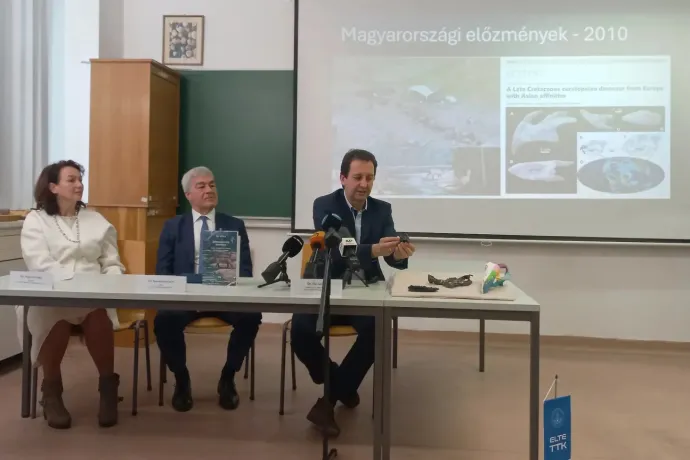


The research group led by Hungarian geologist and paleontologist Attila Ősi has basically rewritten the evolutionary history of Eurasian dinosaurs: with the help of a skull found in Hungary's Bakony Hills, they proved that in various forms, collared and horned dinosaurs were present and widespread in various forms during the Late Cretaceous period in what is today’s Europe. Their new research findings were published in the scientific journal Nature, and they also reported on their research at a press conference on Wednesday morning at the Faculty of Natural Sciences of Eötvös Loránd University in Budapest.
One of the most iconic representatives of collared or horned dinosaurs is the Triceratops, which, thanks to its distinctive collar, is often easily recognizable from pictures, even by children. The herbivorous Triceratops belongs to the group of dinosaurs known as ceratopsians, whose representatives were commonly found in Asia and North America, based on fossilised remains.
Some sporadic fossils have also been found in Europe, but in some cases there was uncertainty as to whether they really belonged to a ceratopsian. However, the fossils excavated in Iharkút in the Bakony Hills clearly indicate that the ceratopsians were also present in Europe. Naturally, one should not imagine Europe as it appears on maps today. Tens and hundreds of millions of years ago, the continent consisted of a string of islands on the edge of the Tethys Sea, and a variety of life forms developed on these islands. The Bakony Hills may also have been an island at one time.
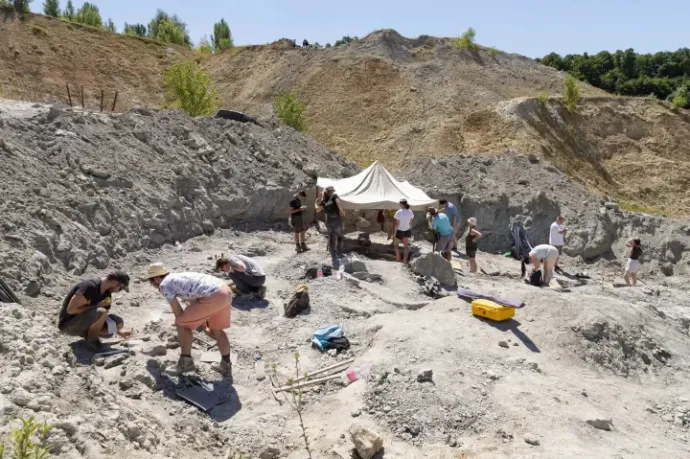
Attila Ősi began excavating in Iharkút, at the site of an abandoned bauxite mine 25 years ago while still a university student. Since then, continued research has uncovered the remains of numerous flying reptiles, dinosaurs, birds, and amphibians. Ősi now leads the excavations as head of the Paleology Department at ELTE and the head of the Hungarian Dinosaur Foundation. The Iharkút sediments, formed 85 million years ago contain a wealth of fossil material, the analysis of which has over time led to important scientific discoveries.
Speaking at the press conference, Ősi said that one of their studies had already caused quite a stir in the field of vertebrate paleontology in 2010. At that time, based on a beak fossil discovered in 2009, they claimed to have found a ceratopsian. Several researchers disputed this, suggesting instead that it likely came from a representative of another group of herbivorous dinosaurs, the Ornithopods, which walked on their hind legs and their presence has long been known in Europe.
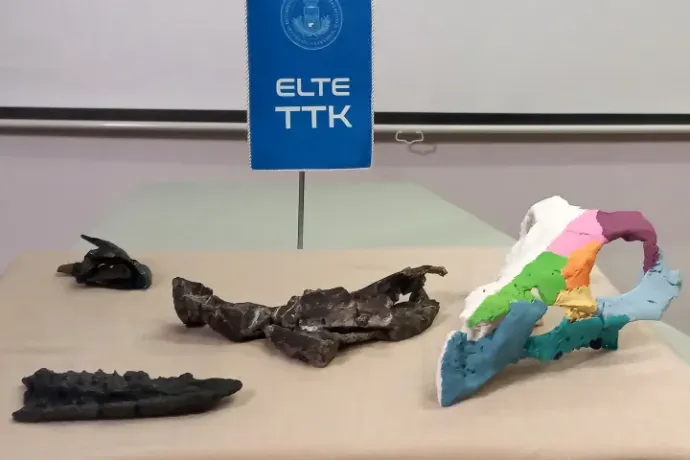
In 2017, Ősi and his team described a new species, Ajkaceratops kozmai, which, as its name suggests, was also classified as a ceratopsian. The fossils of this species were then studied for years, CT scans were made, the animal's skull was reconstructed, and a 3D model was also created. The researchers have now achieved two major results. On the one hand, they confirmed the classification of Ajkaceratops, and on the other hand, they slightly bracketed another of their studies.
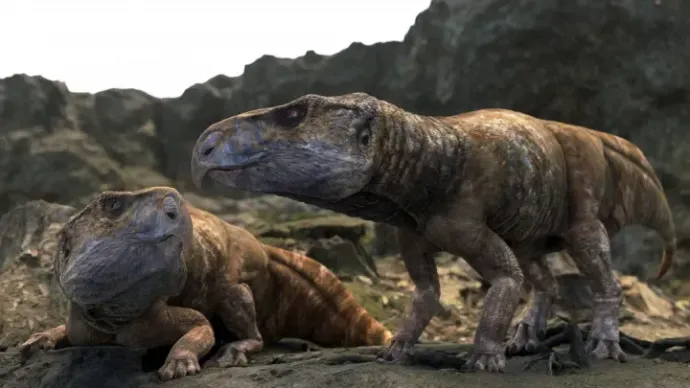
Ősi said that the remains brought about a surprising turn of events. Two years after the Ajkaceratops had been described, another herbivorous dinosaur was found in the Bakony Hills, but the species, named Mochlodon vorosi, which walked on its two hind legs was thought to have belonged to the Ornithopods. During the Mesozoic era, the middle period of Earth's history, this was the other dominant group of herbivorous dinosaurs alongside Ceratopsia for 100 million years.
"We were familiar with its teeth and lower jaw, and when the new Ajkaceratops fossil was discovered, it turned out that it had exactly the same teeth in its jaw as the Mochlodon dinosaur. What's more, the preserved jaw ends are also identical. This simply shows that Mochlodon vorosi is the same as Ajkaceratops Kozmai. Since Ajkaceratops was published first, it takes precedence, and that is the name which will continue to be used, said Attila Ősi.
Ősi said that the remains brought about a surprising turn of events. Two years after the description of Ajkaceratops, another herbivorous dinosaur was found in the Bakony Hills, but the species, named Mochlodon vorosi, which walked on its two hind legs was thought to belong to the Ornithopods. During the Mesozoic era, the middle period of Earth's history, this was the other dominant group of herbivorous dinosaurs alongside Ceratopsia for 100 million years.
"We were familiar with its teeth and lower jaw, and when the new Ajkaceratops fossil was discovered, it turned out that it had exactly the same teeth in its jaw as the Mochlodon dinosaur. What's more, the preserved jaw ends are also identical. This simply shows that Mochlodon vorosi is the same as Ajkaceratops kozmai. Since Ajkaceratops was published first, it takes precedence, and that is the name which will continue to be used, said Attila Ősi.
Based on the fossil finds, paleontologists estimate that the skull of Ajkaceratops was 25-27 centimeters long—the cranial cavity and the temporomandibular joint were not unearthed during the excavations—and given the skull size, its body would have been about one and a half meters long – if this was a quadrupedal ceratopsian.
"There is no complete skeleton, but we can add the limb bones, teeth, and suspension elements previously attributed to Mochlodon vorosi to this dinosaur, and using these, we can roughly estimate that it was 1.5 to 1.7-1.8 meters tall. There is no clear evidence that it walked on four legs. It may have been a primitive branch of the frilled dinosaurs, and it cannot be ruled out that in certain situations they ran on two legs and only walked on four legs during more relaxed circumstances, such as while eating. Proving this would require a find that includes both the front and rear limbs belonging to a single specimen," said Attila Ősi.
The finds from Bakony were examined by an international research group because the stakes were high: they wanted to confirm that there were ceratopsians in Europe, and that these were no ordinary groups. They also tried to clarify who was related to whom in the group. In addition to using the aforementioned CT and 3D models, the researchers also performed numerous comparative measurements. They measured the various protrusions and bumps on the bones and compared the results with the remains of various representatives of the Ceratopsia group. Based on these results, they then drew a taxonomic family tree.
The family tree they presented included another Hungarian name, Ferencceratops shqiperorum, named after Ferenc Nopcsa, who once aspired to ascend the Albanian throne. Nopcsa was one of the outstanding pioneers of Hungarian paleontology and found dinosaur remains in Transylvania at the end of the 19th century. The finds excavated by Nopcsa were sent to the Natural History Museum in London. The species previously had a different name and was thought to be an Ornithopoda. When these finds were re-examined, they turned out to be Ceratopsian. Ősi and his team believe that more Transylvanian Ornithopoda may turn out to have been misclassified, and that this may also be true of other areas of Europe.
"It seems very likely that these Ceratopsians were much more common and more diverse here in the European archipelago than we previously thought. This encourages us to re-examine the fossils collected years, decades, or even centuries ago," said the paleontologist.
Diversity was something that Nopcsa had also considered, and according to his theory of insular dwarfism, species confined to smaller areas will also be smaller in size. This is most evident on islands, and is supported by the finds in Bakony.
According to Ősi, the next big task could be to determine how ceratopsians arrived in the European archipelago 85 million years ago. Collared dinosaurs existed as early as the Jurassic period, 150-160 million years ago. Researchers speculate that they may have arrived from what is today's China and Mongolia, as closely related species were found there.
For more quick, accurate and impartial news from and about Hungary, subscribe to the Telex English newsletter!