Orbán on the war in Ukraine: It's not even clear who attacked whom
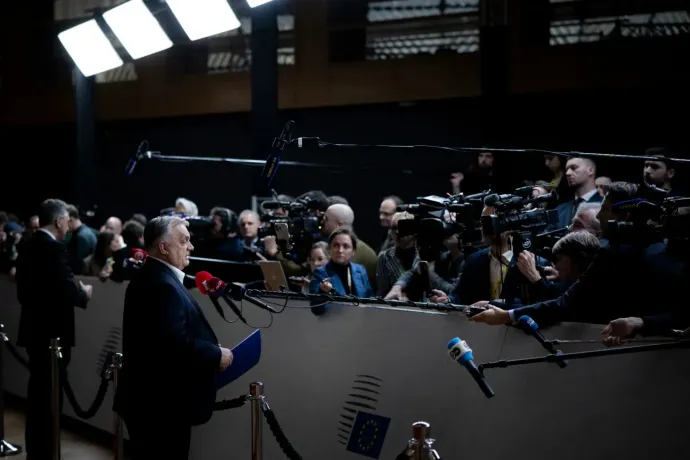


On Friday, Hungarian Prime Minister Viktor Orbán said that "giving" Russian central bank assets to Ukraine would have been idealistic, unfounded, and naive. The Prime Minister made his comments to representatives of the Hungarian pro-government press after the meeting of EU heads of state and government, where they decided to take out a €90 billion loan to support Ukraine. One option was a joint loan, the other was to use assets of the Russian central bank seized in the EU, mainly in Belgium, which had already been frozen until the end of the war and the payment of reparations.
Orbán said that the Belgian prime minister played a huge role in "killing" the second plan. In his view, Bart De Wever did the math and concluded that if the Russians had won the lawsuits, which Orbán considered "more than likely," it would could have led to bankruptcy. He considered the plan dead in the water despite the fact that 25 of the 27 leaders had declared that they reserved the right to use the assets to repay the loan.
Hungary has foreign currency reserves in Western countries too, and "if the frozen Russian assets had been taken away," then "the next day the government would have had to discuss where to put our foreign currency reserves, because we would certainly not leave them in a place where they could be confiscated," he explained. He added that they were prepared, if necessary, to “remove the foreign currency reserves from this uncertain situation.”
A decision was made at the meeting that the EU budget would be used as collateral for the loan, but this would not impose any financial obligations on the Czech Republic, Hungary, or Slovakia. In Orbán's opinion, Ukraine will not be able to repay the loan, so the participating member states will have to do so unless they defeat Russia.
"The loser always pays," so, according to him, the European leaders who made this decision "have set the European Union on a course where Russia must be defeated."
Westerners are "calmly sitting down for breakfast at home, drinking their coffee, and thinking how wonderful and morally right it is to help a small country that has been attacked—though of course it's not that small, and
it's not even clear who attacked whom
— but whatever the case, we are now helping a country that has been subjected to violence, and how nice it is that it costs us nothing, since they are the ones who will pay for it."
He then proceeded to talk about World War II and then came to the conclusion that "in World War I, when the heir to the throne was killed, the general mood among European citizens sitting in cafes and stirring their coffee was that 'surely, our leaders are not so stupid as to lead Europe into war'." Now, "we must work continuously to prevent the others from dragging us down with them," which will require “an extraordinary political achievement. Greater than what Miklós Horthy or István Tisza were able to deliver in their time, because they failed.”
Alongside a Germany which is moving towards war, we must stay out of it, just as we should have done in 1914 and 1939.
Orbán confirmed that it occurred to him that he could use his veto because, as European Commission President Ursula von der Leyen said, the budget must be amended unanimously in order to secure a loan from the common EU budget.
However, he said that "even with such strong chest muscles, it would have probably been unbearable" to have an Italian, a German, and a French boot on his chest. He would have considered a veto the most beautiful martial feat, but "we don't have enough strength for that," and this was the best we could hope for.
He said that he considers the €90 billion sufficient only to sustain Ukraine’s retreat.
When asked whether the Italians and the French had switched to being "silent killers," he replied by asking, "Do you watch soccer?" He then proceeded to draw a parallel with soccer, saying that the Germans do not rely on intuition but on structure: once they have made up their minds, they simply “push, push, push, push.” The “Latins said that this would not work,” but the Belgian prime minister had the final say. He said that more would have had to be returned than the assets tha thad been seized, because he was certain that the Russians would have won in a court in the East. The big debate was about whether to provide an unlimited guarantee. Orbán said that if he had not allowed the second plan to go ahead,
they would have come at him with "eight times the fury," so he thought it better to step aside.
When asked whether it was worth staying in the European Union, he said that "the question is always on the agenda, but we are not there yet", then added that "If things continue this way, we may get there, but we are not there yet."
It is true that "they are squeezing us, but I am always able to extract money from them," because unanimity is required for the budget that will start in 2028 – he said, two weeks before another billion euros could become unavailable for Hungary after the frozen funds already lost at the end of 2024.
Because of the common market, it would still be worth staying in even if we get to the point of exceeding the average level of development in the EU and become a net contributor, "but that's still a far off," and he doesn't know how long it will take.
For more quick, accurate and impartial news from and about Hungary, subscribe to the Telex English newsletter!