Commuters set up their own P+R parking lots along Hungary's western border
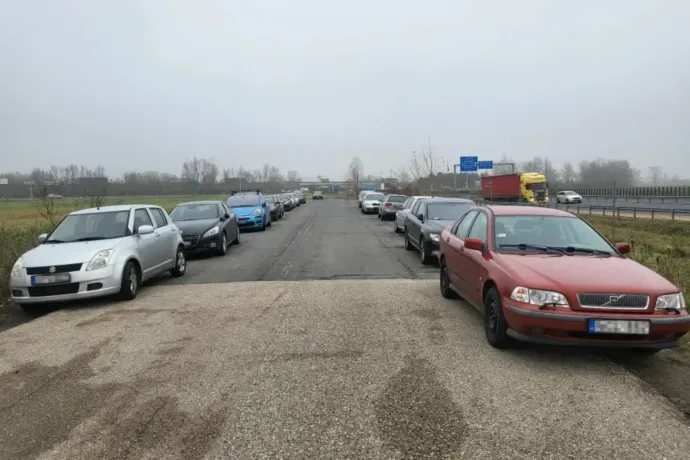


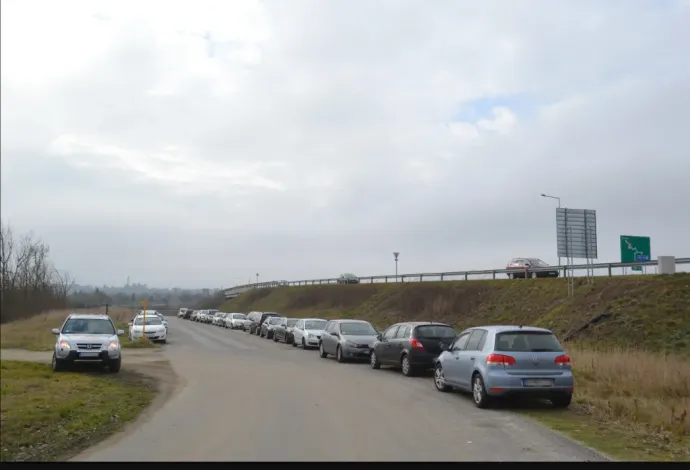
Parking lots are being established near Hungary's western border, but not where they should be, nor how they should be, and most importantly, not how they could be. Along the M85 highway, cars are parked on the side of the road, both inside and outside the city limits of Sopron and Mosonmagyaróvár. There is also an illegal P+R parking lot created by motorists on the outskirts of Győr.
One started it, another saw it, and the third one thought it was a good idea— within a few days, the illegal parking lot was there.
The cars are left behind by commuters, typically from nearby villages, who work in Austria, but people from different parts of the town are also doing this. Four or five people arrive at the agreed location from various directions, mainly located on dirt roads near the M85 exit, then they continue on in one car, leaving the other vehicles behind. As we learned, the car and the driver are rotated on a daily or weekly basis.
For now, the line of cars waiting is just an eyesore, but sooner or later, it could become dangerous for other drivers who don't expect to encounter an obstacle along the road. On the other hand, the commuters' need for a place to park their vehicles is legitimate. From an environmental point of view, this is actually a good solution, as instead of four or five cars, only one ends up going all the way. In other words, instead of bans and penalties, such parking lots should be supported – provided they are set up in legal locations and in compliance with the law.
In Austria, they are doing just that. Park & Ride (P+R) parking was followed by the introduction of Park + Drive parking lots. Car-sharing communities are forming, and the Austrian road management authority, ASFINAG recognised the demand, and is setting up free parking lots across the country in cooperation with the provinces.
Seventy commuter parking lots have already been established in Austria, totalling of more than 3,600 parking spaces, mainly near motorways and expressways.
However, there are only a few examples of this on the Hungarian side along the western border. The local government in Sopron has made some attempts, but with little success. Parking lots with gravel surfaces have been created on Aranyhegy and at the shopping mall. The former is in a bad, remote location, and even locals don't use it much, while the latter is close to the border and inexpensive, yet few people park there. They say this is because they have to turn off the motorway, which wastes time. However, this means they later lose time crawling along in a congested line, and what's more, the prices at the shopping centre are really not very high. We checked: in the parking lot designed for commuters, which could accommodate five times as many cars as there are now, the rates are 200 forints (50 euro cents)/day, 800 forints (2 euros)/5 days, and 5,000 forints (13 euros)/30 days.
In contrast, it is not uncommon to spend 30-40 minutes crawling along at the Sopron border crossing. This is not good for anyone, including the Austrians, due to its environmental impact. Many believe that the solution would be for Austria to extend the motorway to the Sopron border and connect it to the M85 expressway. This is an old plan, but it was vetoed by the residents of the affected communities. The lobby that focused on the increased air pollution caused by the highway was stronger than the one that argued that pollution would be lower if vehicles were speeding along the highway rather than crawling along at the border. Commuters say that if there were a continuous highway to Vienna, there would be no more nerve-wracking daily queues at the border. They could use the Park + Drive parking lots, and everyone would be much happier.
According to a commuter from Sopron, the number of workers commuting to Austria from the district on a daily basis has increased again recently, and in the mornings there are traffic jams at the Sopron border crossing on the Hungarian side, with the same thing repeated in the afternoon on the Austrian side. The number of Hungarians commuting from the county is estimated to be in the tens of thousands. It dropped a bit during Covid due to layoffs and home office, but today it is higher than before the pandemic.
In 2023, the Austrians measured the traffic: there were 22,057 vehicles travelling on a daily basis on the Klingenbach bypass leading to the Sopron border, while 3,864 cars passed through the less busy Szentmargitbánya crossing.
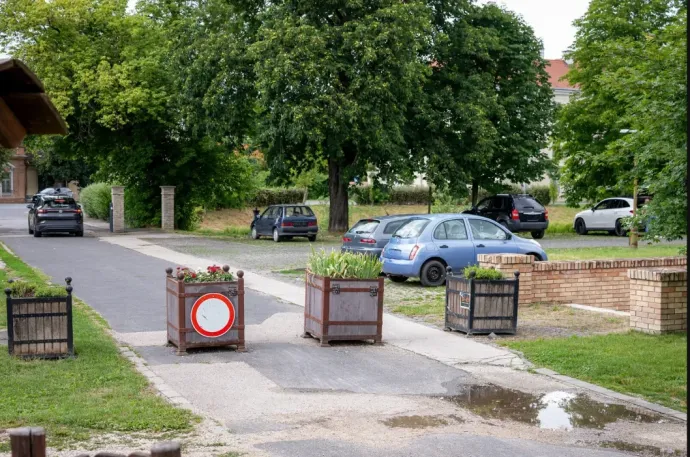
No-parking signs have been put up at the spontaneous parking spots that have popped up on inner-city streets, and anyone who ignores them will be fined. At the spontaneously formed parking lot near Pihenőkereszt, a hill on the outskirts of the town where for centuries carters and travellers stopped for a last rest stop before reaching Sopron, the problem was solved by setting up a no-entry sign. Commuters shared the message from the Sopron Public Space Supervision Authority among themselves: "There has been a change in traffic regulations, no entry from either direction!" A note left on the windshields of cars parked here states that the administrative fine is 49,000 forints (127 euros).
It's a planning deficiency, says a commuting engineer. He finds it outrageous that in Hungary, motorways and busy intersections are planned without modelling the expected traffic and without developing the appropriate infrastructure, such as parking lots. However, commuting from Sopron and the surrounding area is not a new phenomenon, and it was foreseeable that the opening of the M85 would increase traffic at the Sopron border crossing.
Mosonmagyaróvár, another town on the western border, is in the same boat. Mayor Miklós Szabó told Telex that they need to review parking regulations in the town, partly because of the commuters' cars. The first step will be to count traffic: experts from Széchenyi István University in Győr will assess how many people park in problematic areas during the day and for how long.
"We have been considering trying to reach an agreement with the Hungarian State Railways (MÁV) on taking over the area in front of the railway station, so we could potentially build a P+R car park there. However, this may not necessarily serve the interests of locals, and our primary goal is to solve the parking problem in the city for permanent residents," said the mayor.
The university has also experienced this problem firsthand, as in November, it had to modify its parking regulations at the Albert Kázmér Mosonmagyaróvár Faculty parking lot next to Vár Lake. The institution's own property, located on its own grounds has been under increasing pressure in recent times. "It has become particularly common on weekdays for commuters to Austria and Slovakia to occupy spaces for long periods of time, often leaving no free capacity for university staff, students, and guests," they wrote in their statement.
Győr is a little further away from the border crossings most commonly used by commuters, but the first spontaneous P+R parking lots have already appeared on the outskirts of this city too. Such a parking lot had been operating for quite some time at the entrance to the M85, but since a gas station was built there, a new location had to be found. The motorists didn't have to go very far: they found a place for their cars barely 200-300 metres away. There is already a "No Entry" sign there, but this does not seem to bother anyone. The huge parking lot of the nearby Dunacenter shopping centre can – for now – also accommodate commuters' vehicles, and there certainly are more than a few of them parked there, but for the time being, this is not a problem.
For more quick, accurate and impartial news from and about Hungary, subscribe to the Telex English newsletter!