Magyar in Berlin: I don't think it's a good idea to tie the European budget to any other issue
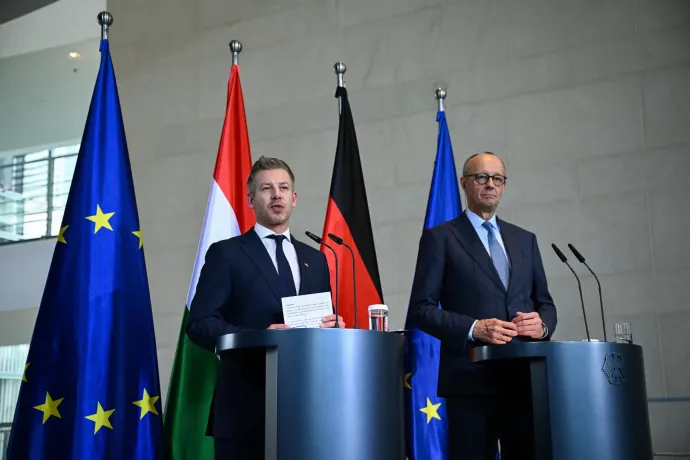

“Allow me to diplomatically and politely point out that I do not consider it a good idea to tie the European budget-which, ultimately, is about the European Union-to any other issue”-Hungarian Prime Minister Péter Magyar said at his joint press conference with German Chancellor Friedrich Merz, held at the Federal Chancellery in Berlin. Magyar was referring to the fact that the Chancellor had written a letter to the President of the European Council, in which he stated that every EU member state must "contribute fairly" to helping Ukraine.
According to Péter Magyar, everything is in place for the already strong Hungarian-German relations to become even stronger. During the work lunch of the two governments on Tuesday, discussions also touched on defense, strengthening economic cooperation, and EU enlargement.
“Your government has implemented reforms in Hungary at an impressive pace, clearly demonstrating that your country is an integral part of the European family,”
the Chancellor began his remarks to Péter Magyar. He noted that there are enormous challenges ahead, which is why he was pleased that they were able to consult with several Hungarian ministers. They also discussed the EU’s long-term budget (MFF) and support for Ukraine. Merz said that supporting Ukraine is a shared responsibility for all of us, which is why they cannot reduce their support, but the MFF must be acceptable to everyone, so changes to the draft will still be needed.
Not long before the meeting, the German chancellor wrote a letter to António Costa, President of the European Council about support for Ukraine. Friedrich Merz called on all EU member states to ”contribute fairly" to reducing the country’s funding shortfall. The chancellor threatened that if there was no joint commitment to help Ukraine, he would block other EU financial matters.
In response to a question from the press on whether he intended the letter as an ultimatum to the other EU member states, Merz said that for them, there are two important issues in the EU’s new budget: competitiveness and defense. The chancellor said that he sees joint support for Ukraine as a prerequisite for the agreement.
“This is a shared responsibility; that’s how we’ve always understood it,” he said. In his view, the EU’s Ukraine policy must be fully reflected in the EU budget.
Merz respects that other countries have differing opinions, and said that he and Péter Magyar had a frank discussion on this issue. “As the EU’s largest contributor and as the strongest supporters of Ukraine, we have to be clear on this subject,” the Chancellor said.
With regard to support for Ukraine, Péter Magyar said that the entire security system needs to be supported, and that member states are contributing within their means. According to him, ever since the outbreak of the war, Hungary has been spending enormous resources on protecting Europe’s external borders, for which the country has received no support whatsoever from the EU. “All we’ve received is that the Hungarian people have to pay a daily fee of one million euros,” he said. The Hungarian PM hopes that they will be able to conclude this matter before the end of the year.
“Hungary is actively participating in NATO, particularly in the European forces. European security must not only be defended in Ukraine, because where Europe is absent, other forces are present,” he said. According to the Prime Minister, Hungary has provided a great deal of assistance to Ukraine in recent years, primarily in the form of humanitarian aid, and it is prepared to continue this assistance, as well as to improve the relationship between the two countries.
“We want to capitalize on the momentum”
Previously, the Hungarian Prime Minister said he was thankful to be in Berlin for the second time since he took office, and noted that this is the second bilateral meeting within a few months, while previously, several years went by without such a meeting. According to the Hungarian Prime Minister, all the conditions are in place for the already strong Hungarian-German relations to strengthen further.
He believes that there is economic and political trust between the two sides. He added that the German-Hungarian trade balance exceeds 65 billion euros, but there is still ample room for growth. The Prime Minister also said that he was pleased that 2028 will be a German-Hungarian Cultural Year.
The Prime Minister touched on the EU’s long-term budget, noting that the goal is for all 27 countries to be able to accept this budget. In his opinion, “It won’t be an easy task. Every country has its own national interests. Perhaps I’m not giving away any secrets when I say that Hungary's interests are slightly different than those of Germany,” he said. Hungary considers it important that support for agricultural and cohesion policies not be substantially reduced. Péter Magyar would also like to see a change with regard to contributions, because under the current proposal, Hungary would be one of the net contributors.
On the subject of energy resources and diversification, Péter Magyar said that if nothing is done about the runaway energy prices, energy security, and diversification, it will be difficult to talk about the competitiveness of EU companies. “The frustration of the European people about this issue is palpable, so we need to do something about it,” he said.
When discussing EU enlargement, the Hungarian Prime Minister said that Hungary has a good relationship with every country in the Western Balkans. He promised that Serbia and the Western Balkans can count on Hungary. “I will strongly advocate in Brussels for the need to accelerate Western Balkan enlargement,” he said. He added that Hungary and Germany are on the same page on this issue.
Péter Magyar recalled that when he met with Volodymyr Zelensky in Brussels, they agreed on a new beginning. He said that the reforms promised by Ukraine are progressing well, but there is still much to be done. “This was a good first step; discussions on economic and other matters will continue at the ministerial level,” he said. He is confident that there will be another meeting between the two sides in the future. Magyar also noted that, in his view, linking the accession of Moldova and Ukraine is not a good idea; each country should be admitted when it is ready. And Moldova and some countries in the Western Balkans are ready.
The German Chancellor said that they both see European enlargement as an important issue. In his view, Hungary is committed to the accession of the Western Balkan countries. He welcomed the fact that they will soon be able to conclude accession negotiations with Montenegro. “Regarding Ukraine and Moldova, I would like us to be able to open all negotiation chapters, and I hope we will succeed in doing so by the end of this year,” he said. Merz pointed out that they must continue to exert pressure on Russia, which includes supporting Ukraine and, consequently, the prospect of the country’s EU membership.
According to Friedrich Merz, they want to breathe new life into Hungarian-German bilateral relations.
“We want to capitalize on the momentum generated by this new beginning,”
he said. In his view, there is great interest in the revitalized relations. “I’m pleased to see the competitive environment in Budapest improving,” he said. Merz noted that they also want to work together to diversify their countries’ energy sources. Germany has offered its expertise in the field of LNG supplies in order to help Hungary reduce its dependence on Russian energy sources. In terms of defense policy, the two leaders see an opportunity for strengthening ties in the area of air defense. They see the EU’s SAFE loan as a good opportunity for strengthening cooperation.
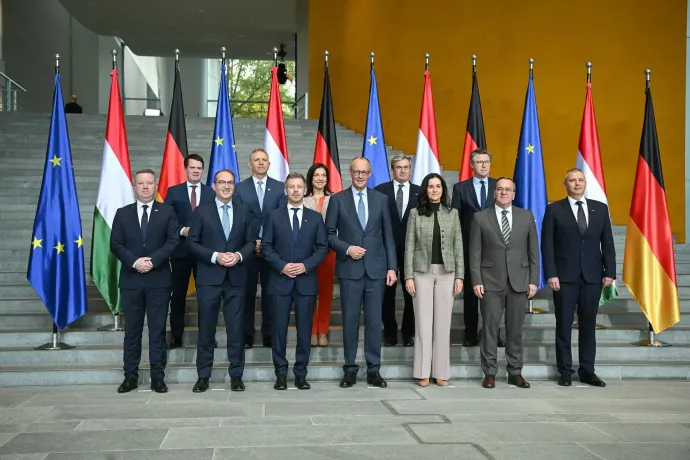
The two heads of government first met in a one-on-one meeting, then attended a business lunch along with their selected ministers, where, according to the Chancellor’s Office, topics included European affairs, defense, economic cooperation, and continued support for Ukraine. Péter Magyar was accompanied to Berlin by Foreign Minister Anita Orbán, Interior Minister Gábor Pósfai, Minister of Economy and Energy István Kapitány, and Minister of Defense Romulusz Ruszin-Szendi.
The first brick from the Berlin Wall was knocked out by the Hungarians
The Hungarian Prime Minister traveled to Berlin on Monday, shortly after his address to Parliament. He delivered a speech on Europe in German, near the location of the former Berlin Wall on Monday evening. Recalling the events of 1989, he quoted former German Chancellor Helmut Kohl, who said that the first brick from the Berlin Wall was knocked out by the Hungarians.
In addition to historical reflections, the Prime Minister also voiced criticism of Europe’s current leadership. According to Magyar, the European political elite has for a long time been writing reports and dealing with bureaucracy, while failing to make the necessary decisions and leaving citizens to fend for themselves. In his speech, he also spoke about what he considers to be the right migration policy. According to Péter Magyar, political elites in Europe are “speaking to the people from their ivory towers, with an air of superiority.” He also pointed out that political extremism built on fear and hatred is on the rise, and that external influences have played a role in this. According to Magyar, leaders should instead listen to the voices of those who were previously invisible.
This is not the Hungarian Prime Minister’s first visit to Berlin: in the fourth week of his premiership, he participated in a bilateral meeting with the German chancellor. “His election victory is an inspiration throughout Europe. Péter Magyar has proven that the pendulum does not only swing toward the authoritarian, illiberal side, but can also swing back toward the center,” Friedrich Merz said at the time. The focus at the June meeting was also on European cooperation and Ukraine.
For more quick, accurate and impartial news from and about Hungary, subscribe to the Telex English newsletter!