What exactly are the communist-era secret service files now opened in Hungary?
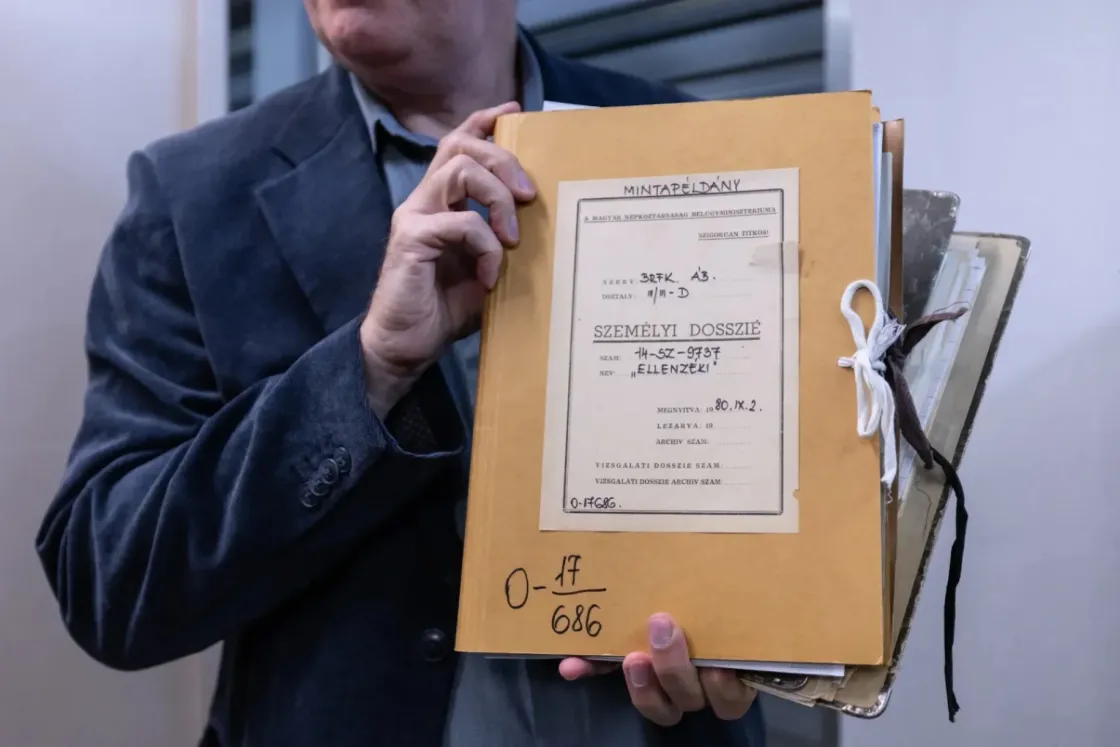

Although over the past nearly four decades, there have been repeated calls in Hungary to make the “agent files” (as they have been widely referred to) public, no government has had the genuine political will to make this happen. After 2010, Fidesz–KDNP consistently voted down proposals submitted by András Schiffer and the LMP party initiating the opening of the files and were not even willing to debate the issue. Barely two months after his first interview with which he burst onto the Hungarian political scene, Péter Magyar promised that if his party came to power, they would open the agent files, a promise he repeated several times during the election campaign. And he kept his promise: 36 years after the change of regime, on the anniversary of the suppression of the 1956 Revolution, the agent files were made available to the public.
Since 4 November, anyone may search these documents on nyitottaktak.hu. This article summarizes exactly what these files will look like, what they might reveal, and their expected effect on Hungarian society.
What is on the page where the files may be accessed from?
The page includes a search engine linked to a database. So instead of a list of names, there is a search interface. Anyone is free to look up names of interest to them, whether those of their parents, grandparents, a close acquaintance, or a former colleague. Searches can also be made based on date of birth and address. The database contains the names of individuals about whom the communist regime’s state security service kept records in some form before the fall of communism.
If a search yields a result for someone’s name, does that mean they were an informant?
It’s not that simple, and it doesn’t necessarily mean that the person was an agent who filed reports on their acquaintances, coworkers, or relatives. It’s also possible that security services simply took notice of them for some reason, which then led to a record being created.
Why is it not certain that someone was an agent if their name does appear in the agent files?
First of all, it’s worth clarifying that there is no such thing as an “agent file.” State Security stored several different types of records. Of these, the infamous magnetic tapes, the so-called “B-logs,” and the “number 6-files” were now made public.
What is on the magnetic tapes?
The state security services began to partially digitize their records in the 1970s: first they made backups on punch cards, and later on magnetic tapes. The magnetic tapes contain the “H” database, i.e. the network registry. This contains approximately 58,000 names dating back to the 1970s. It includes consolidated data on former members of the network as well as the numbers of their recruitment dossiers, but it does not include documents or photographs. The list not only includes those who were recruited, but also individuals who were important to the intelligence services for one reason or another, even though they were never informants or agents. The contents of the magnetic tapes may be more useful for additional research, as the data found there does not explicitly indicate whether a person was an agent.
What are the B-logs?
Recruits' names were logged in numerical order in the so-called B-logs (B-naplók). In addition to personal information, the logs also noted that a file had been opened on a person. However, even this does not reveal why the person was recruited, whether they actually submitted any information, and if so, what type of information this was. Few B-logs have survived; the ÁBTL only has five of them in its possession. These were generated between 1957 and 1962 and contain roughly 25,000 names. Thus, this too is an incomplete database.
What is in the No. 6 files?
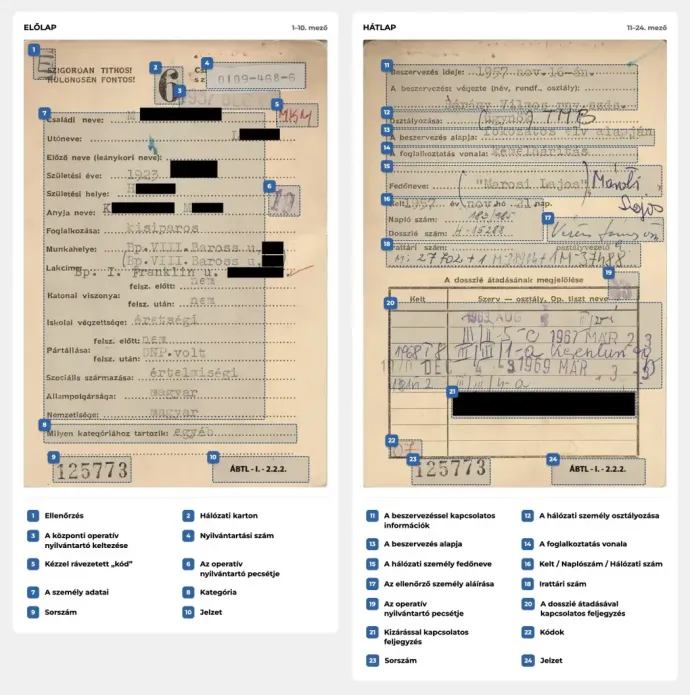
Of the three types of files, the No. 6 files are the most important. These reveal more about a person’s potential history with state security. The front page of the file lists the person’s personal information, occupation, and place of employment, as well as whether they had served in the military or were a member of the (communist) party. The back cover contains details of their recruitment. It specifies when and on what basis the individual was recruited. Some of those who submitted reports were motivated by patriotism or personal conviction; others did so for financial gain; and still others were recruited based on incriminating or compromising information. The No. 6 file also indicates how long the individual remained in the state security records, what classification they received, in what area they were employed, as well as the name and rank of the operative officer who recruited them.
If someone had a “No. 6. file”, does that mean they were for sure an agent and submitted reports?
No, the existence of such a file does not necessarily mean that. If there was a No. 6. file on someone, it signals that the State Security Service had contacted them in some form, but it does not automatically mean they performed any actual work. There were those who did not submit any reports or provided useless information, and there were also those who resisted attempts to recruit them. This was the case, for example, with Asztrik Várszegi, the former abbot of Pannonhalma, who also had a ‘No.6’ file, but was not an informer.
So what can we learn from this?
A great deal can be deduced from the contents of a No. 6. file. This is because it was also indicated in the file whether the person had a so-called work file (munkadosszié), and if so, how many. This is important because that is where submitted reports were kept. If someone had a work file, it is highly likely that they did submit reports; of course, exactly what they reported is another question.
Will these be made public as well?
No. Since those who were surveilled were, in effect, victims of the system, the intention is to protect them by ensuring that the reports compiled on them are not accessible to everyone. According to experts, it would be unfair to innocent people to publish their most closely guarded secrets. Researchers and the relatives of those concerned, however, may request access to these documents. Gergő Bendegúz Cseh, Director-General of the Historical Archives of the Hungarian State Security (ÁBTL), advised that if anyone comes across a name in the documents, they should request these documents as well in order to understand the full story.
So we won’t find out who was reported on?
No. The victims’ names will be redacted from the files, but those involved will be able to identify themselves because the documents will state what tasks the agents were assigned to carry out.
Are these the only documents that were made public?
There is also a fourth category of documents. These are the recruitment files, which will be made public gradually, until 25 February. They reveal the most about a person’s work for the state security services. They provide a detailed account of a person's involvement with the state security services, from the moment the state security services took notice of them, including how their vulnerabilities were identified-for example, how they could be blackmailed or recruited as an informant. These files may range from being just a few pages long to dossiers of several hundred pages, also showing who refused to cooperate, who submitted useless reports, and who cooperated very actively with the state security services.
Why aren’t these documents being made public all at once?
According to the official explanation, this is mainly due to technical difficulties. They were able to prepare the No. 6. files and the recruitment logs more quickly. The digitisation and verification of the recruitment files takes longer – there are about one million pages of such documents. The work is additionally slowed down by the fact that, under the law on agent files, the personal details of those who were surveilled must be redacted from the documents, as they were victims of the system. The law also stipulates that any information relating to the sexual orientation, health and pathological addictions of those who were part of the network must be redacted as well.
What is the role of the advisory committee assisting with the review of classified documents?
The 13-member body is reviewing the still classified, national security-related documents with a view to making them public. Their task is to review the classification of these documents and decide which ones should continue to remain classified and which ones can eventually be made available to the public.
So, could more documents still come to light?
Yes, because there are a great many documents still stored by the national security services. On the government’s instructions, they have begun reviewing the classification status of the files in their possession. This review has already resulted in 1,000 additional recruitment files being transferred to the National Archives. These will become available for public inspection at a later date, as the National Archives still needs to process them. Meanwhile, the committee reviewing the classification status continues to work and further documents may be made public in due course.
How many people may have been part of the network, and how many of their names could now be revealed?
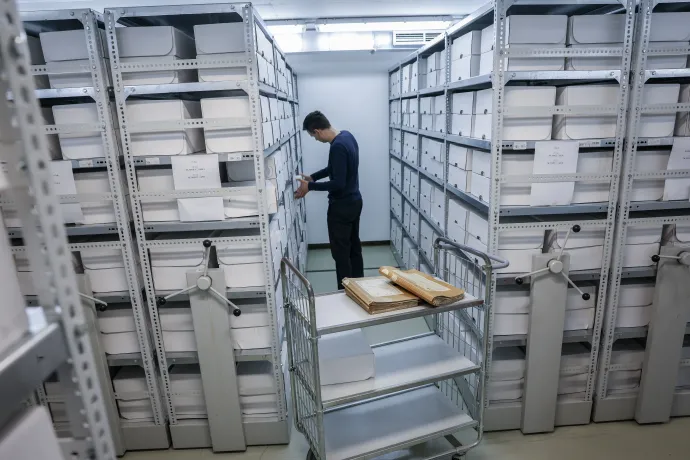
According to research, there were a total of 150,000–160,000 active members of the network under the Rákosi and Kádár regimes. The Director-General of the ÁBTL said that, according to their calculations, 60,000 names were published now. However, there are only 9,000 recruitment files in the archives, and as previously mentioned, they have recently received an additional 1,000. But even so, this represents only a fraction of the original documentation.
How did some of the documents disappear?
The greatest loss of documents occurred during the darkest period of the communist dictatorship. Many documents were also lost during the 1956 Revolution, but a large number of them disappeared shortly before the change of regime as well. There is very little information about what happened to them. It is likely that many were destroyed, and it is also possible that some of them still exist today.
Could the names of well-known people whose past as informers has not previously been revealed be discovered in the database?
The Director-General of the ÁBTL does not expect any bombshell revelations, as the state security records of the truly significant public figures have already been made public, and researchers and those concerned have been able to access the files up to now. While some new names are bound to emerge, in his view, the current opening of files will affect ordinary people more. This is because the state security services were not only targeting intellectuals in Budapest, but border guards, taxi drivers, waiters, porters and members of the clergy as well.
A great deal of time has passed since the change of regime; many of the agents are no longer alive. What is the point of bringing these documents to light now?
Experts are divided on this issue. According to the Director-General of the ÁBTL, the lack of clarity on this matter has caused a great deal of harm to Hungarian society. He believes it could help the younger generation understand how the dictatorship operated and how people’s personal data was misused. Historian János Rainer M., a researcher specialising in this period, believes the release of the files is mainly of symbolic importance; in his view, apart from researchers, the move is unlikely to stir up much excitement amongst the general public. According to historian Krisztián Ungváry, who has been researching the history and the records of the state security services for several decades, if the release of the records prompts people to reflect, if it raises questions and sparks further research, then making them public will have been beneficial.
Why is this important to the government?
The Hungarian government has made disclosing these secret police files a clear priority. Bálint Ruff, Minister in charge of the Prime Minister’s Office, said in an interview with Válasz Online that opening up the secret police files would be the first task of the ministry he heads. He justified this by saying that, to date, properly uncovering the crimes of the previous regimes had not been possible. Prime Minister Péter Magyar, meanwhile, in his address in parliament on Monday said that if the files had been published before, it could have been revealed which members of parliament – past or present – had taken part in the ‘spontaneous privatisation’ and the subsequent privatisation process after the regime change.
Why weren’t these documents made public before?
That’s a good question. As we noted at the beginning of this article, after the transition to democracy, none of the subsequent governments had the political will to make these records available to the public. Before coming to power in 2010, Fidesz promised to make the documents public, but nothing came of it. The proposals put forward by András Schiffer and the LMP were voted down every time without any justification whatsoever. Gergely Gulyás, the former Minister of the Prime Minister’s Office stated at a government briefing in 2024 that, in his view, making the secret service files public would not promote transparency, as these documents had often been falsified and some of them had even been stolen.
What impact could the disclosure of these files have on Hungarian society?
It is difficult to gauge this at present, but the government expects it to cause a great deal of upheaval in many families if it emerges that one of their relatives worked for the state security services. To help people come to terms with this, a helpline was set up where people can seek the assistance of a specialist psychologist and a methodological guide was also published on how to deal with this shock within smaller communities. An interdisciplinary panel of experts was also set up to address the social impacts of the move. Its members include, amongst others, Noémi Orvos-Tóth, a clinical psychologist and founder of the Transgenerational Trauma Institute; Andrea Szabó, a sociologist and political scientist; and János Rainer M., a historian, university lecturer and full member of the Hungarian Academy of Sciences.
For more quick, accurate and impartial news from and about Hungary, subscribe to the Telex English newsletter!