Orbán: They tried to recruit me during the early period of my military service, but I refused
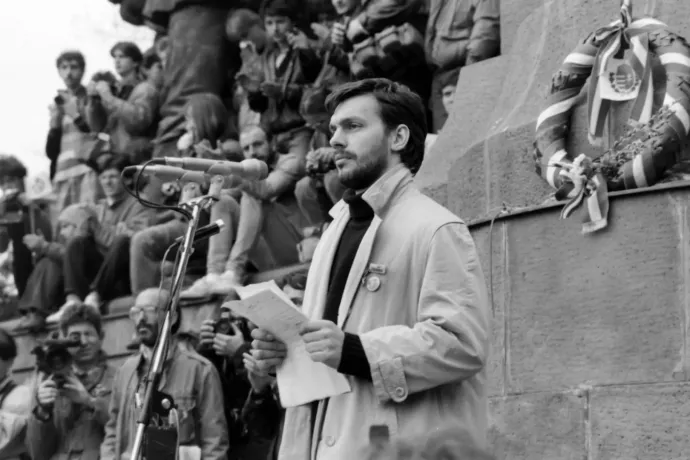


Viktor Orbán shared multiple pages of documents on his social media page on Tuesday to prove that he had never been an informant under the communist regime in Hungary, but was in fact himself kept under regular surveillance, along with his wife Anikó Lévai. He chose this course of action after Hungary’s last pre-regime change prime minister, Miklós Németh claimed that in March 1990, he had seen three handwritten reports that Orbán had submitted as an informant, while doing his mandatory military service.
This is not the first time the topic has come up, but its current resurfacing is due to the fact that the names of tens of thousands of state informants from the communist era are set to be published on Wednesday. Although partial, unofficial lists have surfaced before, this will be the first time that the files will be made accessible to the wider public via a searchable online database.
The publication of the state-security files was one of Péter Magyar’s promises during his campaign leading up to April’s parliamentary elections, and a law allowing for the move was eventually passed in September.
“They tried to recruit me during the early period of my military service but I refused, so the attempt was unsuccessful. My wife and I, as well as my colleagues in the opposition were later kept under constant surveillance. We were all targets of the ruling party’s secret investigations,” Orbán wrote in his post, adding that the documents also reveal that
“from the early 1980s onward, they deployed all manner of secret service tactics against us. They monitored us, planted informants on us, and installed listening devices at our places of work, in our apartments, and even in our bedrooms.”
Orbán's past as an informant is among the topics explored in the forthcoming book of investigative journalist Szabolcs Panyi, Friendship with extras – Putin's servants and their services in Hungary, which the author spoke about in a recent episode of Sándor Friderikusz's podcast.
Fidesz also responded to the claims made in the program. According to them, “Every fact, piece of data, and document is proof that Viktor Orbán was not the one surveilling others; rather, it was he who was surveilled by the communist state. What is it exactly that today’s successors—the neo-communists—are trying to divert attention from?”
Historian Krisztián Ungváry also pitched in on the debate. In a social media post, he wrote that after Viktor Orbán’s discharge from military service, he was a target and subject of surveillance by state security; and while it is possible that he had previously carried out tasks as an agent, this would need to be proven, and everyone is entitled to the presumption of innocence. Ungváry, who is a member of the Advisory Committee Assisting in the Review of Classified Documents, wrote in his post that he finds it troubling “when a verdict is reached based on mere allegations, even when it is not known exactly what happened.”
In his view, the only evidence of Orbán’s alleged recruitment is that “Miklós Németh claims that he saw something, the content and context of which he cannot even properly describe.” The historian added that Németh cannot be considered a reliable source, as he has previously made claims which, according to the historian, were easily refutable—for example, that the complete list of Hungarian agents can only be found in Moscow.
According to experts at the Historical Archives of the State Security Services, the files—some of which are scheduled to be opened now and others on 25 February 2027—will contain 55,000 to 60,000 names, which effectively means that “almost everyone will find an informant in their family.”
For more quick, accurate and impartial news from and about Hungary, subscribe to the Telex English newsletter!