His Unicum-addicted, heartless heroes are admired the world over
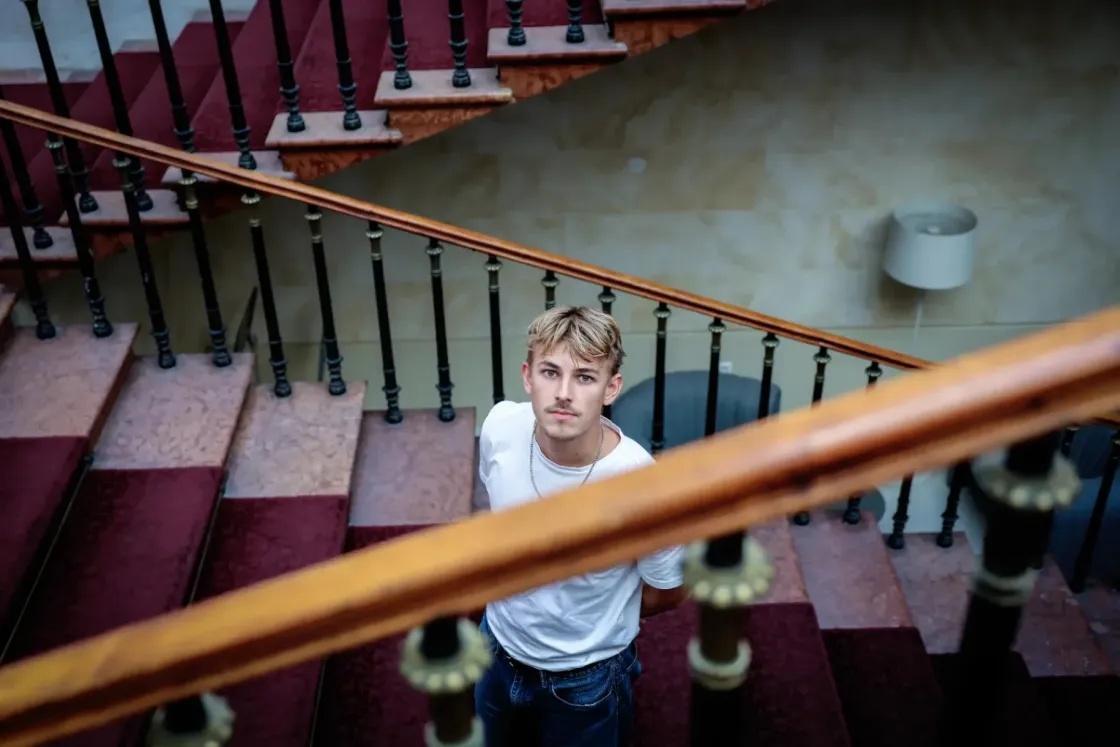


His book sold 200,000 copies in German-speaking countries in four months. His writing has impressed both Patti Smith and Daniel Kehlmann, his teachers love attending his sold-out readings, and the director of Babylon Berlin has purchased the screen rights to his novel. When he isn’t sitting down with his readers at one of the world's prestigious international book festivals, Nelio Biedermann is studying German literature and film theory at the University of Zurich. Still just 23 years old, he was barely 20 when he finished his novel Lázár, inspired by the story of his Hungarian aristocratic ancestors. The book’s publishing rights have so far been sold for nearly 30 languages. The volume, filled with magical realist motifs and brimming with Gothic references, was published in Hungary by Scolar, the translation done by Zsuzsa Fodor. With its unfaithful and hypocritical, Unicum-addicted gentry protagonists, it could even be described as a sort of Jókai satire for Gen Z.
I met Biedermann in the courtyard of the Petőfi Literary Museum. Despite his early-morning flight, he seemed well-rested, wearing a white T-shirt and sky-blue jeans, sporting a signet ring and a Casio watch with a digital display. He could have easily passed for a Grasshoppers Zürich midfielder or the frontman of a boy band. The first thing I asked him was what attracted him to writing prose at a time when the most talented members of his generation are making videos for Instagram or TikTok.
“It wasn’t a conscious decision; it just turned out this way,” Biedermann replied. “I’ve always read a lot, for as long as I can remember. And writing just became a part of my life. During the pandemic, our high school announced a writing contest, and since I didn’t have anything else to do at the time, I wrote a piece. If it hadn’t been for the pandemic, I might have missed out on the opportunity. I would have really regretted that, because since then I’ve felt more and more that writing is what I want to do. So I simply took the plunge, and from that point on, I was no longer just a reader, but a writer, too.”
Something we cannot get by sitting in front a screen
Biedermann’s passion for reading is evident throughout Lázár, which references the works of Thomas Mann, James Joyce, Franz Kafka, Marcel Proust, as well as E. T. A. Hoffmann, Arthur Schnitzler, and Sándor Márai. These authors wrote their books in a completely different era and milieu than our own. So, probing further into the local significance of prose, I asked Biedermann what he believes the role of literature is in the 21st century.
He brought up the views of Jonathan Franzen and David Foster Wallace on the novel. He said that, at the dawn of their success, both American writers spoke about how literature should be more entertaining than television. “The author of Infinite Jest would be completely flabbergasted if he saw how much more serious the challenges faced by literature are in the mid-2020s than, say, around the turn of the millennium,” said Biedermann. “But I think the approach Foster Wallace and Franzen took back then is no longer relevant today. Rather than competing with social media or the content offered by streaming platforms, novels need to offer something radically different instead—something users can’t get from a screen. I’m hopeful that some people will soon grow tired of multitasking, get fed up with the rush, and start reading again. Of course, I am aware that back in the day, books were a privilege of the aristocracy, and I’m afraid there’s a chance that print storytelling won’t immediately win back huge audiences this time around either.”
“I had nothing to lose”
In any case, Biedermann’s book has a huge readership. Not only has it resonated with his fellow writers, but it has also won over critics. In 2025, the novel was nominated for the Swiss Book Prize, and it was also chosen as the Independent Booksellers’ favorite in Switzerland that year. Die Zeit hailed Biedermann as a “new wizard,” while a writer for The Guardian noted that, while reading Lázár, he discovered a narrator who, despite his tender age, was already mature, and said that “anyone who reads this novel will be intrigued to see what its precocious author does next". The success of Lázár, however, was not limited to the old continent; it also conquered the East Coast of the US. In the spring, The New Yorker and The New York Times featured Biedermann within a span of one and a half weeks of each other.
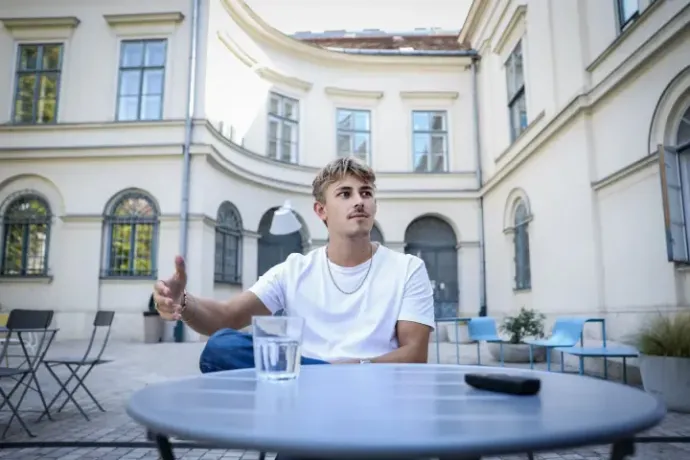
The young author clearly isn't overwhelmed by the attention showered on him, nor has being hailed as one of the greatest hopes of contemporary literature for some time now made him conceited or arrogant. I asked him if he had any fears about writing a family saga set against the historical backdrop of 20th-century Hungary, given that his book touches on some truly weighty issues. He explained that he first set out to tell this story when he was 16, and although he failed several times and had to start over, he felt that he had to give it another shot despite the many difficulties. “I had nothing to lose,” he said, referring mainly to stylistic and technical writing challenges among the difficulties he encountered during the process. “I really love Karl Ove Knausgård’s works, and as far as I know, he sends the day’s output to his editor at the end of each day, and in the morning they discuss the quality of the text over the phone. Knausgård only carries on if the publisher finds everything in order. External validation isn’t that important for me and I don’t like showing others what I’m currently working on, but sometimes I find it hard to believe that what I’m writing could be exciting or interesting to anyone else.”
Walking through the streets, touching the walls
Biedermann was still in high school when he began writing the novel inspired by his paternal ancestors. In real life, the banking family was ennobled by Franz Joseph in 1902, who also owed a debt to them. The family’s castle was erected in Szentegát, Baranya County by Rezső Biedermann in 1880. The family mausoleum, modelled after St. Stephen’s Basilica in Budapest, was built next to it later, in 1900. Nelio Biedermann has paid a visit to the Art Nouveau-style complex, which served as the model for the castle in Lázár, on several occasions.
“When I started working on the first draft of the text, I thought I knew every detail, since I grew up on these stories—they’d been shared with me a thousand times. Then I realized that besides needing to carefully research the historical background, I also had to devote more energy to researching the family. I spoke at length with my uncle, who lives in Budapest, went through the family archives he keeps, and pored over the photo albums as well. But in order to truly absorb the atmosphere essential for creating the setting, I had to return to the locations themselves—these are places I have known since childhood, but they only truly came to life when I again wandered through the streets and touched the walls.”
The gaps in a family’s history
The novel begins on January 6, 1900, and tells the story of three generations, concluding with the Lázár family's emigration in 1956. It is a story filled with infidelity and lies, initially marked by inexplicable and terrifying phenomena, before gradually losing its magic. Perhaps the most intriguing paradox of Lázár is that it seems as though it is precisely the destruction of the aristocracy and the Russian occupation of the country—that is, the complete disintegration of the old world—that brings the members of this pedantic, taciturn, and cold family, used to eating dinner served on Herend porcelain, closer together. Just as the Lázárs hide their emotions from one another in the book, so too did Biedermann’s ancestors find gaps in the family history—ones that ended up being inherited by each new generation.
“This naturally happens with the passing of time, since everyone inevitably retells the same details, and these aren’t necessarily embarrassing or unpleasant incidents. As everywhere else, many of our family’s memories have been lost as well, and while I managed to fill some of these gaps during my research, there are parts I still know nothing about. Naturally, these gaps were filled in by my imagination.”
“This is a novel, and in it, I can do whatever I want.”
When I pointed out that, although the book draws on real-life stories involving his ancestors, the characters in Lázár do not, after all, bear the author’s last name, Biedermann said that changing the family name of the novel’s main characters helped him in the writing process. “The first draft still used the name Biedermann. But that didn’t work—perhaps because it was too close to reality. And I felt I didn’t know enough about reality, so I turned to fiction to fill in the gaps. Changing the name helped remind me that this is a novel, and in it, I can do whatever I want. Although the story was inspired by real events involving my family, it was crucial for me to free myself from the pressure of having to describe everything exactly as it happened.”

And as for why I chose Lazarus (Lázár in Hungarian), a name known from the New Testament? It’s simple. “My ancestors were of Jewish descent, and they took on the German-sounding name Biedermann when they converted to Christianity. Before that, their last name was Lázár. So, on the one hand, this preserved the connection to reality, and on the other, using the old last name provided enough distance to allow me to boldly shape the text of the novel. And, of course, there is also the biblical figure of Lazarus, whom Jesus raised from the dead. In a sense, I did something similar while writing the novel: I brought the past back into the present and tried to somehow breathe life into it.”
A cover featuring a horse? Tough
When I asked Biedermann if he was aware that for Hungarian readers, the surname “Lázár” doesn’t only bring to mind a biblical allusion but also the name of a politician, Biedermann smiled and replied, “I didn’t know that before, but I do now. Several people have already brought it to my attention.”
Since we were already on the subject of Lázár-the Hungarian politician who also happens to be interested in horses-I brought up the horse depicted on the book’s cover. I asked Biedermann why the cover featured the work of American artist Jaime Corum. “It was my idea, but I had to fight for it, because my German publisher thought that a cover with a horse would be a tough sell.” In the end, everyone gave their approval, and I think it turned out to be a good choice. And as for why this was important to me... My family had a Lipizzaner stallion, but the Russians took all of our horses too, and they wanted to take them on foot all the way to the Soviet Union. That’s an enormous distance, so the animals didn’t survive the journey, but as far as I know, some of their descendants are still living somewhere in eastern Hungary.”
The cover, then, serves as a link between fiction and reality and fits nicely with what Biedermann said about his creative process. “I never make outlines, so I don’t know ahead of time where the story I’m working on is headed. To me, writing a book is like a mixture of reading and dreaming. Even though I’m the one creating the scenes, I still don’t know in advance where it’s all going to end up. It’s as if I were reading the story somewhere. It’s similar to what happens when I dream.”
The novel’s framework is also dreamlike. Its three most important motifs—water, snow, and ice—appear at the very beginning, and again at the very end of the text. Biedermann said he was looking for a symbol that expressed fragility and transparency, one which captured the contradictions of the family’s story. After all, the Lázárs are not characters rooted in their own present. In fact Lázár, the book recounts how the heartless, desire-driven, selfish, and untouchable heroes of a fairy-tale world turn into broken, pitiable figures defeated by Central European history. Even though the Monarchy sank into the Danube and the ice cracked beneath them, despite their struggles with both the present and the past, in the end, they were somehow able to find a way to stay together.
For more quick, accurate and impartial news from and about Hungary, subscribe to the Telex English newsletter!