Only a quarter of Hungarians would report corruption if they witnessed it, but many don’t even know where to do so


The Hungarian general public considers corruption one of the country’s biggest problems, but few would dare report it if they became aware of a corrupt act, and even fewer know who to turn to in such cases—these were among the findings of a representative public opinion survey conducted as part of the Integrity Authority’s research program titled On the Clean Path (“Tiszta Úton”). The survey also found that the public is more tolerant of certain incidents classifiable as corruption than of others.
During the presentation of the research findings on Thursday in Budapest, Ferenc Pál Biró, president of the Integrity Authority, emphasized that there is a great deal of talk about corruption in Hungary, and that it was one of—if not the most important—topics of the April elections. Nevertheless, this is the first time a comprehensive, representative survey has been conducted examining the public’s experiences with corruption and integrity in a systematic and contextual manner. The “Tiszta Úton” public survey will be repeated annually, and as Dr. Kinga Vajda, the project's leader explained, it will be supplemented by surveys of business executives and government officials. In fact, the data collection for the survey of business executives has already been completed.
It’s in the top 3
The data for the recently published public opinion survey was collected back in 2025, so it will be particularly interesting to compare it with the data from the 2026 survey. 42 percent of those contacted agreed to participate in the 2025 survey, which Vajda says is exceptionally high.
According to the survey, corruption is one of Hungary’s three biggest problems; only inflation and the state of public healthcare were cited by more people as more serious issues.
41.6 percent of respondents said that corruption is the biggest problem in Hungary. A slightly higher proportion of those surveyed believed that corruption is “extremely widespread” in the country—42.4 percent held this view—while 31.3 percent chose the somewhat milder option of “significantly widespread.” Additionally, 45.7 percent of respondents said that corruption had increased significantly between 2020 and 2025, while 5.1 percent said it had decreased slightly and 0.6 percent said it had decreased significantly.
Not only do respondents see corruption, but they also feel its effects. 10.3 percent of the population feel that corruption affects their daily lives “to a very large extent,” 24 percent to a greater extent, and 41.9 percent to a lesser extent.
In other words, three-quarters of the population feel that corruption affects their lives to some extent, while more than one-third believe it affects their lives to a great or very great extent.
According to Kinga Vajda, it will be important to assess and monitor this in the future because corruption has a statistically demonstrable effect on people’s subjective well-being—that is, the perception of corruption diminishes people’s well-being.
They see it, they reject it, but they wouldn’t take action
One striking finding of the study is that although Hungarian society not only considers the level of corruption to be high and disapproves of it, relatively few respondents said they would also take action if they encountered corruption.
73.6 percent of respondents consider corruption unacceptable, but only 26.8 percent said they would take active steps if they encountered a suspected case of corruption.
According to Biró and Vajda, this contradiction is primarily due to a lack of information, mistrust, and fear. The majority of the Hungarian population does not know whom or which institution to turn to if they wanted to report a case of corruption; nearly 70 percent told the researchers that they are not familiar with any such Hungarian institution. And even if they do know, many believe that Hungarian authorities are unable to provide protection against corruption (33.6 percent say they are not at all able to, while 40 percent say they are probably not able to do so). For this reason, many may feel that even if they reported what they saw, it would not lead to any tangible results—it would not change anything. Moreover, many fear that the state would be unable to protect whistleblowers; in other words, if they reported corruption, they would ultimately be the ones to suffer.
That is precisely the reason why Biró believes it is of paramount importance for the government to build trust and make reporting channels more widely known and safer. The government must protect those who speak out and demonstrate that their reports have real consequences.
What is corruption, and what isn’t?
It is, of course, worth clarifying what people—and the researchers interviewing them—mean by corruption. Dr. Vajda explained that one of the first steps in the research was to establish the definitions of corruption and integrity. The researchers defined corruption as “the phenomenon in which an individual, group, or institution abuses the power entrusted to them for the purpose of gaining a personal advantage, which typically involves harming the public interest or violating laws, regulations, and/or integrity standards.
It is also considered corruption when someone, for the purpose of gaining an advantage, offers or provides some form of personal advantage to an individual, group, or an institution vested with power. We consider all such cases to be corruption, even if they occur under the pretext of some perceived or actual public interest.”
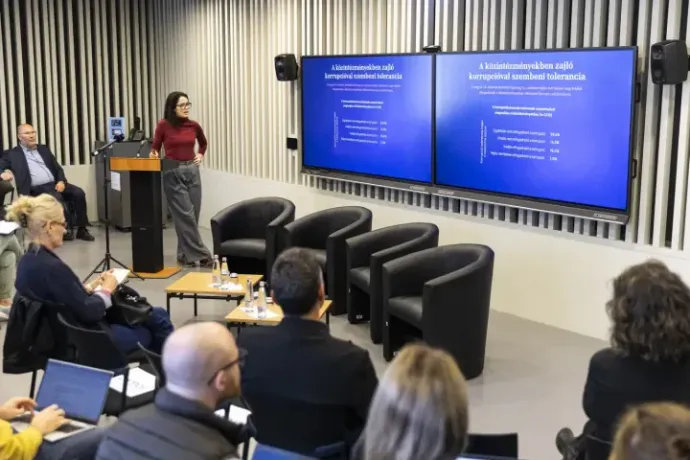
Those surveyed were naturally not asked whether they agreed with this definition; instead, they were asked various questions, such as whether they considered it corruption for a public official to accept a bribe, for a patient to give a nurse a smartwatch, or for someone to use their connections to skip the line to see a doctor, and so on. Tímea Vajda pointed out that it is an interesting finding that Hungarians tolerate different acts of corruption to varying degrees.
While 90.6 percent of Hungarians consider it unacceptable for someone to give money to another person to gain an advantage, only 68.7 percent view a gift in the same light, and 63.9 percent disapprove of a favor.
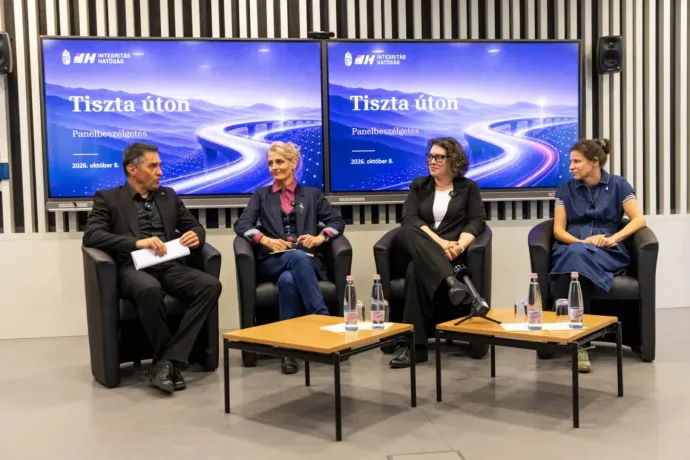
The perception and acceptance of various acts of corruption were also key topics of discussion during the panel discussion that followed the presentation of the study. According to Dr. Petra Burai, head of education at the Integrity Academy, which is part of the Integrity Authority, based on the definition used in the study, it is considered corruption if someone does not ask a mechanic for a receipt or, as a company executive, accepts the gift of a ticket to a soccer game. When seeking to understand attitudes toward corruption, it is important to recognize that individuals may have different everyday experiences of it.
According to Dr. Andrea Szabó, a researcher at the Institute of Political Science at ELTE’s Faculty of Social Sciences, while such everyday cases do involve the pursuit of personal gain, abuse of power rarely occurs in such instances, so they fall outside the definition of the Integrity Authority. According to Dr. Orsolya Vincze, a legal expert at the K-Monitor Public Benefit Association, the definition could be broadened even further if we considered whether it constitutes corruption when someone changes their address to their grandmother’s in order to send their children to a better school. There are many such examples in Hungarian society—acts that certainly undermine integrity—but it is not certain that all of them meet the definition of corruption.
The participants in the roundtable agreed that, in the long term, change can be achieved by transforming attitudes toward education, corruption, and integrity, so that society would not only reject high-level corruption but also the little loopholes used in everyday life. According to Andrea Szabó, however, in the short term, nothing is more powerful than the impact of policy—specifically, the state’s efforts at improving public trust. Orsolya Vincze notes that there are visible results: according to a K-Monitor study, not only have authorities largely eradicated under-the-table payments from the Hungarian healthcare system through regulatory measures and education, but doctors now feel uncomfortable even when someone tries to refer a patient to them through personal connections. According to Petra Burai, as with any social change, the key question in the fight against corruption is to what extent people feel that the change is their own. Society can change, however; someone just has to set the process in motion.
For more quick, accurate and impartial news from and about Hungary, subscribe to the Telex English newsletter!