


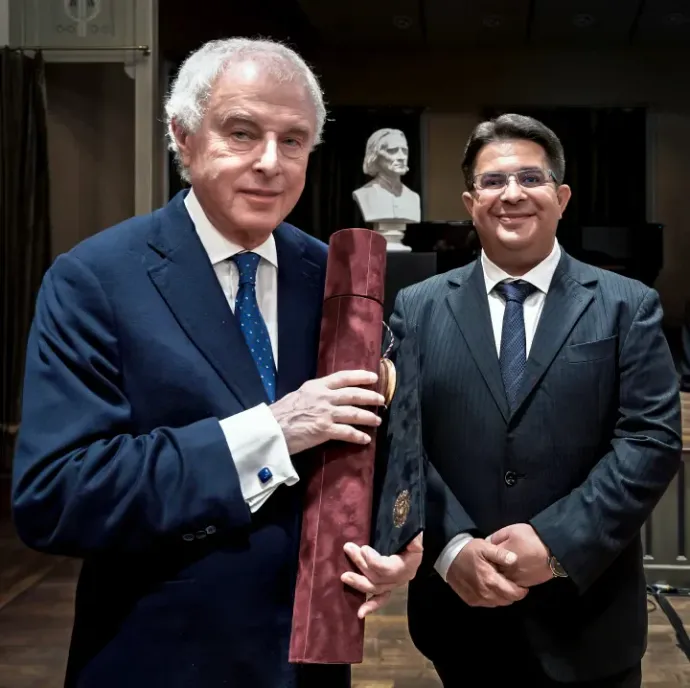
The Liszt Academy has awarded an honorary doctorate to András Schiff, the world-renowned Hungarian pianist who has returned to perform in Hungary after sixteen years. He arrived in Budapest in the evening on September 1 with his wife and his mahogany-colored Bösendorfer piano, on which he is to give two concerts, on September 3 and 4. Schiff has decided to donate the proceeds from the concerts to the establishment of the Aladár Rácz Roma College of the Arts. The program for the concerts was not revealed in advance, making it a surprise for the audience.
At the beginning of the press conference held at the Liszt Academy, Rector Gábor Farkas expressed his delight that the Academy could serve as the venue for the artist’s return to Hungary, who is giving concerts in Hungary after a long hiatus. Schiff shared his thoughts next, and finally, for about three-quarters of an hour, the artist answered questions from the press. Schiff began by apologizing for not being available to journalists outside of this press conference. As he put it, the two concerts he was about to give would be very demanding, both mentally and emotionally.
He would make a poor politician
This May was the first time he had returned to Hungary since his mother’s death and funeral in October 2010. He said that, unfortunately, in the season that followed after that, he felt he no longer had a place here. He explained that he is convinced that the arts, society, and politics cannot be separated. He is aware that many people disagree with this; there are those who think it would be better if he kept his mouth shut and just played the piano, and didn't concern himself with matters he doesn't understand.
“It’s not as if I understand politics. I’d be a very poor politician. And I’d do a terrible job of it,” he added. Schiff has never shied away from expressing his opinions; in fact, he didn’t just speak up when asked.
He sometimes spoke out in the pages of foreign newspapers, even in letters to the editor, and expressed his concerns about the system that was being established in Hungary at that time. A particularly controversial episode in this story occurred in January 2011, when Zsolt Bayer, in his infamous essay titled “The Same Stench”—which went on to spark lawsuits—specifically named the pianist. The piece compared him, Daniel Cohn-Bendit, and a British journalist named Cohen to Béla Kun and his followers, and stated: “There is nothing new under the sun. Unfortunately, we were unable to bury them all up to their necks in the Orgovány Forest.” This was just one of several incidents. He also received anonymous threats that his hands would be broken. At a later point during the press conference, Schiff shared that at the same time, he had received multiple messages through informal channels urging him to stop criticizing the regime and come home, assuring him that he would face no retaliation. He did not come.
He remained steadfast in his resolve not to set foot on Hungarian soil as long as the Orbán regime remained in power. He said he experienced the change of government as a miracle, something he had stopped believing would happen. Like many around him, he did not think the regime could be overthrown peacefully. He remained pessimistic until the very last moment. He recalled that he had come to Hungary a few weeks after the election as a private citizen and noticed people smiling. He could sense a positive energy and noted that wonderful people had taken office, mentioning Andrea Rost (world-renowned opera singer, now a Tisza Party MP) by name.
Although he hasn’t visited for a long time, he maintained his relationships, especially with his childhood friends. He reads a lot, mostly in Hungarian, including contemporary works.
He believes that Hungarian literature is currently experiencing a new golden age. As a musician, he also follows Hungarian contemporary music, noting that the upswing seen in literature does not necessarily extend to new Hungarian musical compositions. But these are waves; they don’t have to be in sync. In May, he visited György Kurtág at his home at the BMC, and he hopes he’ll have the opportunity to do so again.
Wolfgang Sandner of the Frankfurter Allgemeine Zeitung asked Schiff if he thought there was a possibility of him moving to Hungary. “I’m extremely happy to be here right now and I hope this will happen more often, but as for moving back home permanently… Wow,” he replied.
When one looks in the mirror, they should not have to spit on it
András Schiff left Hungary in 1979; since then, he has primarily lived in London, Salzburg, and Florence. He used to hold Austrian citizenship in addition to his British citizenship, but renounced it when the far right gained strength in Austria. He was knighted by Queen Elizabeth II in 2014 and has been entitled to use the title “Sir” ever since.

The question posed by the publication of the Music Academy's student body raised the point that artists are people too and cannot be apolitical. “What opportunities does a performer of classical music have to express his or her views in this environment?” they asked.
“One shouldn’t be naive. I’m just a tiny speck in the ocean. I don’t know what impact what I stand for or say will have, and it certainly won’t change the world. But my own conscience must be clear. When one gets up in the morning, goes to the bathroom, and looks in the mirror, one shouldn’t have to spit on it. And that’s already something,” said Schiff. He then explained that it would have had a bigger impact than that if certain teams hadn’t traveled to the World Cup. Or if, at the currently ongoing U.S. Open, a few famous tennis players had refused to play as a protest against what Trump is doing. He’s well aware that by not performing in the United States, he won’t make a big impact—in fact, he’s cutting himself off from a significant source of income. But for those who are attuned to these issues, his decision carries meaning.
His role model is Pablo Casals—not only as a musician, but also as a person. Casals emigrated and refused to perform in Franco’s Spain, nor did he perform in countries which had immediately recognized Franco’s rule, including England and the United States. This gave many people the strength to resist. Or take Béla Bartók, who could have stayed at home—nothing bad would have happened to him. He didn’t have to leave. Yet he went to America anyway, where he nearly starved to death. There’s no compromise here; to him, that’s completely clear.
His favorite audience is in Russia—there’s none better; they’re simply wonderful. But now, because of the horrific war Putin is waging against the Ukrainians, it’s perfectly clear to him that he can’t go to Russia. He said that, shocking as it may be, he has colleagues who still go to Russia without batting an eye, arguing that the audience needs the music, and so on.
The same thing happened under fascism: even though people didn’t like Hitler or the exclusion of Jews, they still went there to play as late as 1940. He finds it unacceptable that when the world changes, people change their clothes and claim they didn’t really mean it—and say that it wasn’t about them anyway, but their neighbors. He believes this is a particularly relevant subject in Hungary right now, and we need to pay attention to it. We must not assume that the vast majority of people have a poor memory. “For example, I remember exactly who were the ones who benefited from this system over the past sixteen years, but at the same time—as he said—we shouldn’t seek revenge.” As good Christians, we must forgive, but we must not forget, he added.
The next question was about the Aladár Rácz Roma Specialized College. Rector Gábor Farkas was the first to respond. The college will begin operating in September 2027; its goal is to support the education of Roma youth by covering travel expenses, providing housing, and enabling their participation in master classes. The proceeds from András Schiff’s concerts this week will make the setting up of the college possible. The pianist had decided long ago to donate the proceeds from the two concerts to a charitable cause, but was unsure exactly what that cause should be. “There are as many candidates as there are stars in the sky,” he said. The plight of the Roma people is particularly close to his heart. As a Jew, he has had—and continues to have—quite a few problems with anti-Semitism.
“Although it doesn’t officially exist in Hungary, sometimes when one talks to a taxi driver or a building superintendent, the cat comes out of the bag,” he said on the subject. But this is still a better situation than that of the Roma. This is just one of the many pressing problems, and the foundation the proceeds will support is just a drop in the bucket.
As for the programs of the two concerts, Schiff explained that he last played in the main hall of the Liszt Academy in 2010, and it has undergone a major renovation since then. Its magic is the same as before, but the sound will still be different. He will have the opportunity to play there for the first time on the morning of the 3rd to hear what the sound and acoustics are like now. He’ll be playing his own piano at the concerts. “The composers are always the same,” he said. For him, Bach is the ultimate authority; he starts every day by playing Bach on the clavichord before breakfast, then spends another hour on the piano afterwards. Then he plays the others. For him, a concert always begins with Bach, followed by pieces from the composers he loves most: Haydn, Mozart, Beethoven, and Schubert. And, of course, Bartók—usually as the encore. When talking about encores, he also shared a few thoughts on China, where he has been giving many concerts lately.
“How come you perform in China so often, but not in the United States? After all, China is a dictatorship!” Schiff quoted the criticism he had received before. He explained that during his visits to China, he never felt the dictatorship. It’s true that there are cameras on light poles, but he has nothing to hide. He recalled, however, that the concert halls are always packed, the average age of the audience is twenty, and they ask for as many as fifteen encores—they simply don’t want to go home. Even children listen to *The Art of Fugue* with their eyes sparkling, despite the fact that sitting through it requires no small amount of interest,” he added.
In the highly esteemed city of London, you might get one encore if you’re lucky, and then they stop. They go home. He played an encore at the end of a concert in London, and the critics immediately complained, “Why put the audience through the ordeal of yet another encore?”
Finally, he listed the composers whose works he would be playing in Budapest: Bach, Haydn, Mozart, Beethoven, Schubert, and Bartók. He expressed his hope that at the two concerts in Budapest, the audience will sense that this marks the end of a sixteen-year hiatus. Tickets for András Schiff’s two concerts sold out months ago, within half an hour of going on sale.
For more quick, accurate and impartial news from and about Hungary, subscribe to the Telex English newsletter!