Hungarian Parliament appoints political scientist Anna Unger to head office for recovering public funds


The Hungarian Parliament, where the Tisza Party has a supermajority, has elected Anna Unger as president of the National Asset Recovery and Protection Office (NVVH). The office's deputy president for investigations, Katalin Tasnády, was also elected at Friday's session. Their terms will begin on September 1, 2026, and will last for six years. Another three deputy chairs are still being sought, as the applications received so far have been declared invalid.
Most of the Fidesz and KDNP representatives left the meeting room ahead of the secret ballot, while Mi Hazánk MPs stayed behind.
Four civil society organizations also participated in the process of selecting the leader of the NVVH: the Hungarian Civil Liberties Union (TASZ), the Hungarian Helsinki Committee, the anti-corruption NGO K-Monitor, and the Worldwide Association of Hungarians.
The path to nomination
Unger is best known to the public as a political analyst and was nominated for the post by the Parliament's Committee for Judicial and Constitutional Affairs on Thursday, after receiving 6 votes in favor, 1 against, with 1 abstention (Fidesz representatives chose not to participate in the process).
She earned a bachelor’s degree in political science from the Faculty of Law at Budapest”s ELTE in 2003, followed by a Ph.D. in political science in 2018. As a researcher of democracy and an election expert, she has been a regular guest at events organized by civil society organizations and think tanks on the subject.
She has been an associate professor at ELTE’s Faculty of Social Sciences, teaching at the Institute of Political and International Studies and the Department of Human Rights and Political Science. Her main areas of research include the comparison of democratic and non-democratic systems, elections and direct democracy, the analysis and examination of the processes of autocratization and democratization, and the functioning of the European Union. According to the reviews on Markmyprofessor, a platform for evaluating instructors, she teaches her courses well, but some students have found her style somewhat off-putting. Some university students have described her as a meticulous and strict teacher.
Speaking at a Political Capital conference on accountability shortly after the April election, she said: “This isn’t about revenge, but if it doesn’t happen, the Tisza party could lose its political legitimacy". Prior to this, Unger has not really spoken out on the subject of corruption.
She isn't the nicest person, but she's a good organizer
At her hearing before the Parliament's Committee for Judicial and Constitutional Affairs, Anna Unger noted that she had spent ten years studying political and party financing, as well as corruption. According to her, she was the first person to develop a university course on this subject in Hungary. “I understand quite well what Hungary’s situation was and is,” she said, adding that she does not feel the need to prove her expertise.
In her view, the most important lesson to be learned is that if there is no accountability or justice for the victims of an authoritarian regime, and the perpetrators are not punished, then the newly emerging democracy cannot be consolidated in the long term.
If corruption remains uninvestigated and the stolen assets stay in the hands of the perpetrators, “they will not only be able to use them to secure protection for themselves when necessary, but will also be able to eventually use them to return return and rebuild the systems and the institutional and political foundations needed for their return.” As an example, she cited Keiko Fujimori, the daughter of former Peruvian President Alberto Fujimori, who became president because her father was able to use his stolen assets to protect himself.
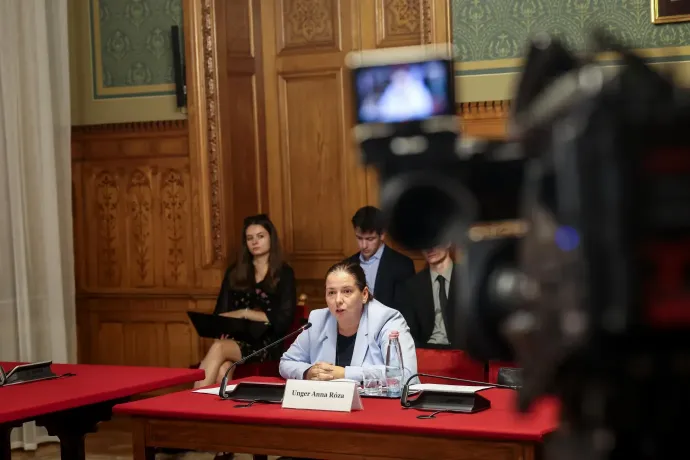
According to Unger, what happened in Hungary was not a simple case of corruption, because laws were also bent, the rule of law was dismantled, and people were intimidated. The NVVH’s task is to outline the system that created and facilitated corruption and the regime itself. She believes that other than the newly established office she is to head up, corruption cases can also be uncovered by the Integrity Authority, the prosecutor’s office, the police, the competition authority, and the State Audit Office.
Voters must be made aware “who the players who facilitated this were
—if necessary, their names, addresses, and phone numbers should also be made available.” “I do not agree with the view that a few million brainwashed voters were the ones responsible for this,” she said, defending the citizens.
Good work takes time
Unger expressed skepticism about expectations of quick results: “I think it's foolish to think that final judgments could be handed down within six years—which is how long the Office’s first presidential term will last.” She recalled that it took eight years for a first-instance judgment in the Quaestor case (a massive financial fraud and brokerage scandal which erupted in Hungary in 2015-TN). She believes, however, that six years may be enough to bring everyone responsible before the court.
Anna Unger said that she intends to involve the best professionals from various fields of expertise in the work of the Office, including investigators, prosecutors, and data analysts, and estimates a headcount of about 150. She stressed that hiring would be done via public job postings, and nobody would be hired because they know someone in a key position.
With regard to prioritizing cases, she said that she wants to review the concessions and the funds, and stressed the need for identifying the specific model on which the NER based its operations. All major state contracts must be reviewed without delay, because they can be challenged up to one year of their signing. Unger is hopeful that both the Hungarian and the European Public Prosecutors’ Offices will begin to do their part.
NER is short for Nemzeti Együttműködés Rendszere, meaning ’System of National Cooperation.’ The term was coined by the Orbán government after their election victory in 2010 to refer to the changes in government that they were about to introduce. Over the years, it became a word in its own right, and is used in colloquial Hungarian to refer to Fidesz' governing elite, complete with the politicians and the oligarchs profiting from the system that was set up.
“In my opinion, the private equity funds were the biggest crime,” because they lacked transparency and served no public interest. She added that there are many cases which have already passed the statute of limitations, and it is uncertain whether the assets siphoned out during the first term will ever be recovered. If we manage to recover even 10 billion forints, I will be pleased", she said.
She described herself as follows:
“People have said a lot of things about me, but one thing I haven’t heard anyone call me was defeatist. I’ve been told I’m generally a pretty good organizer. I’m not friendly, I’ve also heard that a lot. Which, I think, is an advantage here.”
Anna Unger said it was “a tremendous honor” that the committee had “endorsed her vision centered on delivering justice” by nominating her for the role.
The charter of the office she is to head will be drafted by the government, and will need to be approved by Parliament. The document will specify the size of the agency, its staffing needs, and its budget. With the establishment of the agency, the prosecutor's office will lose its monopoly on bringing indictments. The NVVH will have the authority to assume jurisdiction over cases involving public funds and directly take them over from the prosecutor's office.
For more quick, accurate and impartial news from and about Hungary, subscribe to the Telex English newsletter!