Important part of Budapest history revealed by record-low Danube levels


One week ago, the Danube's water level in Budapest surpassed its all-time low; at that time, the National Water Management Authority (Országos Vízügyi Igazgatóság) measured the water level at just 30 centimeters (which, of course, does not mean there was only 30 centimeters of water in the river, but rather that this was the level relative to the zero point on the water gauge). The situation has not improved since then; in fact, according to the latest data, the reading was 20 centimeters at 7 a.m. on August 5—which, despite being a slight improvement compared to Monday morning’s measurements, does little to alleviate the problem.
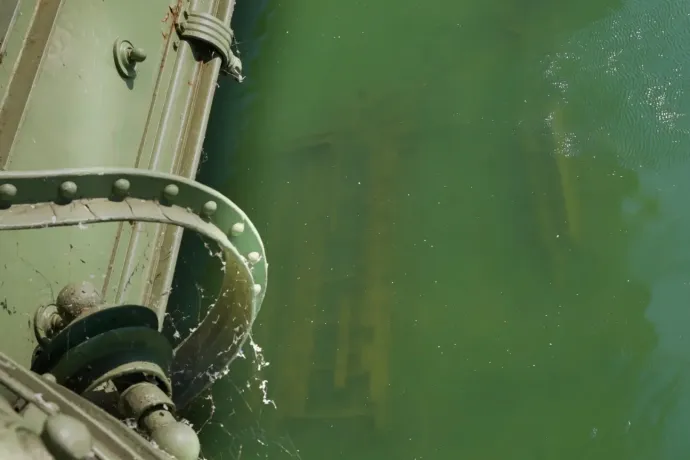
If those walking across the Szabadság Bridge during this period look down at the severely depleted river, they’ll be greeted by an interesting sight: the remains of the former Ferenc József Bridge are now visible in the river. This bridge was the predecessor to today’s Szabadság Bridge, and was blown up by the German forces during World War II (or was it? More on that a bit later).
Although the Soviets cleared away most of the rubble toward the end of the war, a few pieces of the bridge were left at the bottom of the Danube, parallel to the current bridge.
This is not the first time the remains of the old bridge have become visible: the water level of the Danube was very low in 2018 as well—though not as low as now-the lowest point then was 32 centimeters, but the remains of the Franz Joseph Bridge could still be seen emerging from the water.
At the time of its construction, this was Budapest’s third bridge; the Art Nouveau style structure was completed in 1896 as part of the Millennium World Fair and was adorned with turuls (a Hungarian mythical bird) and the Hungarian coat of arms. It was named after Emperor Franz Joseph, who also inaugurated it and personally hammered the final silver nail into the structure.
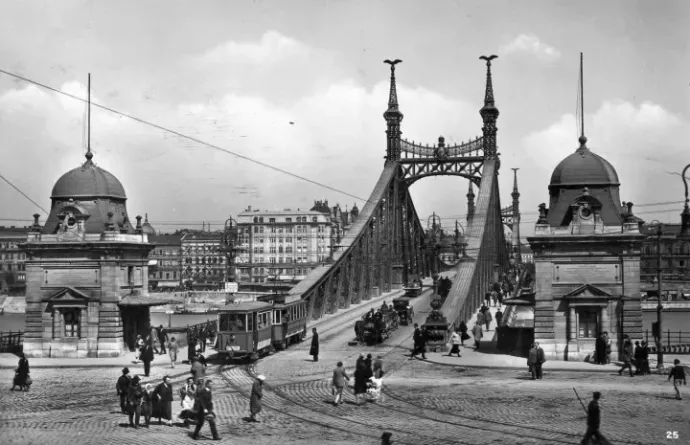
The bridge was blown up in January 1945, 49 years after its construction. The popular belief is that it was destroyed by retreating German troops, but historian Krisztián Ungváry says that this is not at all certain; this may have been the narrative pushed by postwar Hungarian and Soviet propaganda, given that the Soviet military leadership also had an interest in having the bridge blown up—so much so that Stalin himself actually issued the order for the destruction of the Budapest bridges.
At 10:15 p.m. on January 16, the 9th SS Mountain Corps sent a telegram stating that the Franz Joseph Bridge had been destroyed in a bombing raid. Previous attacks had already damaged its deck, but crossing still remained possible. The bridge was ultimately destroyed because a Soviet mortar shell—not an aerial bomb—triggered the explosive charge previously installed on it by German troops.
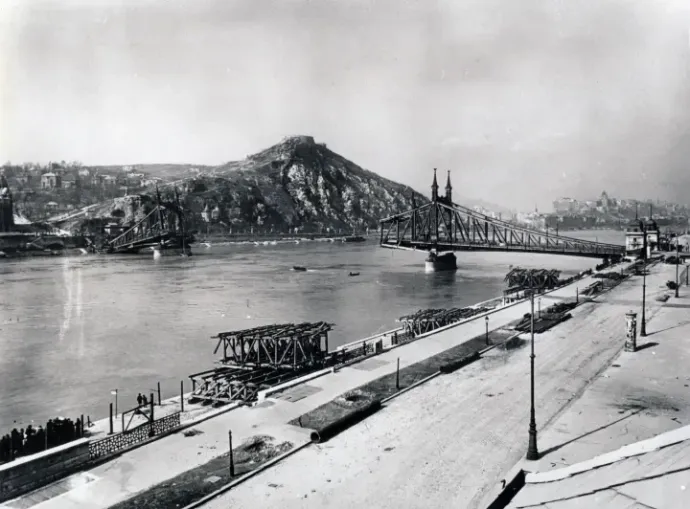
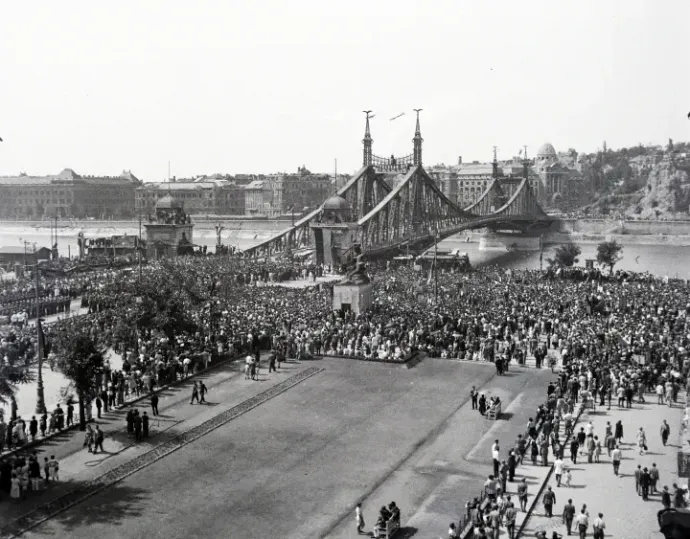
The river swallowed up almost the entire central span, with the riverbank abutments also sustaining damage. The war was still raging when the Soviets started dismantling the unusable remains of the structure and built a pontoon bridge on top of the ruins. This was destroyed by drifting ice in January 1945. When the construction of the new Szabadság Bridge started, they used the remaining, still usable structural elements of the previous bridge. This ended up being the first bridge to be rebuilt across the Danube after World War II. Work began in the summer of 1946, and the bridge was opened to the public on August 20 of the same year.
The so-called Rock of Poverty is actually located quite close to today’s Szabadság Bridge; This rock only becomes visible when the Danube’s water level is very low—hence its name. It may be that the remains of the Ferenc József Bridge will soon be added to the list of landmarks signaling drought.
It’s worth mentioning that the part of Gellért Hill facing the Danube today is the result of human intervention; in the past, the river stretched all the way to the base of the cliffs and kept eroding the unstable hillside. According to the Dunai Szigetek blog, landslides were quite common, and as a result, huge boulders would end up scattered across the riverbed. One of these cliffs is the Ínség Cliff, but there are plenty more: one of them, a roughly 60-meter-long rocky ridge located to the southwest of Szabadság Bridge has a visible impact on the river’s flow patterns. If one looks out from the bridge in that direction, one can often see the funnels of massive whirlpools here.
The remnants of the Ferenc József Bridge have been examined using sonar, and the images clearly show the location of the pile of debris relative to the Szabadság Bridge. A significant portion of the wreckage is now covered up by a layer of sediment, but a small part still protrudes from the river’s sludge, offering a great photo opportunity for anyone passing by.
For more quick, accurate, and impartial news from and about Hungary, subscribe to the Telex English newsletter!