For big shows, the members of Queen always wore white. What they'd wear to their Budapest concert was a no-brainer
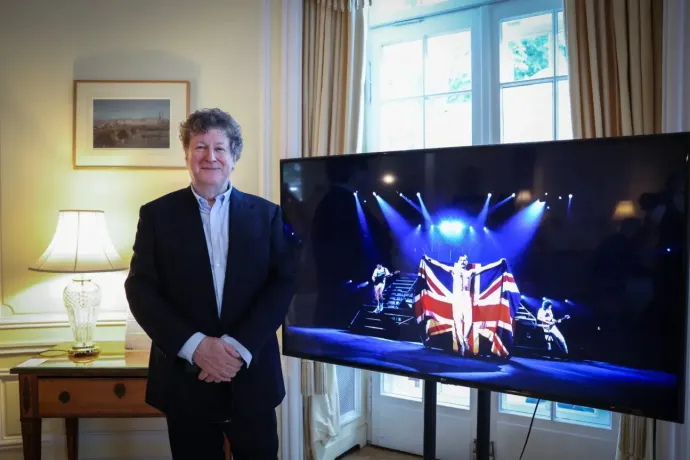


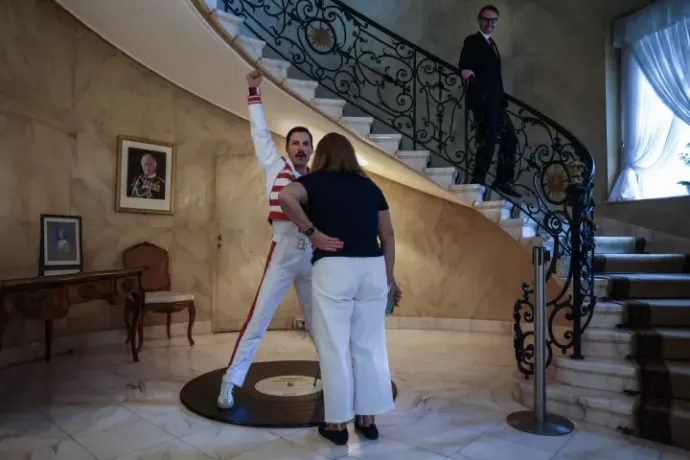
“I won’t be a rock star—I will be a legend,” Hungarian Foreign Minister Anita Orbán recalled Freddie Mercury’s famous statement forty years after Queen burst through the Iron Curtain and took Budapest's Népstadion (today’s Puskás Arena) by storm. To mark the 40th anniversary of the band’s 1986 concert in Budapest, a few days before the event’s July 27 anniversary, British Ambassador Justin McKenzie Smith gathered figures from the Hungarian cultural and diplomatic communities at his residence. The event featured an exhibition of Denis O’Regan’s archival photos taken during the band’s tour, and the photographer himself was also in attendance, along with Peter Freestone, Freddie Mercury’s onetime personal assistant and confidant. Sitting at the Buda residence, it was easy to be struck by just how much the world has changed in forty years. The event, which in 1986 was a surreal meeting of the desire for freedom, the Eastern Bloc, and Western rock ’n’ roll, was now the theme of a diplomatic reception.
Guests were guided through the photos by their author, Denis O’Regan himself, who was the guest of honor at the event. O’Regan’s life has been completely intertwined with Queen; he photographed them throughout their 1986 Magic Tour, and, as he shared with us, the very first photograph he ever sold was also taken of the band.
This wasn’t his first time in Hungary; he has visited Budapest several times, in various eras. Because of this, by the time of the Queen concert in ’86, he had a solid reference point which allowed him to really see the cracks in the Iron Curtain: “The first time I visited Budapest was in 1974, when the country was still very much behind the Iron Curtain. Then I was here again in 1978 as part of Eddy Grant’s entourage, and later with Queen. So I was able to observe the changes between 1974 and 1986. One of the most striking differences was that there were so many non-Russian cars on the road by then. Previously, it was all Ladas and Trabants. “As for Queen, the very fact that the country even invited the band meant it was opening its doors to the West. Hungary opened up much earlier and more widely than other countries behind the Iron Curtain,” O’Regan recalled.
Although at the time, the Western media often wrote about the rigid nature of the Socialist Bloc, the band and its entourage didn’t notice any of that during their visit:
“We were told that everyone was being followed by secret agents, but I didn’t notice any of that. We stayed at a hotel and went wherever we wanted.”
While at the other European stops of the Magic Tour, the opening acts were well-established rock bands, in Hungary, the legendary British band was preceded by a joint performance of the Hungarian band Zizi Labor and the Veresegyház Women’s Choir. “There we were, and suddenly these ladies walked into the room to have a few pictures taken. We just looked at each other, thinking, ‘Okay…’ Freddie stood there surrounded by these elderly women dressed in traditional folk costumes, with a handmade doll in his hands. It was a pretty strange situation—we were all a little embarrassed—but at the same time, it was an incredibly sweet moment. The ladies didn’t really know what to make of this British rock band either, and the band had also never seen anything like it. But that’s exactly what made it wonderful, because something like that couldn’t have happened in any other country on that tour,” O’Regan recalled.
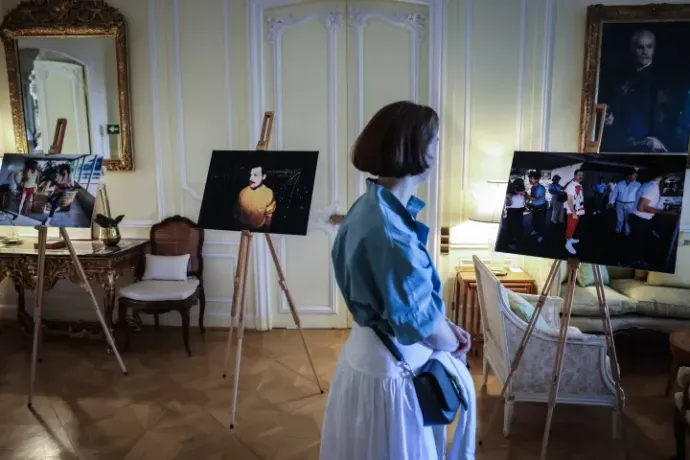
Pausing in front of a photo of Freddie singing to the crowd in Budapest, Peter Freestone recalled an unwritten rule the band followed. “For a big show, the members of Queen always wore white. When it came to their Budapest concert, what they’d wear was a no-brainer.” According to his former assistant, Freddie Mercury was a completely different person offstage compared to his onstage persona, but the moment the spotlight hit him, his showman side took over. He recalled that later, when his illness had eroded the singer’s ability to take the stage, it was a clear sign that he was giving up the fight. In July 1986 at Budapest's Népstadion, however, there was still nothing threatening his reign.
Denis O’Regan’s photos have a very distinctive documentary power. When I mentioned that his consecutive shots looked eerily similar, he smiled and simply said that when it comes to good rock photography, no two moments are ever the same. “I was never interested in staged poses, but rather in what was happening just around him.” This approach demanded the rigorous discipline of the analog era. Professional autofocus cameras didn’t exist yet in ’86, in fact, O’Regan himself ended up receiving the first test model from the manufacturer a year later, in 1987. Everything had to be put into focus manually on the stage at Népstadion. “If you weren’t able to anticipate his movements, you’d miss the moment. Someone like Freddie Mercury, who kept running around in circles… Well, he definitely made our job a lot harder.”
The band stayed at the Hotel Duna Intercontinental (today's Marriott) on the Danube Promenade, and Freddie Mercury was given the presidential suite on the top floor, which had a terrace offering a panoramic view of the entire Danube riverfront right below. Roger Taylor’s birthday happened to be during their time in Hungary, and the band celebrated on that very terrace. (It was also on this terrace that Freddie famously rehearsed singing the Hungarian folk song “Tavaszi szél.”) Denis recalled that when the band's drummer first stepped into the singer’s suite, he couldn’t help but comment—with a touch of envy—on the difference in the size of their rooms; Mercury retorted with a touch of socialist irony unusual for him: “Roger, in the Hungarian People’s Republic, all suites are equal!” to which Taylor countered with a reference to Orwell's classic, Animal Farm saying that the frontman’s suite was, nevertheless, more equal.
At the end of the evening I chatted with the members of the tribute band Don’t Stop The Queen, who performed in the garden, about how a good British song never has two completely identical choruses—they always tweak the instrumentation or the delivery of the recurring themes a little. This seems to be some kind of a British fixation. During our conversation, the musicians confidently remarked that there’s practically no Queen song they don’t know. To which I quickly fired back: “Do you know ‘Barcelona’ by heart, too?”—after all, that album really captured Freddie Mercury’s multifaceted personality and his ability to cross between musical genres.
In the end, we agreed that unlocking the entire Queen catalog and performing it accurately requires an enormous amount of work. The members of the tribute band are also quite firm in their opinion that you can’t talk about Queen solely in light of Mercury’s persona. Without Brian May’s unique guitar sound and songwriting ideas, along with Roger Taylor’s business acumen, there would have been no Queen—it’s also thanks to the latter that they were later able to breathe new life into the band by bringing in Adam Lambert—a development members of the tribute band are somewhat ambivalent about.
The most stylish moment of the evening came toward the end of their set, when the band surprised both Peter Freestone and Denis O’Regan with a crate of official Queen beer. It was especially touching to see the seasoned British photographer holding his phone up high to film the Hungarian tribute band during “Don’t Stop Me Now"-as if he hadn’t heard this song a million times over the past four decades. Denis is clearly the kind of guy who could listen to Queen hits for another thousand years, and in that regard, he’s perfectly in sync with the Hungarian audience.
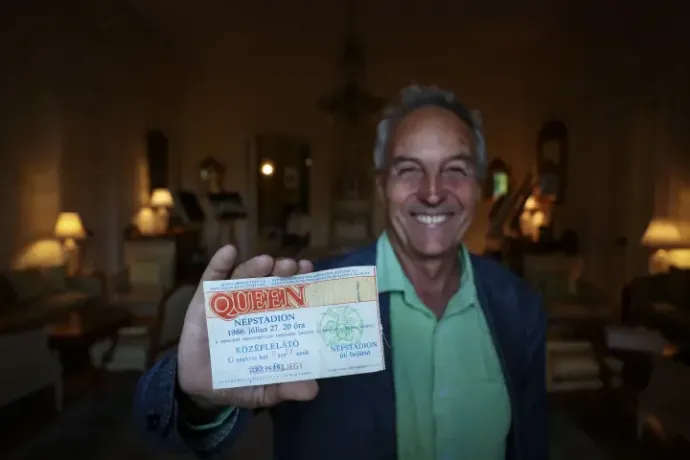
Four decades later, it is clear that the 1986 concert is more than just a part of pop history. Almost every Hungarian family has its own set of legends surrounding it. Even today, many people still treasure the little piece of paper they paid a few hundred forints for—a ticket which, back then, took weeks of scheming and bartering to obtain. My father, for example, scraped together the money for the ticket by buying and selling adult magazines he’d gotten from under the counter. Of course, even the black market wasn’t a guarantee for everything, and this kind of trade didn’t always work out, but accessing culture during socialism could certainly include some surreal steps.
This was the Hungarian reality Queen had stepped into. From this perspective, the iconic scene of Freddie asking whether the parliament building was for sale, when spotting the scaffolded building during their cruise on the Danube isn’t all that surprising. The parliament, of course, hasn’t been sold since then, but those few days in ’86 without doubt thoroughly shook the Hungarian system. Not only because the world’s biggest band at the time had come to Budapest, but also because they gave the audience an experience unlike anything seen here before. The film documenting the band's performance has also become a great classic, so it is no wonder that its remastered version will be screened worldwide in honour of the 40th anniversary. Denis O’Regan’s photos of Freddie Mercury and several other pop icons are currently on display at the Hungarian House of Music, and an exhibition featuring memorabilia from Queen’s Budapest concert is set to open on August 4.
For more quick, accurate and impartial news from and about Hungary, subscribe to the Telex English newsletter!