Russian secret service targets ambitious young Hungarians
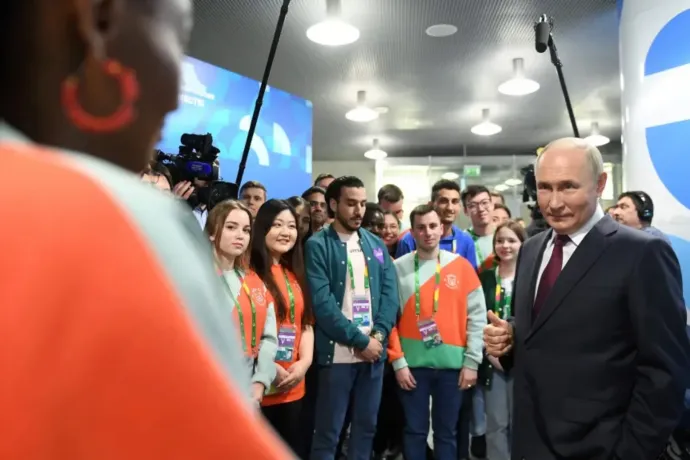

Early last year, a young university student applied for a job with a Hungarian government body. To secure the position, they had to undergo a national security screening; however, the student initially failed to disclose to the authorities that they maintained close, friendly ties with a Russian diplomat accredited to Budapest. As Telex has learnt from sources familiar with the Russian methods and the case in question, the relationship was uncovered, the diplomat is suspected of working for the Russian secret service, and a youth festival in Russia, where other young Hungarians have also been invited is also part of the scheme.
The case highlights that the Russian secret service is targeting talented and ambitious Hungarian university students as part of a well-structured, long-term strategy. The aim is to gradually build up a network within Hungarian and EU decision-making circles that works in Moscow’s interests.
Alexander V., the helpful third secretary at the embassy
We understand that the investigation revealed that the young university student was secretly in contact with Alexander V., a diplomat holding the post of third secretary at the Russian Embassy in Budapest, who is suspected of working for the Russian intelligence agency, the SVR. The Russian diplomat not only helped the young university student with their studies and smoothed the way for their career, but also specifically encouraged the student to apply for the post. However, he insisted that the student keep their relationship secret during the vetting process.
The university student was eventually caught out and ended up disclosing the relationship with the Russian diplomat to those conducting the vetting process and did not get the job. Although the case came to light, Alexander V. suffered no adverse consequences as a result, nor was he expelled from the country, even though the network responsible for recruitment remains active: they are already in the midst of organising the event in Russia to which only young Hungarians who have already been vetted by Russian intelligence in Budapest will be allowed to travel.
We have learned that the Hungarian university student who failed the vetting process was a member of the 20-strong delegation of young Hungarians who were able to participate in the World Youth Festival held in Sochi, Russia, in March 2024. The tone of this event is openly built around anti-Western rhetoric and is aimed primarily at young people from developing countries, Latin America, Africa and Asia, with the message that Russia is the leader of a more just, multipolar world that respects traditional values. The festival recruits young people – including aspiring politicians, journalists, researchers, entrepreneurs and civil society leaders – who the Russians believe may become decision-makers in their own countries in 10 to 20 years’ time.
Such large-scale events in Russia, which attract thousands of foreigners, are organised by Rosmolodyozh (the Federal Agency for Youth Affairs) and the Russian Ministry of Foreign Affairs, but the Russian secret services are also present behind the scenes. Detailed information is presumably collected from participants as early as the visa application stage. The Russians are interested in the participants’ political views and career aspirations, while at the festival they assess the participants' susceptibility to influence through digital surveillance and informal activities.
The heads of national delegations attending the festival are often appointed or selected from among those who are loyal to the Russian political narrative and who are willing to cooperate closely with Russian embassies or cultural centres. In this way, the Russian secret service is able to exercise indirect control over the entire delegation.
Roland B., who chose the East and the Russian language
The situation is no different with the Hungarian delegation. The delegation was led by Roland B., a Hungarian man living in Russia who defines himself as a businessman, and who is responsible for recruiting candidates.
Nothing in the life of Roland B., who was born in Hungary, suggested any affinity with Russia; until 2012, he had no ties whatsoever to the country. He later explained this change of direction on his own blog by saying that he had never been one to follow the crowd – so whilst his contemporaries were turning towards the West, he chose the East and the Russian language after a friendly meeting-about which he failed to disclose anything more specific.
His language studies quickly turned into a career, and he soon ended up in Moscow. By 2013, Roland B. was already honing his language skills at the Pushkin Institute, and a year later he was admitted to the Russian Presidential Academy. This is not merely a university: it is the foremost incubator for Russia’s administrative and political elite, with regular visits from ministers, regional governors and heads of state-owned conglomerates, whilst the organisation also plays a key role in networking and in programmes designed to build up foreign elites.
This was not the first time Roland B. had shown his organisational skills, as he had already set up a Facebook group in 2012 to promote the Russian language. An important milestone in his career came in 2019, when he founded his one-man consultancy firm, Matrix Monitoring, in Moscow.
As far as we know, at the very least by then, he may well have come to the attention of the Hungarian counter-intelligence services, but it does not appear as though he encountered any particular obstacles. Indeed, judging by his posts on Facebook, the Orbán government’s policy towards Russia may even have worked in his favour. Last December, for example, he took part in the business forum of the Hungarian–Russian Intergovernmental Committee on Economic Cooperation in Moscow, where the former Minister of Foreign Affairs and Trade, Péter Szijjártó was also a guest. Roland B. commented on this on Facebook as follows: “At present, our country is the only EU Member State conducting such a bilateral economic dialogue with Russia.”
His social media posts also suggest that Roland B. has access to the Russian Embassy in Budapest. He organised the trip for the young Hungarians who attended the Sochi festival in March 2024, and acted as head of the delegation. This delegation included the young Hungarian whom Alexander V. later encouraged to apply for a government post subject to national security screening – as well as to conceal their relationship during the vetting process.
The talent spotter
Within the network, Roland B. appears to have the role of talent spotter; at least, all the evidence points to that. In intelligence jargon, a spotter is an agent who is part of the network and is used for a specific, targeted task. Spotters do not recruit people themselves, nor do they carry out direct intelligence gathering; rather, they identify potential candidates within their circle who hold positions of value to the service, have access to classified information, or can be blackmailed or won over.
Thanks to Roland B.’s arrangements, Alexander V. did not only meet the young person who failed the security screening, but also made contact with the other members of the delegation in Sochi. By this point, Russian intelligence likely had relatively accurate information about each of them. The reason for this is simple: the applicants had applied for the visas required for their trip via the Russian Embassy in Budapest, and the Russian secret services had already carried out preliminary screening during the registration process. They knew what political views the applicants held, what their career aspirations were, and were also able to gauge how easily they could be influenced or swayed. Consequently, only those whom the Russians considered promising were selected for the delegation from the outset.
Furthermore, the Wi-Fi networks and accreditation systems used at the festival venues all provide Russian intelligence agencies with the opportunity to monitor foreign guests’ digital devices, collect data or even install spyware.
During the festival, Russian secret service agents assess the young people’s personalities, weaknesses and sympathies through casual conversations and informal-style events. They do not necessarily recruit only traditional spies, but also opinion leaders (journalists, influencers, activists) who, upon returning home, spread Russian narratives in the local media and on social media platforms for free or in exchange for covert support. Young leaders from Western countries or states of strategic importance, in particular, are considered prime targets for future collaboration or recruitment as agents.
The festival where new horizons opened up
“It was one of the most significant events of our lives! These few days were a truly brilliant blend of new knowledge, connections and, of course, wonderful experiences. Thanks to the Festival, new horizons have opened up for us on a global scale,” said Roland B. in a statement to the Russian state news agency TASS, which devoted a special report to the Hungarian delegation.
The report also reveals that, at the end of the festival, Roland B. and the other participants attended a meeting with Russian President Vladimir Putin before travelling to Kazan as part of the regional programme, where young representatives from various countries were received by the head of Tatarstan, Rustam Minnikhanov. “A few other members of the Hungarian delegation also visited St Petersburg, Volgograd, Nizhny Novgorod, Salekhard and Petropavlovsk-Kamchatsky,” the news agency reported.
Alexander V. also met the members of the Hungarian delegation that travelled to Russia in March 2024. The Russian man turned up at various events, met the Hungarians and befriended them. Then, not long afterwards, in May 2024, he came to Budapest, but this time as a diplomat under consular cover. It was then that he deepened his friendship with the young individual who later – partly at his encouragement – attempted to secure a position at one of the state agencies. He probably singled the student out because it had by then become apparent that this person was aspiring to a career that could be of use to Russian intelligence.
To our knowledge, the man is still on the staff of the Russian Embassy. Similarly, Roland B., a key supporter of the network living in Russia, is also active.
This is demonstrated not only by Roland B.’s presence on social media and the fact that, drawing on his extensive Eurasian network, he has sought to link leading Hungarian universities with foreign educational institutions and establish some form of contractual cooperation, but also by the fact that he is once again promoting the same festival in Russia. Because the Russians are organising the event again in September, this time in Yekaterinburg. Several young Hungarians have reportedly already signed up for the gathering.
We have contacted Roland B. about this matter and have sent him several questions, but he has not replied.
For more quick, accurate and impartial news from and about Hungary, subscribe to the Telex English newsletter!