“Gentlemen, you’re doing everything wrong”—Europe’s biggest Mercedes plant opens in Kecskemét
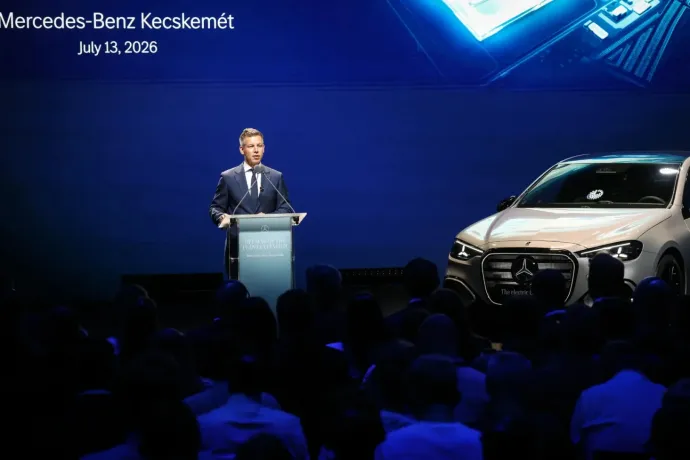


Ten years after negotiations about the project first began and four years after construction started, the second production unit at Mercedes’ Kecskemét plant was officially inaugurated on Monday, July 13. This expansion doubled the plant’s capacity, making it the second-largest Mercedes plant in the world and the biggest in Europe.
The plant will manufacture several different models, such as A-Class and GLB vehicles. Most importantly, however, it will produce the electric C-Class—one of Mercedes’ most popular cars—which, following a transition, will be manufactured exclusively here in Kecskemét.
The event was attended by Prime Minister Péter Magyar, Minister of Economy István Kapitány, State Secretary for Foreign Economic Relations Judit Zolnay, the Tisza Party's local MPs, and Mercedes executives. Among them was Ola Källenius, Mercedes’ global CEO, with whom Magyar had already test-driven one of the cars manufactured here prior to the ceremony.
Before the ceremony began, journalists and guests were ushered into a section of one of the factory’s buildings which had been cordoned off with black curtains, so we could initially see almost nothing of our surroundings. It wasn’t until after the ceremony that the curtains were lifted, allowing us to see that we were in the middle of a massive production hall.
Péter Magyar: Hungarian workers should be respected
“Sehr geehrte Damen und Herren”—Péter Magyar began his speech in German, greeting the ladies and gentlemen present. He then briefly continued in German, highlighting the close ties between the German and Hungarian economies and the prominent role of German companies in the Hungarian economy. Magyar continued with an anecdote about how the Hungarian engineer Béla Barényi began his job interview at Mercedes by saying, “Gentlemen, you’re doing everything wrong.” Legend has it that he then went on to explain everything that was wrong with Mercedes’ models at the time in great detail. The company hired Barényi on the spot and set about implementing his recommendations, most of which had to do with passenger safety.
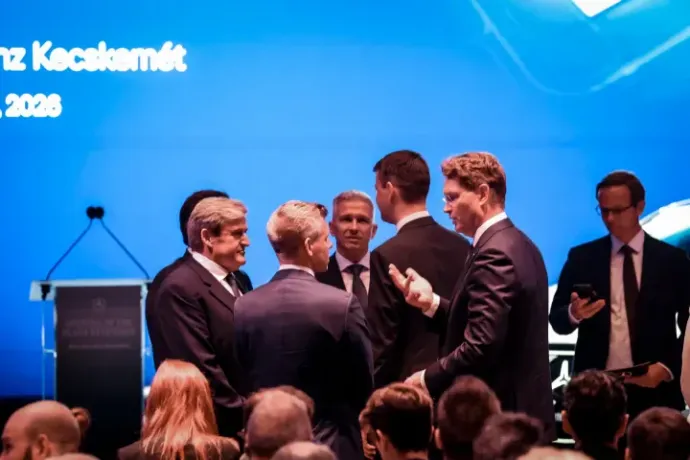
In his speech, Magyar emphasized that Mercedes had spent one billion euros on expanding this plant, thus doubling its capacity. With this expansion, the Kecskemét plant will be the second-largest Mercedes plant in the world and the largest one in Europe. According to Magyar, this expansion proves that Hungary is capable of hosting industrial investments of strategic importance. “Our country is ready to provide a predictable environment for foreign companies investing here,” Magyar said, listing at length how Hungary can contribute to this primarily through a competitive tax system, a skilled workforce, and an environment that supports innovation. He added, however, that there is another side to this: “The new Hungarian government expects everyone to follow the rules and respect the Hungarian workforce,” he said.
“We will create an environment that is beneficial for everyone,” Magyar said. According to him, the goal is for Hungarian small and medium-sized enterprises to be able to grow and thereby become higher-level suppliers to foreign companies such as Mercedes. He primarily considers the presence of foreign companies in Hungary as important so that Hungarians can learn from them—whether it be technical expertise, management skills, or expanding their business networks.
According to the Prime Minister, the next Béla Barényi may already be in the Hungarian higher education system, and he only needs to be recruited so he can contribute to major technological advances at the company. He therefore encouraged Mercedes to hire as many young Hungarians as possible for the plant’s second unit.
Mercedes executives emphasize flexibility
On behalf of the company, Swedish CEO Ola Källenius thanked all their Hungarian partners for the successful collaboration. He noted that today’s opening was made possible by the deep trust that has developed between Mercedes and Hungary since the opening of the first plant. Källenius also mentioned that this trust extends to Péter Magyar, who had already test-driven one of their cars manufactured in Kecskemét before the opening.
The newly commissioned plant will primarily manufacture electric C-Class models, but the production lines will be adaptable for manufacturing hybrid vehicles as well. In his speech, Källenius emphasized that the decision to base the production of this important and popular model in Hungary was influenced by the fact that some of its components—such as the batteries—are also manufactured here. Although he did not say so explicitly, according to previously published reports, the newly opened plant will primarily use batteries manufactured by CATL in Debrecen.
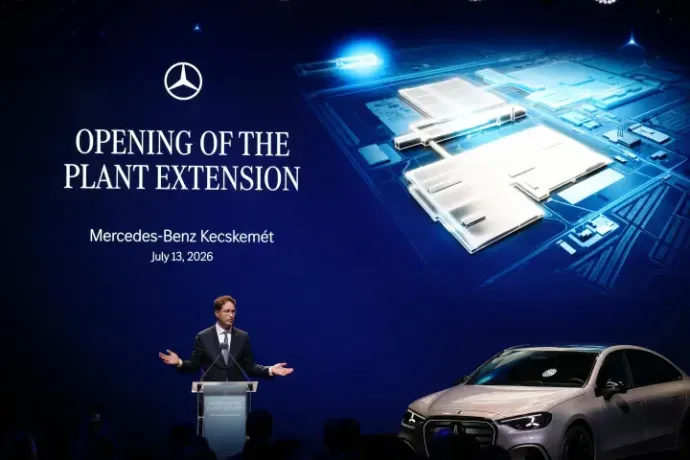
Källenius noted that competition has intensified all over the world in recent years, with technological advancements, manufacturing costs, and flexibility becoming increasingly important factors. He believes that in this context, Hungary is a very good manufacturing location, though he did not add that this is primarily because wages are lower and labor regulations are more flexible here than in Germany.
Michael Schiebe, a member of the Board of management of Mercedes-Benz AG also emphasized flexibility in his remarks, noting that the Hungarian saying “fából vaskarika” (literally, “an iron hoop made of wood”) aptly describes Hungary, as it reflects the fact that Hungarians are often able to solve problems that initially seem insurmountable. He also spoke about how seriously they take the role of the local community: they are collaborating with the local János Neumann University, and they have a separate preschool for the children of their own employees.
Mercedes opened its first plant in Kecskemét in 2012, and negotiations between the company and the plant about its expansion began just a few years later. The expansion was finally announced in 2018, but construction of the new units had not yet begun at that time. The project was temporarily put on hold during the coronavirus pandemic and redesigned so that the new facility could produce electric and hybrid cars instead of internal combustion engine models. The new production halls were built between 2022 and 2025, with production set to begin this year.
For more quick, accurate, and impartial news from and about Hungary, subscribe to the Telex English newsletter!