Magyar in Vienna: Hungary will apply the polluter pays principle with regard to the asbestos contamination
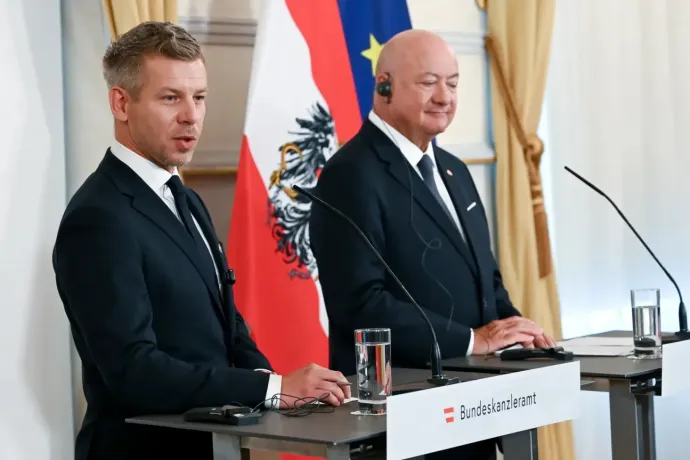


Similarly to Warsaw, Péter Magyar was greeted with a military salute at Vienna’s Ballhausplatz, in front of the Office of the Chancellor of Austria. The Hungarian Prime Minister and his delegation, consisting of several ministers, arrived in the Austrian capital in the early hours of the morning from Gdańsk, Poland. Foreign Minister Anita Orbán, Minister of Transport and Investment Dávid Vitézy, Minister of Energy and Economy István Kapitány, and Minister for the Living Environment László Gajdos accompanied the Hungarian head of government on this leg of his first international trip since taking office.
After holding talks with Chancellor Christian Stocker, the two leaders held a joint press briefing addressing the currently most pressing topics between the two countries, among others the asbestos contamination in some Western Hungarian regions due to aggregates sourced from Austrian mines, questions related to transportation, special taxes, and diversification.
Stocker: We are stronger together
Stocker started by asserting that he was confident that there will be progress ade in the cooperation between the two countries. According to him, the results of the Hungarian election have great significance beyond Hungary’s borders too, as they show that a large majority of Hungarians rejected isolationism and have opted for a civic approach. “This is good for Austria and good for Hungary,” the chancellor said.
The Chancellor said that Hungary’s special taxes were also discussed, which they see as discriminatory against Austrian companies. He would like to see these challenges resolved, as it would foster trust, which requires dialogue.
“We are stronger together when we act as a region,”
and in order to achieve results, it is necessary to forge a partnership and to more vigorously exploit shared opportunities with neighboring countries.
According to the Chancellor, as a region the two two countries will be able to make their voices heard more loudly in Brussels too. He also spoke about the importance of improving competitiveness, a key aspect of which is that “we will not become dependent on anyone.”
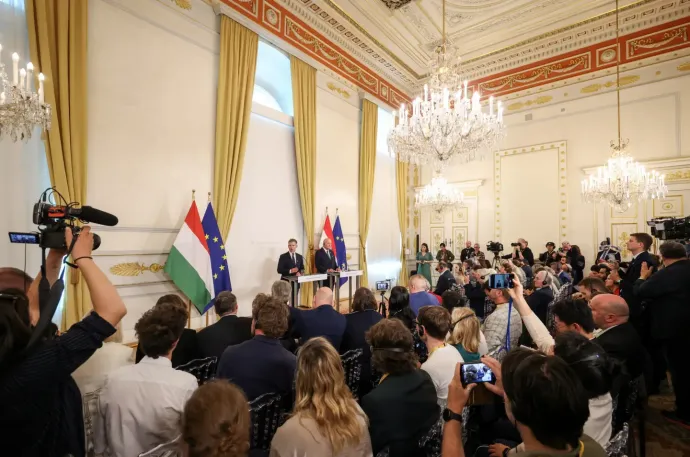
Stocker said that European unity is now more important than ever before, particularly in light of the war between Russia and Ukraine and the opening of the Strait of Hormuz. “Both Hungary and Austria are committed to the European Union,” the Chancellor said. In his view, both countries support EU enlargement, and it is time for the Union to honor its prior commitments to candidate countries. “It is important, however, that there is no fast lane, and there are no shortcuts”, he added.
Christian Stocker spoke about the fact that Austria and Hungary are cooperating on managing refugee policy, and said he considers it a positive sign that it’s been a long time since the number of asylum seekers in Austria has been as low as it is right now.
He briefly touched on the issue of asbestos-contaminated aggregates from some Burgenland mines which were sold in Hungary. He said that they support the creation of a working group to address the matter. According to Stocker, they agreed to launch joint projects with Hungary, though he did not elaborate on what these might be. The Chancellor added that there may also be a joint government meeting later this year.
Magyar: Austria and Hungary can resolve any issue together
Péter Magyar began by thanking Christian Stocker for his invitation in German, then continued in Hungarian. The Hungarian Prime Minister said he was pleased that the Chancellor had shown him the room where Count Gyula Andrássy had once worked. “The room is more modern now, but it is in good hands; I am glad that the spirit of Gyula Andrássy is here with us.” According to Magyar,
Andrássy’s legacy is proof that Austria and Hungary can resolve any issue together.
“Vienna, much like Budapest, sends the message that these two nations are capable of great things when they work together, help one another, and collaborate,” he said. According to Magyar, the time has come for a more peaceful, mutually supportive era to dawn in Hungary's relationship with others. They agreed to hold joint government meetings with the Austrians in the future, and extended an invitation to the Austrians for such a meeting at the Grassalkovich Palace in Gödöllő in September. Magyar said that the ministers of the two countries had also coordinated on specific matters, but he did not elaborate on what these were.
"Austria and Hungary won’t always be in agreement on everything, but that’s not a problem", he said, since we have shared interests, even though we see the world differently on certain issues. Hungary will be a constructive member of the European Council and the Council of Ministers; there will be disagreements, but Budapest will also respect the "interests of the club". He thanked Stocker for his support in “bringing EU funds home,” and spoke about the importance of the fight against corruption, restarting the economy, and stabilizing the budget.
Péter Magyar said that developing shared infrastructure was also a topic of discussion today: in his view, there is a great deal that needs to be developed. Under the previous government, there was much debate between the two countries on the issue of transport, but Magyar said that a more fruitful phase is set to begin between the two nations in this area as well. They would welcome the development of the Budapest-Vienna railway line, as well as the extension of the Győr-Sopron highway into Austria. The Prime Minister thanked the Chancellor for their help in eliminating the repeatedly recurring border checks, which would make life easier for the tens of thousands of Hungarians who commute to Austria for work. He promised Stocker that no illegal refugees would come from Hungary in their direction.
With regard to the asbestos contamination in western Hungary, Magyar said that while it is unclear how many municipalities are affected, the number of people impacted could run into the thousands. He thanked Stocker for his flexibility and assistance, noting that “there is no room for evasion here; we need complete transparency and openness,” and said that joint efforts are required. The joint committee tasked with this issue will begin its work on Monday, when environmental, health, and legal experts will be traveling from Hungary to Austria.
According to Magyar, in one Hungarian community, asbestos contamination is 300 times higher than allowed, even though there were previously no related illnesses in the area. It was recently found that for years, five Austrian mines have been extracting rocks containing asbestos, which have entered commercial circulation and were then sold in Hungary. It is unclear to Magyar how this could have happened, and he said that these cases must be thoroughly investigated. One such mine is still operating in Austria, but it is crucial that no asbestos-containing rocks be allowed to enter commercial circulation. Hungary has begun conducting a survey on the situation, and starting Monday, they will be working together with their Austrian partners. Remediation needs to be fast, “no matter the cost". According to the PM, in the end, Hungary will expect the polluter to pay, regardless of whether it’s a company or the government. Perhaps this case will serve as a model for how effectively the two countries can resolve difficult issues.
Magyar: The polluter should pay
In his answer to a question on the same subject, Stocker said that the province of Burgenland is responsible for the asbestos issue. He said that mines where the limit was exceeded have already been closed. He confirmed the establishment of a joint task force to ensure the exchange of information, which will meet for the first time on Monday.
According to Stocker, the fact that there is no mandatory limit for natural asbestos at the EU level does not simplify matters. “People’s health on both sides of the border” is the most important thing though, he added.
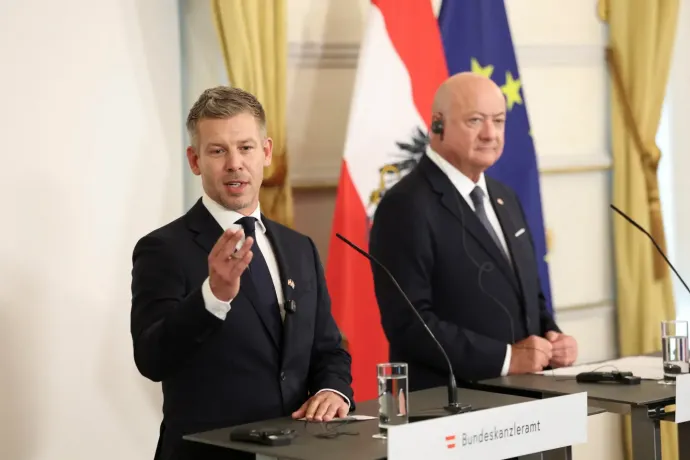
Magyar stressed that he and the Chancellor had had a frank conversation; every contentious issue was discussed, which is how it should be. Friendship is based on honesty, and they will always lay all problems on the table. Magyar is a bit skeptical about the joint committee, but he was promised that they would be provided with all information, such as who in which official body was aware of this and whether there is a corruption angle to the case. He noted that unfortunately, “the intertwining of corruption and politics is not a problem unique to Hungary.”
The Polluter Pays Principle is an international rule, and there will be no debate on this, Magyar said. He hopes that as little compensation as possible will have to be paid and that there will be no health-related damages. He doesn't expect this matter to cast a shadow over the joint work of the two countries.
On the European Green Deal and Europe’s competitiveness
The two politicians were also asked about the European Green Deal, which Stocker believes undermines competitiveness. At the same time, the Chancellor stressed that “we are committed to the fight against climate change,” but they do not want to abandon common sense. They already get more than 90 percent of their energy from renewables and do not purchase natural gas or crude oil from Russia. He pointed out that there are thirty billion euros going to the US to fund innovation annually, while that money might as well stay here, in Europe instead.
On the same subject, Magyar said that Europe has not been in a good position in terms of competitiveness for the past 5–6 years, but the energy crisis is putting European companies at an even bigger disadvantage. “We must do everything we can to ensure that the continent” is energy-independent and can supply itself from multiple sources, he said.
He gave an example: if a greengrocer wants to sell apples and sources them from four different suppliers, they can be sure they’ll be able to get the apples even in the event of a conflict. This would also allow them to get them more cheaply because such a setup forces suppliers to compete on the price.
In his view, Europe has made many mistakes, including in relation to environmental protection, by setting limits that were too high—these were standards we could not expect other global players to meet.
As a result, many have moved their manufacturing operations elsewhere. Europe was late in recognising this. We must fight climate change, which is clearly visible in Hungary as well, because of the effects of the drought. Hungary will do everything in its power to help Europe regain its competitiveness,” the Prime Minister concluded.
Following his meeting with Chancellor Christian Stocker, Péter Magyar will meet with Austrian President Alexander van der Bellen, after which he will have lunch with high-ranking representatives of Austrian companies operating in Hungary. The Hungarian delegation is expected to return to Hungary by train this afternoon.
For more quick, accurate and impartial news from and about Hungary, subscribe to the Telex English newsletter!