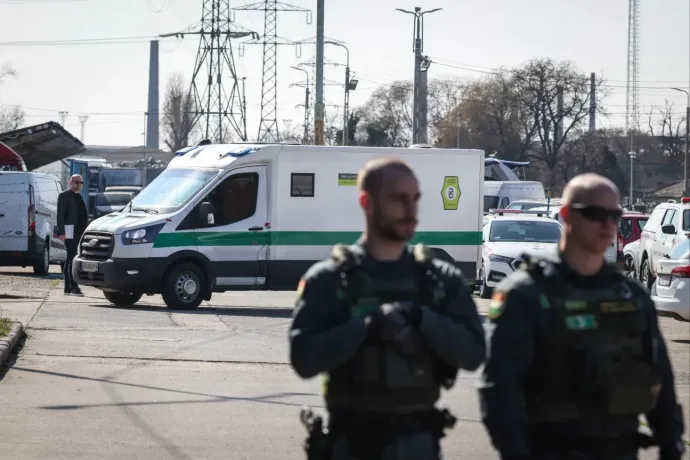


“On April 27, 2026, the Metropolitan Investigative Prosecutor’s Office ordered an investigation into the crime of the unlawful detention of seven Ukrainian
individuals, based on reports of unlawful detention and other criminal offenses ,” Dr. Lóránt Horváth, legal representative of the seven persons affected in the seizure of the cash-in-transit vehicles of Ukrainian Oschadbank wrote on Wednesday.
In the statement, the representative of the Ukrainian parties writes that the seven individuals were transported to the facility of the Counter-Terrorism Unit unit and “the apprehension and detention of said individuals between 1:00 PM on March 5, 2026, and 6:15 PM on March 6, 2026, is unclear in regard to procedural law,
but it can be established that they were subject to coercive measures restricting their personal liberty; they were kept in handcuffs and blindfolds for 29 hours, and one of them had to undergo life-saving medical treatment.”
The complaint was filed against an unknown party, and it is argued that in investigating the suspicion of abuse of office, not only must an evaluation be made of the conduct of the individuals who carried out the measures in question, but also of “the entire institutional and decision-making chain involved in ordering, executing, and supervising the arrest and seizure of property.”
The complaint also noted that the individuals concerned had continuously sought legal assistance from the moment of their arrest, which, in their view, they were denied on the grounds that no authorized legal representative had appeared, and that their country's consular service had refused to provide assistance.
On March 5, members of Hungary's special Counter-Terrorism Center (TEK) apprehended seven Ukrainian citizens and seized gold and foreign currency worth more than 27 billion forints from their vehicles. According to the prosecutor's office, they acted in response to a tip-off. The lawyer for the Ukrainian cash couriers later said at a press conference that to their knowledge, only members of the Counter-Terrorism Center (TEK) were present during the raid—contrary to the official report—and that the National Tax and Customs Administration (NAV) only initiated proceedings in the case later.
The Ukrainians’ lawyer, the legal representative of Ukraine's Oschadbank, which was the intended recipient of the funds, and Raiffeisen Bank of Austria, which had sent the money, there was nothing unusual about the shipment that the cash couriers intended to transport from Austria to Ukraine.
A few days after the seizure, the Hungarian government and its propaganda machine began claiming that there was a problem with the shipment, that it may have been linked to a money laundering scheme, and that the money might be linked to the financing of the Tisza Party—but to date, no evidence has been presented to support these accusations and insinuations. On March 10, the government issued a decree stating that “the legal ownership of the assets seized in the Ukrainian money transport vehicles could not be clarified on site.”
Adrienn Laczó, a partner at the law firm Dr. Lóránt Horváth Legal Office, which is defending the money transporters, previously told Telex: the Ukrainian money transporters were led away by Hungarian authorities in handcuffs and blindfolded.
For more quick, accurate and impartial news from and about Hungary, subscribe to the Telex English newsletter!