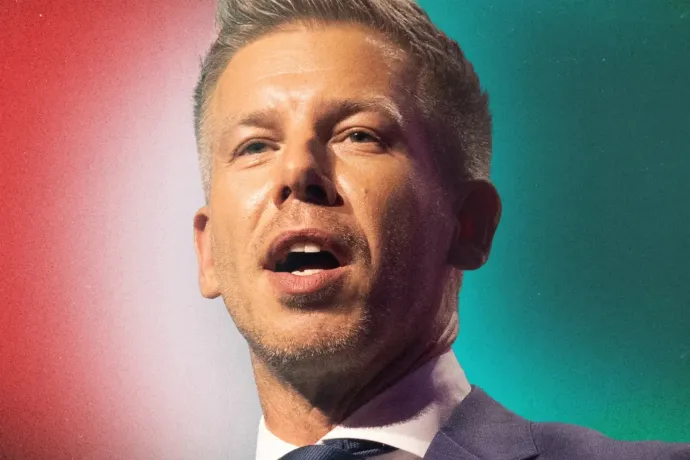


More Hungarian voters than ever before turned out to cast their ballots on Sunday and decided to entrust Péter Magyar with leading the country. The Tisza Party, founded just two years ago, received more than 50 percent of the vote, while Fidesz, led by Viktor Orbán, garnered less than 40 percent.
By 6:30 p.m. on election day, 76.88 percent of eligible voters had cast their ballots—a turnout higher than at any election since the first free elections in 1990. Although analysts had previously believed that a high turnout was favourable to Fidesz, this assumption has been proven wrong. Turnout was already breaking records early in the day, and the constituencies where analysts had predicted an advantage for the Tisza Party were the most active.
As things stand, the Tisza Party has won 95 of the 106 single-member districts, while Fidesz candidates have won in 11. The Tisza Party is expected to hold 138 seats in the National Assembly—no party has ever won this many seats since Hungary's transition to democracy. Fidesz representatives are expected to receive 54 seats; the final number of seats will be determined after mail-in ballots and votes cast abroad are tallied in the coming days. In addition to the two major parties, Mi Hazánk also entered parliament with seven representatives. DK received slightly more than one percent of the vote, while the Hungarian Two-Tailed Dog Party received less than one percent.
During the campaign, Péter Magyar promised that if he won, the country would undergo not just a change of government, but a regime change.
“Starting on April 13, Hungary will be a democratic state governed by the rule of law. A democracy, but not an illiberal one, not a restricted one, not a hybrid one, not a populist one—simply a democratic state, governed by the rule of law”.
– he said Saturday evening when closing their campaign in Debrecen. He promised that if he receives a two-thirds majority, the country will have a new constitution following public consultation, which will be ratified by a referendum. From the Tisza Party’s programme, he highlighted that immediately after the election, they would introduce a wealth tax on billionaires, join the European Public Prosecutor’s Office, reform pensions, and open the files on secret agents and the clemency case. He also promised to initiate an investigation against Péter Szijjártó.
Péter Magyar entered the Hungarian public eye on February 10, 2024, with a Facebook post. The immediate context of his post was the resignation of President Katalin Novák and Magyar's ex-wife, former Justice Minister Judit Varga, over the clemency case. Magyar wrote that he had resigned from all his positions in state-owned companies because he did not want to be part of a system in which “those who are truly responsible hide behind women’s skirts
The following evening, he gave a long interview to an online platform in which he openly criticized Viktor Orbán’s system. Millions of people watched the interview. A month later, on one of Hungary's biggest national holidays, March 15, Magyar held his first political rally, which drew a bigger crowd than Viktor Orbán’s commemorative speech on the same day.I t was then that he announced the launch of a political movement called Talpra Magyarok. Then, ahead of the 2024 EP elections, he took over the Tisza Party; and in the election, barely six months after he emerged on the political scene, the Tisza Party won nearly 30 percent of the vote and finished as the second-strongest party behind Fidesz.
In April 2024, Magyar set out on his first nationwide tour and, with only minor interruptions, has been on the road until the campaign ended on Saturday. By his own account, he visited more than 700 towns and villages, some of them as many as six times. His popularity grew steadily. According to opinion polls, the Tisza Party first took the lead from Fidesz on October 23, 2024, and since then the gap between the two parties has widened almost without interruption. The most recent polls showed the party with a two-thirds majority, or a lead close to that.
The 16 years of the System of National Cooperation
It was 20 years ago that Fidesz first lost an election; in the 2006 parliamentary election, the Hungarian Socialist Party (MSZP) received 1.2 percentage points more votes, but after the Öszöd speech was made public, Fidesz won the fall municipal elections in 2006.
In the 2010 election, Fidesz-KDNP received a two-thirds majority, and they have managed to maintain this in every election since then. Following the victory in 2010, Viktor Orbán announced the establishment of the System of National Cooperation, and during their first term, they drafted a new Fundamental Law, reformed the electoral system, the media law, and other key regulations. The government launched a policy of the Eastern Opening, and at the end of their first term, they signed a contract with Russia to expand the Paks nuclear power plant.
At the beginning of the next term, Viktor Orbán announced that instead of building a liberal democracy, he intends to build an illiberal state in Hungary. More and more businessmen with close ties to Fidesz began to dominate public procurements, and the ruling parties also established a media empire, which they used to disseminate the government’s messages with ever greater effectiveness. The system was solidified after the 2018 two-thirds majority, and following the failure of the opposition coalition in 2022, many lost hope that Viktor Orbán’s system could be replaced through elections within the current framework. Viktor Orbán has repeatedly stated that he plans to remain at the helm of the country until 2030, after which the party’s younger generation may have an opportunity to take over.
In recent months, however, he has been more cautious in his wording, and in several speeches he has even raised the possibility that Fidesz might not win the election.
Difficult years ahead Both Péter Magyar and Viktor Orbán emphasized during the campaign that even if they win, difficult years await Hungary. At the last event of the Tisza campaign on Saturday, Magyar spoke of how the next government would inherit an empty state treasury, a ruined budget, and questionable contracts. Viktor Orbán, on the other hand, attributed the coming difficult years to external challenges, stating that the country would face them even if he won.
Magyar also noted that if the Tisza Party wins, part of the country will be disappointed by the result. He emphasized that we must reach out to them, because if Hungarians turn against one another and divisions persist, our homeland could be lost.
For more quick, accurate and impartial news from and about Hungary, subscribe to the Telex English newsletter!