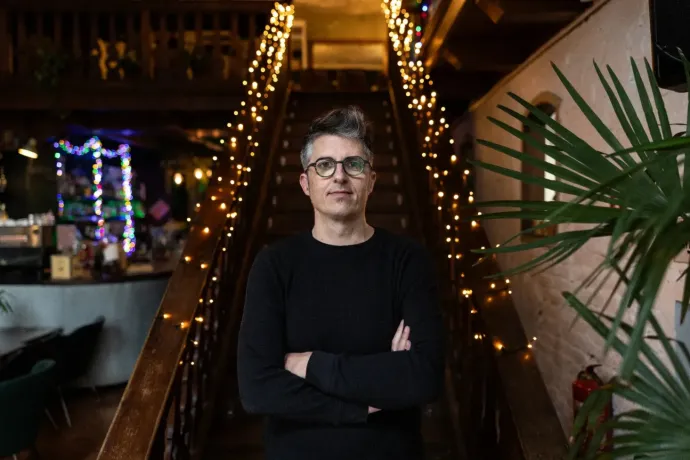


Jehan Paumero is a Frenchman from Pécs. When he first arrived in Hungary, Puskás Öcsi (the Hungarian football legend) was still alive, and we were not yet members of the European Union. Right from the start, he found the country's quirks amusing, so he decided to stay. When he turned forty, he felt it was time to write down everything he had learned about us Hungarians over the past two decades. He documented his observations in Hungarian, and borrowed the title of his book from a statement made by Loïc Nego, a French-born player on the Hungarian national soccer team.
We spoke with the author of My Homeland and My Home – who also plays the accordion for the band Psycho Mutants – about nightlife in Pécs, the city's positive energy, and the invisible network of connections among its residents. We discussed pogácsa with chocolate, transgenerational trauma, identity, and how long Hungarian politics has been bothering him. He admits that being caught between two countries and two cultures is not easy, but believes that running away is never the solution. And he says that the people of Hungary are better than they think they are.
In your book, you recount that at the beginning of your second year here, when you looked out of the window of your rented apartment, Pécs seemed to you like an aging woman. What does the city look like now, 21 years later, in the winter of 2025?
It has had a small facelift since then. Some things suit it well, others less so, but it is still beautiful. However, it is noticeable that there are 50-60,000 less people living here than at the turn of the millennium. The crisis hit us exactly in the year when Pécs was the European Capital of Culture. Many people moved to London, Munich, and Vienna around 2010, because they couldn't secure their livelihoods otherwise. I know many people who said goodbye to the city at that time, but neither of them was happy to leave the heart of Baranya (the county Pécs is located in -TN) behind.
How did it make you feel that the city had shrunk so much?
In the context of the European Capital of Culture, it was particularly striking how the character of Pécs changed. We were spoiled in 2010, with one great cultural programme after another, but even then it was clear that the concept was flawed.
In that flood of events, everyone from concert fans to lovers of puppet theater or dance could find something to their liking, but less energy was devoted to building a sustainable model for the future. I was a member of the organizing team, so I saw it from the inside that these wonderful initiatives would not have a follow-up. It soon became clear that, despite the completion of the Zsolnay Quarter, there was still no plan that would ensure its long-term operation.
Until 2010, Pécs was a big city, and the ECC programs reinforced this image, but then the city shrank dramatically. I had a pretty rough time in the four or five years that followed, when my favorite clubs, cafes, and pubs closed down, but the good vibes have recently started to return to Pécs. For a while, organizing concerts for weekday evenings was unimaginable, but it is now once again possible to sell 60-70 tickets for a foreign band's gig.
All those who stayed here want Pécs to be a better place, and young people are beginning to recognise the assets of the city. They are not running away, but are trying to make a life for themselves here, and their ideas have clearly shaken up Pécs.
You arrived in 2003, before (the legendary local band – TN) 30Y had released any albums, but Zoli Beck and his bandmates were already touring intensively.
I first saw them at the Sörház in 2004, before their first album was released, and we quickly became friends. But Mitsoura and Besh o droM were also among my first concert experiences at the Pécs University Club.
Did you find out about these concerts from Pécsi Est?
For years, I stayed informed through Pécsi Est, and I tried to decipher Balázs Gróf's comics with the help of a dictionary, but there were so many subtleties and local jokes in them that I didn't understand them at all for a long time.
You came to Pécs at the age of 22 without knowing the language. How long did it take you to find your place here?
It didn't take long. The pace of life was much faster than I had expected, and I made lots of acquaintances, friends, and met many supportive people in a short time. Back then, the night never seemed to end. We would sit down somewhere just to be together, without any particular plans for the evening. The bartender or owner would usually let us stay past closing time, and then the sun would suddenly come up and we would find ourselves at the market.
People from all walks of life and with all kinds of interests would gather at these parties. Everyone knew someone from somewhere, and it wasn't uncommon for die-hard rockers to end up at one of the electronic music nights at the TV tower just so they could finish the debate they had started with someone over a glass of beer. Of course, our friends who were fans of electronic music didn't miss the concerts of Gallon Drunk from London, Messer Chups from St. Petersburg, or Fishbone from Los Angeles. To this day, I feel that there is a kind of invisible network among the people who live here.
Your eyes lit up as you recalled your first years here, and nostalgia is an important theme in your book as well. However, you don't really write about whether you ever felt nostalgic for France.
I did miss France, especially during my first year in Pécs. I say "first" because at the time it looked like it would be my only year here, since the Comenius scholarship that brought me here to teach French at a local high school was only for one school year. During the first three or four months, I missed my friends very much – my family less so, but I think that's perfectly normal when you're in your twenties. Although the parties in Pécs were great, I would wonder from time to time what I was missing out on back home. I also missed French cuisine, because a kifli is not a croissant, and on occasion I would put chocolate chips in my pogácsa.
I think chocolate pogácsa expresses my nostalgia for France quite well.
For a long time, I didn't think about the extent to which I was French or Hungarian. But when I started writing this book, I asked myself that question, and it wasn't an easy one to answer. For a while, I thought of myself as a Frenchman living in Hungary. Then I realized that it wasn't that simple, because during the two decades I've spent here, being from Pécs has become part of my identity.
Of course, the Hungarian language still frustrates me sometimes, because no matter how well I have learned Hungarian, in many cases I cannot express myself as colourfully as I would like to. Around 2020, I also began to notice that my French was getting rusty. My vocabulary isn't quite there, and there are some expressions and concepts that I only know in Hungarian. I had stopped putting chocolate in my pogácsa by then, but of course I miss people even more than I miss words.
I would like to show you an excerpt from a poem. The author is Roberto Bolaño, (whom Mercédesz Kutasy translated into Hungarian), and this is how the text begins: "I was twenty years old at the time / and foolish / I lost a country / but I gained a dream. / And if I have the dream, / nothing else matters." It seems that several elements of this introduction resonate with your story. The dream can be identified with Pécs, but now that there is no more chocolate in the pogácsa, how do you stand on the issue of having lost your homeland?
France today is not the same country I grew up in. On average, I go home about once a year and I usually only stay for a week, so I spend very little time there, but I feel that everything has changed a lot. Cashiers have disappeared from stores, the post office has become fully automated, and you can't take care of your banking matters in person either, only online or by phone. The village pubs, which used to play a key role in people's social lives, have closed down. In addition, important economic players have bought TV channels and newspapers, so the media reports in accordance with the interests of the owners.
Such things are not unheard of in our country either. In the chapter entitled It annoys me, you write about the Hungarian prime minister and the ruling party. When did politics start to annoy you?
I have long been interested in politics, both in the French and the Hungarian context. I should add that it was good for me not to concern myself with it for a few years after I arrived here. I didn't follow events here for quite some time, mainly because I didn't speak Hungarian well enough, but it has been terrible to see how politics has driven a wedge between groups of friends and family members in Hungary over the past decade and a half.
I have vivid memories of Fidesz's 2006 campaign. It was because the slogan "Work, home, family" was identical to the motto used by Nazi France under Marshal Pétain. I was curious to see if anyone would bring this up in the debates leading up to the election, but to my knowledge, no one addressed the parallel at the time.
After 2010, the reform of the electoral system and the abolition of the second round of voting already raised red flags for me, as did the other significant reforms that the government rushed to pass at the beginning of its rule. Then, when Népszabadság was shut down in 2016, I once again felt that something was wrong. Admittedly, by then French newspapers had long been referring to Hungary as a dictatorship, which then still seemed like an exaggeration to me. However, during the 2018 campaign, which was based on enemy stereotypes and fearmongering, it became clear to me that Fidesz was playing a very dangerous game. And Trump's re-election as president of the United States only emboldened Orbán even more.
In My Homeland and My Home, you write that despite the actions of both the Orbán government and the Trump administration, you still feel at home in Hungary. Could politics become radicalised enough to make you move away?
Fleeing is not a solution, so it is never a real option for me. I don't have a vote here, which means I don't have the means to influence big politics, but I do have a responsibility to ensure that by getting to know each other, talking to each other and engaging in debate, we contribute to making Hungary a better place in the future. That's why I don't see myself moving away from Pécs anytime soon.
Was there ever a time when you felt you should leave?
I thought about it a few years ago, but to be honest, I don't know where we could go, because populism is now a global trend.
You have been living in Hungary for 22 years now. During that time, not only have you learned the language well enough to write your first book in Hungarian, but the chapters of My Homeland and My Home convinced me that you also have a thorough understanding of the mentality, the preferences and even the way of thinking of the people here. After all these years, can this country still surprise you in any way?
It might not surprise me anymore, but I regularly come across things that make me laugh out loud, because I am sure that something like this could only happen in Hungary. I am amused by the country's quirks, and my sense of freedom is also due to the fact that regulations are interpreted quite loosely here. In France, on the other hand, everything is overregulated. My father is familiar with all the regulations, and when I try to do things the Hungarian way, he usually points out that it's not allowed. Most recently, he pointed out that I would be fined for driving in slippers. I believed him that this rule really exists in France, so I changed out of my slippers for his sake.
In one of the first chapters of the book, you mention that you started it as a form of therapy. Why did you need to start therapy?
I felt like I was floating between two countries, two cultures, but I didn't really belong anywhere. It was my 40th birthday, and I was going through some kind of midlife crisis, plus I was burned out in my work, and writing offered a solution to all of that. It was a joy to be able to immerse myself in it.
Was it a given that you would write in Hungarian?
On the 18th anniversary of my move to Hungary, I published a post on Facebook about my experiences here. I received a lot of feedback on that. It evoked feelings of nostalgia in many of my friends, and as the reactions poured in, more and more memories started coming back to me. I decided to keep writing, and although I didn't think it would ever become a book, the next day when I went to Reggeli (a restaurant in Pécs) for breakfast, I knew I would continue to write the story.
I was afraid that if I didn't record my first two decades in Hungary, I would forget everything I had experienced here. As for why in Hungarian? My experiences came back to me in Hungarian, and from then on it was clear that the soundtrack to my time here was in Hungarian.
Have you thought about translating the text into French?
Actually, that's what I'm currently working on, because I want my family members to understand it too, but it's difficult because there are many expressions for which I cannot find a French equivalent, or even anything similar. So for now, the text is somewhat bland.
Will you only show it to your family when it's finished?
Yes, because I don't think there would be much demand for it in France. Besides, My Homeland and My Home is about Hungarians and for Hungarians. It has always bothered me that you, Hungarians, focus on the negative and don't recognize your own good qualities. I wanted to show that the people of this country are better than how they see themselves. This book is a confession, or rather a love letter to Hungary and its people.
You have been playing in the band Psycho Mutants since 2005, and in the book you say that there is no better experience than writing songs and performing them live. In comparison, writing follows a completely different dynamic, the feedback is more delayed, and the creative process is also more solitary. What has writing given you?
Neither the band nor the book were created for the sake of success. To this day, we play to bring joy to ourselves and our audience, whether there are fifty or a thousand people that came to hear us. I experienced essentially the same thing with the book, although, as you say, the rhythm is completely different. It's great that the book is reaching more and more readers, but for me, it's just as important that I enjoyed writing it. I've actually missed it since I finished it.
You just said that My Homeland and My Home is a love letter, but while reading it, I kept thinking that this book could also serve as a diary for your son, Leo. If I'm not mistaken, fatherhood has perhaps been the most important milestone since your arrival here.
Exactly. For years after moving to Hungary, I kept saying that I had things to take care of, so I would spend another year in Pécs. When my son was born, it became clear that I would stay here. My wife has two older daughters from her previous marriage, and when we got together, it was only natural that I wouldn't take them away from their father. I assured her that I would never do such a thing. And you're right, even when I still thought I was just writing the text for myself, it already occurred to me that I would show it to Leo. I wanted him to understand me better and learn about my past.
Do you consider this important because you don't know your father well?
I know little about my parents, but I don't think I'm alone with that. And yes, that was also a big part of my midlife crisis. There are skeletons in the closet, and it never hurts to let them fall out after a while. I hope that thanks to me writing My Homeland and My Home, my son will have to see a psychologist less often than I did, and he will have less transgenerational trauma in his life.
You mention in the book that reconquering the French language could be your next big commitment.
I would like to write in French. Outlines of an autofictional story are beginning to take shape, but I am still searching for the right voice for it. I'm uncertain, I'm strapped for time, so as much as I'd like to continue writing, I'm putting it off for now.
Yet the chapter titled Discharge Note reveals that your goal with your savings is to take a year off once in your life. How is that project going now?
I haven't been thinking about it much lately, so for now it remains just a plan. I like it when life is busy, so I would probably slip into despair if my days weren't structured. But maybe one day I'll get that year off!