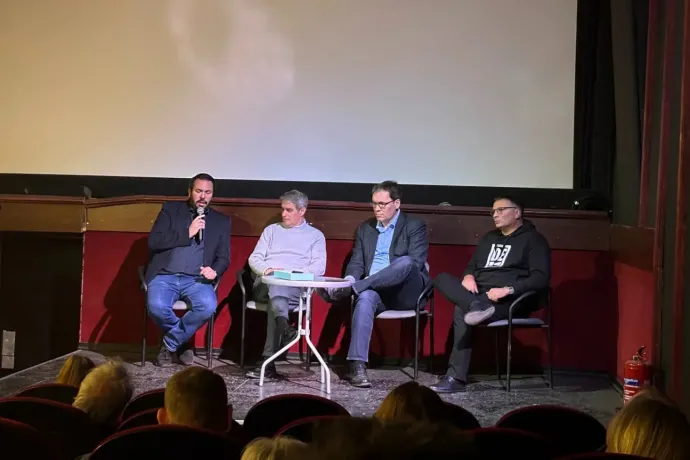


A newly formed non-governmental organisation has published a documentary accusing the Orbán government of repeated, organized vote-buying via intimidation in rural parts of Hungary. The film, which features interviews with former participants in vote-buying schemes, opposition voters living in extreme poverty, as well as mayors and police officers, documents the threats and the vulnerability that have become a daily reality for those living in Hungary's small, rural communities.
The filmmakers from the De! Action Community conducted more than 60 interviews across 10 counties, with the film primarily featuring locations in eastern and northeastern Hungary. They chose these regions because this is where most of the settlements are located where they suspected something amiss upon seeing the results of the last election. What they found suspicious was that in some of the villages featured in the film, Fidesz received 80%-100% of the votes in the last elections.
Filming began in 2025 and lasted until the spring of 2026; it features Áron Tímár, a member of the De! Action Community, and Ádám Tompos, a journalist of Magyar Hang; the latter joined later, after closely following the election at Tiszabura – which featured a multitude of candidates and had to be repeated three times.
It’s not the process that matters, but the intimidation
After the film’s premiere, Áron Tímár said that they had originally wanted to make a film about the phenomenon of buying votes. “It quickly became clear that this wasn’t what this is about. This is about dependency, rooted in vulnerability. Buying votes is just the icing on the cake,” said Tímár. The film does not feature any documented cases of abuse, but the filmmakers point out that based on the accounts of civilians and police officers working in various parts of the country who were interviewed for the film, a similar pattern has emerged across the country in recent years: those living in extreme poverty are intimidated, and a kind of dependency is created, whereby if they do not vote in accordance with the instructions of the mayor or local authorities, they face retaliation. The filmmakers also emphasized that this relationship of dependency is not limited to the Roma population; it is a much more widespread problem.
One interviewee was nearly excluded from the public work programme, while an openly pro-opposition resident with a chronic illness – and clearly in need – and his brother were taken off the list of those receiving state-provided firewood. Still others were threatened with having child protective services called on them and their children removed from the family. “With these threats of removal, the point isn’t whether the procedure actually takes place, but the intimidation, the point is to make one cower, to make them keep their head down,” said Ádám Tompos. In many cases, these steps have proven effective in intimidating voters into voting the way the local leader expects.
We spoke with hundreds of people – people who had never met each other before, who didn’t know one another, and yet they described the same phenomenon – as if they were finishing each other’s sentences. This strongly suggested to us that we were not dealing with isolated incidents, but with a systemic pattern,” Áron Tímár said. This was also confirmed by one of the film’s subjects, Tamás Bod, a journalist for Magyar Narancs, who wrote a lengthy article in early 2026 about how Fidesz was attempting to influence the April parliamentary elections in 53 constituencies through a data collection and mobilization project among the Roma.
Incidentally, the film contains several claims for which the filmmakers provide no tangible evidence; we only hear about them in the accounts of the civilians: one example of this is the claim that buying votes is not only Fidesz's pastime, with some claiming that this was already the case in their village during the Gyurcsány government (between 2004 and 2009), while others mentioned that the opposition coalition also used similar methods in 2022.
The BBC has reached out to government ministers, the communications offices of the government, the interior ministry, and the police to request their reaction to the claims made in the film. The only one to respond so far has been Tibor Navracsics, Minister of Public Administration and Regional Development. He said that: "If there is any wrongdoing, just let the ministry of interior do its job," and declined to comment on specific allegations made in the film.
Recruiting election monitors
Members of De! have said that they believe that those behind the buying of votes set a goal of purchasing approximately 500,000 votes in the April election, and De!’s motivation for making the film is to prevent this from happening. They hope that the film will serve as a deterrent to mayors who resort to retaliation by showing them that more and more people dare to speak out against these abuses, as these cases have so far gone virtually unpunished.
The film was the organization’s first initiative. At the premiere, the creators announced that starting from now until the 12 April election, they will be recruiting volunteers who are willing to go to problematic polling stations and monitor the election from the early morning hours. According to Tímár, there should be at least 10 observers per polling station, because otherwise there is a risk that those trying to monitor the integrity of the election could be verbally, or even physically assaulted.
For more quick, accurate and impartial news from and about Hungary, subscribe to the Telex English newsletter!