


Rather than reducing their dependence on Russian crude oil since the start of the Russian-Ukrainian war, Hungary and Slovakia have instead increased it significantly. This is not surprising, however, because according to a recently published study, Mol and the Hungarian state are cashing in big time from this dependence on Russian crude oil. And, of course, the Russian state – and through it the Russian army bombing Ukraine – are also profiting handsomely. And yet, according to a joint study by the Center for the Study of Democracy (CSD) and the Centre for Research on Energy and Clean Air (CREA), Mol actually has to pay higher transit fees for using the Druzhba oil pipeline connecting Hungary with Russia than for the Croatian Adria pipeline, the price of which Péter Szijjártó and Mol's management have complained about a lot.
Greater dependence = greater profit
A joint study published by the Bulgaria-based Center for the Study of Democracy and the Finland-based Centre for Research on Energy and Clean Air examines the extent to which Hungary and Slovakia have managed to break away from their dependence on Russian oil, as all other European countries have done.
The short answer is that they have not, quite the contrary. In 2022, the EU imposed sanctions on Russia on account of its invasion of Ukraine, which included a ban on EU member states purchasing Russian crude oil. The purpose of this move was to weaken the Russian military machine, which is largely financed by energy exports, and to reduce Russia's economic leverage over European countries. However, Slovakia and Hungary were granted an exemption because the two countries indicated that they would not be able to stop their imports of Russian crude oil overnight. The main reason for this is that both countries are primarily supplied with fuel from Mol’s refineries, which were designed to process Russian Urals crude oil. At the time, Mol said that it would take several years and hundreds of millions of euros of investment to convert its refineries in Százhalombatta and Bratislava in order to be able to process other types of oil. Therefore, these two countries needed more time.
Since then, however, Hungary's dependence has only increased: in 2025, 92 percent of the crude oil used in Hungary came from Russia, while in 2021 this figure was only 61 percent.
In 2025, Hungary purchased 53 percent less non-Russian crude oil than in the previous year. And what is the reason for this decrease? The fact that buying, processing, and selling Russian oil is a huge business for Mol and, through it, for the Hungarian state. Hungary was able to purchase crude oil from Russia at a 20 percent discount, largely because the Russian side was happy to still be able to sell the goods to someone in the West. According to the study, this saved Mol €47.3 million per month, or nearly HUF 18 billion at today's exchange rate, compared to what it would have cost to purchase crude oil through Croatia's Adria pipeline. However, Mol did not pass on the savings to consumers; in fact, in 2024, fuel was 5 percent more expensive in Hungary than the EU average in 2024.
The difference is even more striking when comparing Hungarian prices with those in the Czech Republic, a country in a very similar situation to Hungary. According to the study,
in 2025 Czech drivers were able to buy gasoline 18 percent cheaper and diesel 10 percent cheaper than Hungarians, excluding taxes.
During this period, Mol's revenues increased by more than 30 percent. Through this, organizations with political, ideological, and personal ties to the Orbán government, such as MCC, (Mathias Corvinus Collegium, a heavily government-affiliated educational institution) which received a significant portion of the Hungarian state's Mol shares, also profited greatly. After a while, however, the extra profits from Russian oil ended up directly enriching the Hungarian state, which took them away from the Hungarian oil company in the form of taxes. The Russian state earned even more than Mol in the form of taxes. According to the authors of the study, the Russian state earned €85.8 million per month from taxes on Mol's purchases.
Is the Adria pipeline more expensive?
The Hungarian government usually argues that we are forced to buy oil and natural gas from Russia due to geographical constraints, because as a small landlocked country we are dependent on the pipelines that are available. It was with this logic that Viktor Orbán has also managed to get the United States to grant Hungary an exemption from its sanctions on Russian oil purchases (at least for a while).
However, as energy market experts Attila Holoda and András György Deák explained in an episode of Telex Téma, in contrast to what the government claims, Hungary is not actually dependent on Russian energy imports in either the natural gas or crude oil markets. Hungary has natural gas pipeline connections with all of its neighboring countries except Slovenia, and it has two crude oil pipelines: the Druzhba pipeline and the Adria pipeline, which runs through Croatia. According to Attila Holoda, these two pipelines put Hungary in a rather privileged position in Europe, as most European countries actually have only one pipeline. The aforementioned data clearly shows that Hungary used to purchase much more non-Russian oil than it does now. In other words, it cannot be argued that the country can only be supplied from Russia.
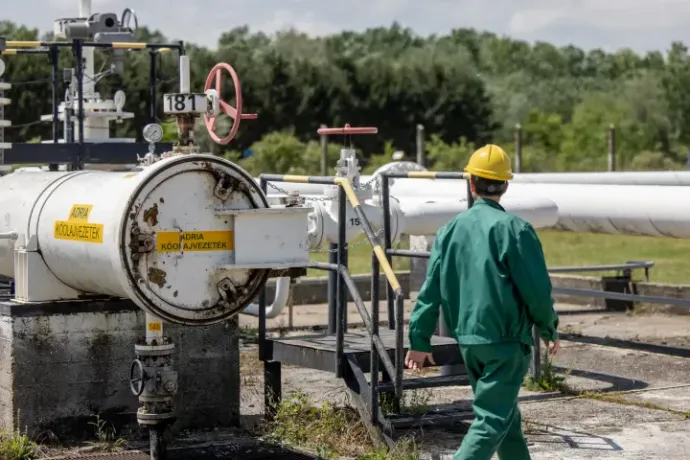
On the other hand, the Hungarian government and Mol have for some time had a dispute with Janaf, the company operating the Croatian pipeline. According to the Hungarian side, there are two reasons why the country's oil supply cannot be resolved via the Adriatic pipeline, which is preventing us from phasing out Russian crude oil:
- the capacity of the Adriatic pipeline is not sufficient to meet Mol's crude oil needs and to enable the company to supply the Slovak and Hungarian markets;
- Janaf is charging excessive transit fees for the use of the pipeline.
According to the CSD and CREA study, however, neither argument is particularly convincing or based on facts. Let's start with the second claim, that the Croatians are asking for excessively high transit fees for the use of the pipeline. What is high and what is not is obviously relative, but according to the study, it is a fact that Mol has to pay almost twice as much, or more precisely 1.7 times more in transit fees for using the Friendship oil pipeline than for the Adria pipeline.
Based on Eurostat data, the authors write that in 2024, a transit fee of €12.22 per tonne had to be paid on the Adria pipeline, while the Ukrainian operator charged €21 per tonne for using the Druzhba pipeline. The Druzhba pipeline also passes through Belarus for a short section, where an additional €2.16 per tonne must be paid. This extra cost is, of course, offset by the fact that Hungary receives a 20 percent discount on the pipeline's content, but in any case, the comparison of transit fees provides a different perspective on which pipeline is cheaper to use and whether the Croatian operator is really charging too much.
With regard to the pipeline's capacity, the authors of the report reference Janaf's September 2025 capacity test, which found that with the addition of lubricants, Adria could transport enough oil to cover Mol's needs. Mol disputes this, and experts who previously commented on the subject to Telex also believed that it might be necessary to expand the pipeline's capacity in order to meet Hungarian demand, although this may not be a sufficient argument against the Adria pipeline.
Until now, Janaf has defended itself by saying that Mol only ordered small quantities on the Adria pipeline, so it received small quantities. András György Deák, a senior research fellow at the John Lukács Institute of the National University of Public Service, previously told Telex that the debate between the Croatian and Hungarian parties regarding capacity is fundamentally theoretical and cannot really be resolved until Mol and Janaf sign a 3-4 year contract and test the pipeline at full capacity. Tamás Plester, an oil and gas analyst at Erste, also previously told Telex that we could only get a clearer picture of the price and costs at which Janaf could transport to Hungary by signing a long-term contract for larger volumes . On the other hand, this would also be an appropriate incentive for the Croatian company to take the necessary steps towards expanding its capacity if Adria's capacity should prove to be insufficient.
Of course, for all this to happen, there would need to be political will on the part of the Hungarian government, which is obviously lacking. The reason for this is perhaps precisely what the study of the two NGOs pointed out: namely, that the Russian deal is profitable enough for both Mol and the Hungarian state for them not to want to give it up, even if the Russian state is earning even more from it than they are, and is using the money to finance its war. In this sense, contrary to the claims of Viktor Orbán and Fidesz, even though it is not participating with weapons, Hungary is actually not staying out of the war, but is participating in it through the purchase of large quantities of crude oil.
Mol reacted to the study as well. They wrote that it betrays a fundamental lack of factual knowledge and is questionable from a professional standpoint in several respects. According to Mol, the conclusions of the study are also flawed, and professionally unsound studies of this kind are not helpful in the current situation. They do not contribute to decisions that promote the security of supply for the region's population. They only create confusion and cause unnecessary concern. This is particularly undesirable at a time when the Druzhba oil pipeline is not operational," they wrote, before listing their objections to the report.
These are as follows:
- It is not true that Mol did not reduce its dependence. Import data does not reveal anything about the upgrading of the refineries and logistical improvements that have taken place.
- It is not true that transportation via the Druzhba pipeline is more expensive. In fact, the opposite is true. Transportation via the Adriatic costs nearly twice as much as via the pipeline in war-torn Ukraine. And it is approximately 4.5 times more expensive than the average European transport price. The transit fee presented in the study did not take into account the obvious fact that the volume is not the only thing to be considered but so is the distance that the oil travels in the pipeline. The Druzhba pipeline is almost three times longer than the Adria pipeline, so the transport fee calculated on the basis of distance is much higher on the Adria pipeline, even with the incorrect figures mentioned in the article, and the ratio of actual transport fees is less favorable than presented. In the case of the Adria pipeline, the oil has to be transported by sea to the Omisalj feed-in point, which is more expensive than transport by pipeline.
- Fuel prices in Hungary are not higher than those in neighboring countries. Mol's wholesale pricing is not based on production costs either. Fuel prices are determined by the regional supply and demand balance and export-import conditions, which are not directly affected by costs. This pricing formula has been approved by both the EU and the Hungarian Competition Authority. Production costs affect Mol's profitability and can divert resources from the company's investments and developments. If the company is unable to process Russian crude oil (see below), this affects fuel prices, as it leads to product shortage and a price increase. According to the January report of the Hungarian Central Statistical Office, fuel prices in Hungary are lower than the average price in neighboring countries, which was also the case throughout 2025.
- The complete loss of Russian crude oil would result in a price increase. This is because it would reduce the amount of locally produced fuel in the region by 5-10 percent, which would then have to be replaced by imports, as both of Mol's refineries are designed for Russian crude oil. Using other types of crude oil would allow them to produce different products and smaller quantities. Additionally, importing gasoline, diesel, and other refined products to a landlocked country is expensive. Increased transportation and other costs would lead to higher fuel prices and a much more fragile market throughout the region.
- It is impossible to know how much the Adria pipeline can transport. There is still no reliable data on the actual condition and capacity of the Croatian section of the Adria pipeline. The study glosses over this issue, but the fact remains that this section of the pipeline has never transported more than 2 million tons per year. Everything else is a speculation, but based on experience to date, it cannot be assumed that Janaf is capable of transporting 14 million tons of crude oil per year, or 40,000 tons per day. The tests conducted so far are not suitable for estimating the long-term, sustainable performance of the pipeline. The capacity of the southern Adria pipeline has not yet been fully tested, so uninterrupted transport cannot be guaranteed. Nevertheless, the European Commission, Hungary, Slovakia, and Croatia have agreed on detailed capacity testing to ensure a secure and predictable supply.
“Mol’s goal remains unchanged: to achieve maximum flexibility and diversification in its refineries and supply chain, while ensuring security of supply, economic interests, and consumer interests under all circumstances. Mol fully complies with EU sanctions regulations, having received an exemption from the EU, which gives it until 2028 to comply. […] The position of the Mol Group is that the issue of energy supply should not be addressed based on short-term political considerations, but rather on long-term security of supply, economic, and technological considerations. The company's objective is not to exclude certain sources, but to secure the region's fuel supply with the greatest possible flexibility," they added.
For more quick, accurate and impartial news from and about Hungary, subscribe to the Telex English newsletter!