

As the 2026 parliamentary election campaign continues, the Tisza Party's lead over the ruling parties shows no sign of diminishing. Péter Magyar's party has an 8 percentage point lead over Fidesz-KDNP among the entire population, and a 10 percentage point lead among those who are certain to vote and already know which party they will vote for, according to a nationally representative survey conducted by the IDEA Institute in early February.
They added that in recent weeks, many people have chosen a party to support, and some of the smaller parties have also benefited from this. If parliamentary elections had been held in early February, a four-party parliament would probably have been formed as both the left-wing Democratic Coalition (DK) and the far-right Mi Hazánk would have reached the 5 percent support level required to set up a parliamentary faction.
The support for TISZA and Fidesz-KNDP has remained essentially unchanged over the past month. If parliamentary elections had been held in Hungary this Sunday, more than a third of the adult population would have voted for the TISZA Party (36 percent) and just over a quarter for the Fidesz-KDNP coalition (28 percent).
Apart from these two parties, there are currently three others that enjoy measurable support: at the beginning of February, 4 percent of the adult population would have voted for DK and for Mi Hazánk respectively, while 3 percent would have voted for the Hungarian Two-Tailed Dog party, MKKP. The number of those who answered “I don’t know/or who gave no answer” fell by 3 percentage points.
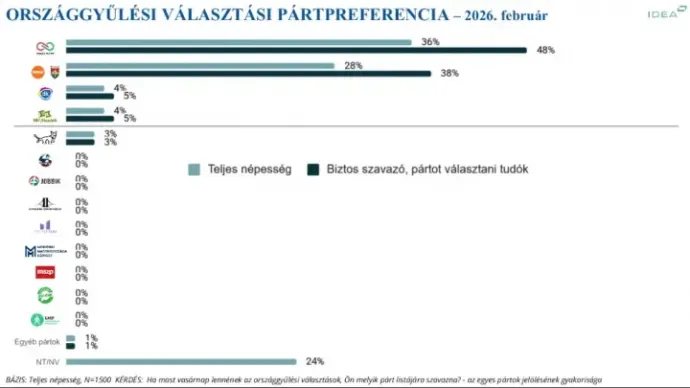
At the beginning of February, almost half (48 percent) of those who were certain to vote and knew which party to choose would have voted for Péter Magyar's party, while 38 percent would have voted for Fidesz–KDNP. However, a notable change compared to previous months is that, for the first time in a long time, the February results predict the formation of a four-party parliament rather than a three-party one. Similarly to previous months, DK's support reached 5 percent in February, while Mi Hazánk also made gains recently, reaching the 5 percent parliamentary threshold for the first time since the summer of 2025.
Methodology:
The IDEA Institute compiled the research data between January 31, 2026, and February 6, 2026, using an online questionnaire.The final results of the study are representative of the country's adult population in terms of educational attainment, age, gender, place of residence, and region. The data collection was carried out across the entire Hungarian internet and social media using query software and a self-administered online questionnaire (CAWI). During weighting, the varying habits of internet and social media use are taken into account, supplementing the weighting procedures that ensure representativeness. The margin of error for the sample of 1,500 is a maximum of ±2.3 percentage points for basic distributions.