Hungarian-born historian who became expert on Lincoln, dies at 86
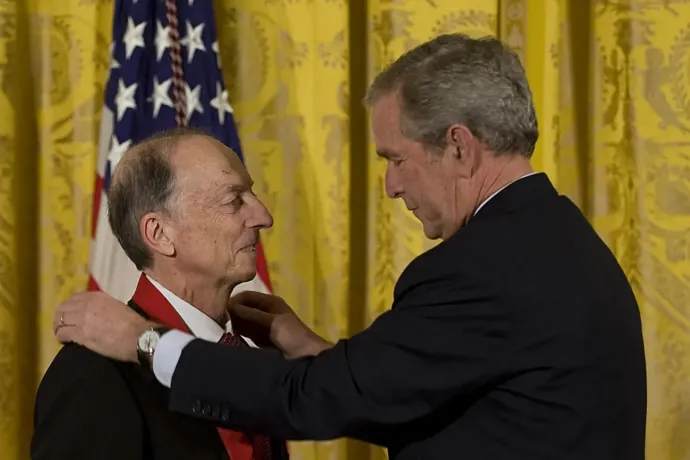


Historian Gabor S. Boritt passed away on February 2 in Chambersburg, Pennsylvania, not far from Gettysburg College, where he taught for decades. He was born in Budapest during World War II. He survived the Holocaust, participated in the 1956 revolution as a teenager, and then arrived in New York in 1957 as a penniless refugee. He went on to earn a doctorate in history and became one of the world's foremost historians on Abraham Lincoln, while his knowledge of the American Civil War was among the most extensive in academia.
From the Budapest ghetto to New York
Boritt was born on January 26, 1940, as the third child of Rózsa and Pál Róth-Szappanos. Until the German occupation of the country the family lived in Budapest's Rózsadomb neighbourhood, and in 1944, they moved to the edge of the Budapest ghetto, at 44 Wesselényi Street. Here, the family found refuge in the room of a school's custodian that had been converted into a temporary hospital. His father spent several months (this was the time when the Nazis started rounding up the Hungarian Jewry and sending them to concentration camps by train) rescuing people from railway stations.
After the war, his father and brother were imprisoned by the pro-Soviet authorities, and his mother died shortly thereafter, so Gábor and his sister were sent to an orphanage. He was a teenager when he took part in the 1956 revolution. According to an article published by The Gettysburg Connection, he joined the crowd that set out to topple the statue of Stalin, and shortly after the revolution was crushed, he managed to leave the country.
He and his sister spent months in an Austrian refugee camp, and later became some of the 40,000 Hungarian refugees accepted into the United States by President Dwight Eisenhower. He arrived in America with just one dollar in his pocket, which his brother had sent to him. It is from here that he had to start over.
Final destination: Gettysburg
Shortly afterwards, his father and brother followed them to the United States. They changed their last name to Boritt, but Gábor kept the prefix S. in memory of Szappanos. For a short time, he worked in a hat factory in New York, then headed west to explore the region that was then widely regarded as "the real America". During his travels, he studied English with the help of a notebook containing Lincoln's writings. The 16th president of the United States ended up remaining with him for the rest of his life.
Six years after arriving in America, he graduated from the University of South Dakota with a degree in history, and in 1968 he received a doctorate in history from Boston University. Shortly thereafter, he served in the US Army in Vietnam, teaching American history to the soldiers stationed there.
Boritt later taught at Harvard, in Michigan, at the University of Washington, in St. Louis, and at the University of Memphis before moving to Gettysburg, the site of the bloodiest battle of the Civil War, in 1981. He lived in a farmhouse built in 1799, which had been owned by a free African American man named Basil Biggs before the Civil War and which served as a Confederate army field hospital during the Battle of Gettysburg.
Boritt founded the Civil War Institute at the local college and was instrumental in the creation of the Lincoln Prize, which includes a $50,000 award each year. He also wrote and edited numerous books on various aspects of Lincoln's life and presidency. In addition to his teaching and academic duties, Boritt also devoted time to giving guided tours on the battlefield at Gettysburg. He guided Nobel Peace Prize winner Elie Wiesel, Charlton Heston, Colin Powell, and President George W. Bush around the site. The latter awarded him the prestigious National Humanities Medal in 2008.
He passed away on February 2 at the age of 86 at a hospice in Chambersburg, Pennsylvania. "He had that immigrant's passion," David Blight, a professor of American history at Yale said of him.
For more quick, accurate and impartial news from and about Hungary, subscribe to the Telex English newsletter!