Hungary remains most corrupt EU state, Transparency International report finds



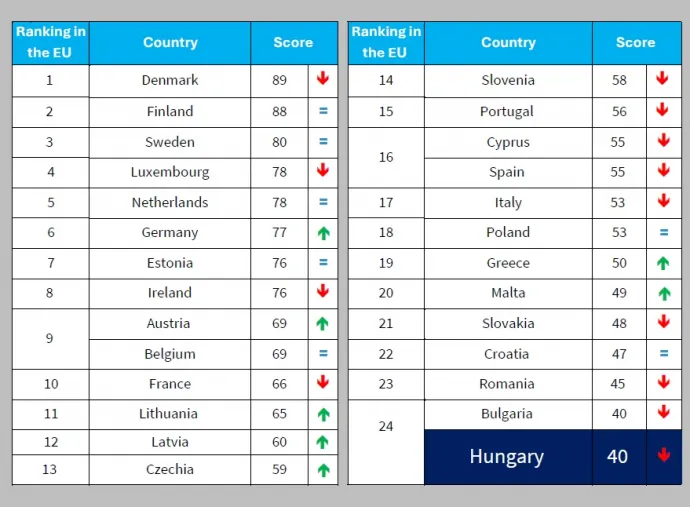
Hungary's score on Transparency International's Corruption Perceptions Index has worsened, according to the organization's latest report. The country is once again at the bottom of the rankings among EU member states this year, although this time we are sharing the last place with Bulgaria. This is the worst ranking Hungary has ever had in the CPI. According to Transparency International, corruption is the main reason why Hungary is now among the worst-performing countries in the EU when it comes to most economic indicators.
This is the 31st time that Transparency International has published its report based on the organization's Corruption Perceptions Index, which ranks countries according to their level of protection against corruption in the public sector. Based on this year's result, businesspeople and experts in Hungary perceive the level of corruption in the public sector to be the same as that in Burkina Faso, Cuba, North Macedonia, or Tanzania, which is not a big change compared to last year's results.
Scoring 40 points, Hungary ranked 84th out of 182 countries, which is two places lower than a year ago. This year, we are again at the bottom of the EU rankings, but this time – as mentioned above – we are not alone, as Bulgaria also scored 40 points. According to TI, Hungary has experienced the most significant decline among EU member states over the past 13 years: between 2012 and 2025, its score measuring resistance to corruption fell by a total of 15 points during this time.
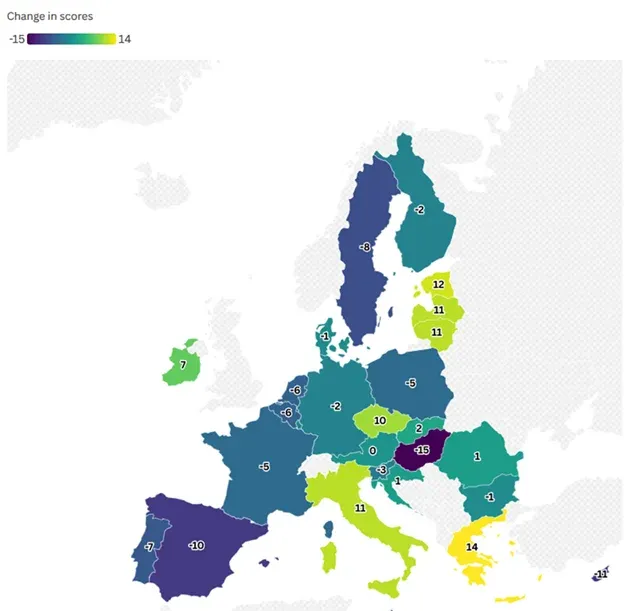
The differences between the countries of the V4 have also widened: while the Czech Republic's score of 59 points is almost 10 points higher than in 2012, Poland's position has stabilized after the change of government in 2023, while Slovakia's has shown a downward trend over the past two years.
No change despite EU pressure
The report also addresses the measures taken by the European Union in recent years aimed at strengthening and restoring the rule of law in Hungary. The most important of these is the conditionality procedure launched in 2022, which includes 27 conditions relating to the rule of law and the fight against corruption. The Hungarian government was supposed to fulfill these conditions, “it has become clear that the proposed reforms have not been able to break systemic corruption or restore the rule of law. This is partly because the government’s centrally orchestrated system of channelling public money into private pockets (known as the National System of Cooperation, or NER in Hungarian) is incompatible with the rule of law.”
According to the organization, the Hungarian government is only interested in legal solutions that do not endanger the preservation of its power.
Transparency examined the rule of law and anti-corruption requirements and concluded that “some requirements cannot break systemic corruption, while the implementation of others is simply being sabotaged by the government.” The organization also analyzed another tool, the recommendations of the EU rule of law reports, and concluded that:
“the government does not protect whistleblowers, does not prosecute high-level corruption, and does not guarantee fair party and campaign financing, leading to the entanglement of party and state.”
According to TI, despite the fact that several milestones in the EU's conditionality procedures were intended to clean up the public procurement system, the sector, which accounts for 5.3 percent of the GDP, remains a hotbed of corruption. Although the proportion of single-bid tenders has slightly declined, the most valuable contracts continue to be won by actors close to the government, such as Lőrinc Mészáros and László Szíjj.
According to the organization, the image of public procurement is further damaged by the widespread use of framework agreements: in 2024, agreements of this type worth HUF 3,219 billion were concluded, two-thirds of which were concluded in a competition-restricting manner, with only one market actor. Opaque private equity funds are also threatening competition in public procurement, given that in these cases, the identity of the ultimate investors remains hidden. The organization views these funds as being inflated by state capital investments through many channels: by the end of 2024, the Hungarian state had invested HUF 1,311 billion in private equity funds – without any guarantees of transparency and accountability.
According to Transparency International's report, the main reason for the poor performance of the Hungarian economy is the dismantling of the rule of law,
while corruption has made Hungary one of the poorest states in the EU. They believe that the turbulent period following Covid has revealed that the Hungarian economy is far more vulnerable than its competitors.
As they say: “The government has undoubtedly achieved results in reducing petty corruption but has used organized corruption as a tool to entrench its power and enrich NER-linked actors. To this end, it has channelled several trillion forints of public money — directly or indirectly — to NER-linked economic actors, severely distorting market conditions. The only way out of the vicious circle of systemic corruption and weak economic performance would be the restoration of the rule of law, which is inconceivable within the framework of the current political regime.”
They also pointed out that, due to rule of law deficiencies, Hungary has permanently lost €1.1 billion from the European Union's cohesion policy financial framework allocated to the country between 2021 and 2027, meaning that only €19.6 billion of the €21.7 billion is now available. A similar risk looms over the Recovery and Resilience Facility (RRF), a fund created in response to the Covid pandemic: if the Hungarian government fails to fully implement the 27 anti-corruption and rule of law restoration measures it committed to in the RRF plan by the end of the year, it could lose the entire RRF budget allocated to it.
Hungary's balance was further worsened by the 2024 ruling of the Court of Justice of the European Union, which ordered the government to pay a one-off fine of €200 million and a daily penalty of €1 million because Hungary has consistently failed to implement a previous European Court of Justice ruling on asylum law.
The Corruption Perceptions Index was compiled based on 13 surveys and assessments by 12 organizations. In 2025, data was available for 182 countries, and Hungary was assessed on the basis of 10 different sub-indices. The CPI score for each country is projected on a scale from 0 to 100. In the Corruption Perceptions Index, "0" indicates the country most affected by corruption, while "100" indicates the country least affected.
The pro-government Nézőpont Institute issued a statement ahead of the publication of Transparency's report, claiming that the allegations in TI's report were untrue and that the NGO was corrupt and biased in favour of the Tisza Party.
According to Nézőpont, which is often quoted in the pro-government press, the claim that based on the Corruption Perceptions Index, Namibia, Ghana, Senegal, Romania, and Moldova are less corrupt than Hungary, is false. According to them, Hungary's level of corruption is in the mid-range in Europe, and the organization does not measure the level of corruption, but uses 13 other indices that only partially examine corruption based on different interpretations. They believe that a biased, "left-wing jury network" is in fact evaluating the countries, and according to other reports, such as Eurobarometer, Hungary was ranked as the fourth worst in Europe in 2009, while Transparency ranked the country in the midfield of European countries at that time. Meanwhile, according to them, in 2025, the governance indicator was in line with the European average, while Transparency ranked Hungary last.
Transparency International responded to the position of Nézőpont in a press release: "Although the Hungarian propaganda is consistently trying to convince us otherwise, TI's Corruption Perceptions Index, is not the only one showing that the level of corruption in Hungary is serious. All other authoritative analyses, such as Eurobarometer surveys and the World Bank's governance indicators have pointed to the same. Hungary is among the most corrupt countries, both in the regional and the EU context," the organization wrote.
For more quick, accurate and impartial news from and about Hungary, subscribe to the Telex English newsletter!