Budapest court sentences German anti-fascist to eight years in prison for attacks targeting far-right demonstrators
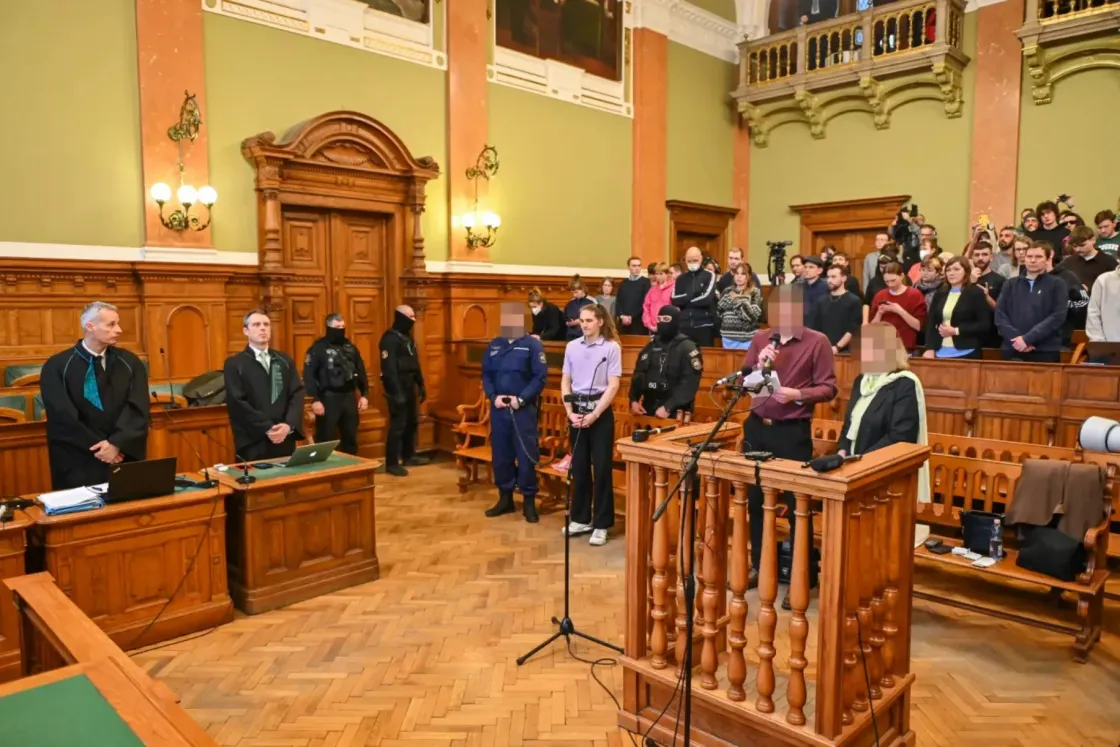

Amidst huge international media interest, the Budapest Metropolitan Court announced its first-instance, and therefore not yet final, verdict in the Antifa case on Wednesday. Maja T, a non-binary German citizen received an eight-year prison sentence for participating in the Antifa attacks committed in February 2023 in Budapest. Maja T. and the group she was with were accused of attacking and beating several people in February 2023, whom they believed to be far-right extremists based mainly on their clothing, and who they thought were going to the "Day of Honour" commemoration (an annual event organized by extreme far-right organizations, dedicated to commemorating the Nazi forces who broke out of Russian-encircled Budapest at the end of World War II). Of the defendants, only Maja T. was present in the courtroom, but on Wednesday, the court also found two other defendants, who were abroad, guilty. Italian Gabriele M. received a seven-year prison sentence, while Anna Christina M. received a two-year suspended prison sentence.
The prosecution charged Maja T. with attempted aggravated assault committed as part of a criminal organization and attempted aggravated assault with malicious intent, committed as part of a criminal organization. At the preliminary hearing, the prosecution recommended a 14-year prison sentence if Maja T. confessed to her crimes.

"We all know what verdict the Prime Minister of Hungary wants," said Maja T. in her closing statement before the court retired to deliberate. She spoke at length about how dissent is suppressed in Hungary, saying that the aim of those in power is to intimidate, which is why they want to banish her from society.
Maja T. also brought up that the demonstrations in her support, which her father had organised on several occasions, had been banned. "Are they really afraid of me or my father?" asked the defendant. She hopes that after serving her sentence, she will be able to return to Germany "as an active person." She said she had experienced the solidarity of many people. She expressed her gratitude to them and thanked them especially for their support. Her supporters in the courtroom applauded when she finished her closing statement.
At the start of Wednesday's hearing, Maja T. was escorted into the courtroom by several members of a swat team. On one side of the room, the defendant's supporters greeted her with applause, while on the other side, bald men, including members of the far-right Hatvannégy Vármegye Ifjúsági Mozgalom (a far-right youth movement), expressed their opinion with loud boos.
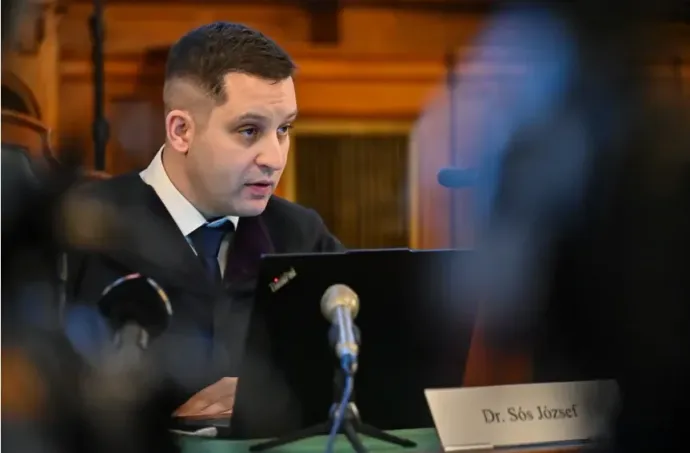
Then Judge József Sós presented the medical expert opinion on Maja T. The defendant did not suffer from a mental condition that prevented her from recognising the consequences of her actions—this was the essence of the 130-page expert opinion, which was presented only very superficially in response to Maja T.'s question. The judge briefly mentioned that the defendant's physical health was appropriate for her age. The judge also reported in more detail on her mental health. In the expert opinion, doctors described Maja T. as an anxious person with adjustment difficulties, whose "mood is low, but without suicidal thoughts."
Judge Sós spent more than two hours justifying the court's verdict. He said that Maja T. had not made a substantive confession admitting her guilt. The judge however, noted that the defendant had criticised the conditions of her detention in Hungary several times and ahead of Wednesday's verdict, she had repeatedly stated that the court's verdict could already be predicted. "It can be established as fact that more than ten people took part in the attacks," the judge said in his reasoning.
He quoted from several witness statements, which revealed that the group's objective was specifically to assault right-wing individuals. During the investigation and court proceedings, several individuals also stated that they had divided up the various tasks among themselves when carrying out the attacks. He also spoke at length about how, according to the testimonies, the attacks committed in February 2023 at multiple locations in Budapest were carried out with expandable batons, which could have caused life-threatening injuries.


József Sós explained how the attackers were identified based on witness statements. The judge stated emphatically that Maja T. was identified based on several on-site videos and a witness statement taken shortly after the attacks. According to the court, the evidence clearly shows that Maja T. contributed to the series of unprovoked attacks, which were carried out in a coordinated and choreographed manner, either actively or simply by her presence.
The judge also detailed the assault on the victim who was beaten up by a group of eight people in Gazdagrét. A clearly visible video recording was made of the attack in front of the grocery store, which, according to the judge, clearly showed that someone was "brutally attacked with no reason whatsoever". None of the defendants said exactly why they attacked the man, but the judge said that there could be no reason for it and that the victim had no chance to defend himself. "No one deserves this," said the judge, quoting from the victim's testimony about his head needing 24 stitches afterwards.
Towards the end of Wednesday's hearing, the judge also discussed why the group that carried out the attacks could be classified as a criminal organization. He described it as group of at least three individuals, operating for a longer period of time in a hierarchical and conspiratorial manner, with the intention of committing crimes punishable by imprisonment, thereby explaining the conditions under which an organization can be classified as a criminal organization. According to the judge, the camera recordings, the statements of the victims and bystanders, and the setting out of the objectives of the attacks all indicated that the participants in the attacks had acted in an organized and conspiratorial manner. Each attack was brief and silent, and in each case the attackers left the scene via a specific route.
According to the judge, in order for the latter to be possible, it was necessary to discuss these details in advance, but it was also necessary to define hierarchical roles when committing the attacks. Both the prosecution and the defense appealed the verdicts handed down on Wednesday. The prosecutor appealed for more severe sentences for all three defendants. The defendants' lawyers also appealed against Wednesday's court decision. Anna Christina M.'s lawyer appealed only for a reduction of the sentence, while Gabriele M. and Maja T.'s lawyers appealed for full acquittal. Maja T. confirmed this verbally, receiving loud applause from her supporters. At the end of the trial, Maja T.'s supporters held up banners and shouted loudly in English, "Freedom for Maja!" and "Free all anti-fascists!" Maja T. looked back, smiled, and was then led out of the courtroom in handcuffs.
Hunger strike and protests
The defendant criticized the custodial conditions in Hungary in several court hearings. In June 2025, she began a hunger strike to protest the conditions of her detention. Due to the deterioration of her health, she ended her hunger strike after a little more than five weeks and was transferred to a prison hospital.
Several sessions of the trial were accompanied by small demonstrations outside the building of the Budapest Metropolitan Court. However, prior to Wednesday's verdict, only a dozen supporters of Maja T. stood at the corner of Nagy Ignác Street and Markó Street. Unlike on previous occasions, they were not demonstrating, but simply stood together on the street corner. The police presence was quite considerable in relation to the size of the crowd; in fact, there were more police officers on standby than there were Maja T. supporters.
The main defendant in the case was Ilaria Salis, an Italian teacher. However, she was elected to the European Parliament in 2024 as a candidate for the Italian Green and Left Alliance, so the Hungarian authorities released her and suspended the court case against her. In order to continue the proceedings against the defendant, the Hungarian authorities repeatedly asked the European Parliament (EP) to suspend Salis's immunity. However, this has not happened so far. In September 2025, the EP's Legal Affairs Committee did not recommend suspending Salis's immunity.
The case caused a huge stir not only abroad, but also in Hungary. The Hungarian government repeatedly spoke out in outrage against the Antifa attacks. As a result of the case, in September 2025, Antifa organisations were declared terrorist organisations in Hungary, following a similar decision in the United States.
For more quick, accurate and impartial news from and about Hungary, subscribe to the Telex English newsletter!