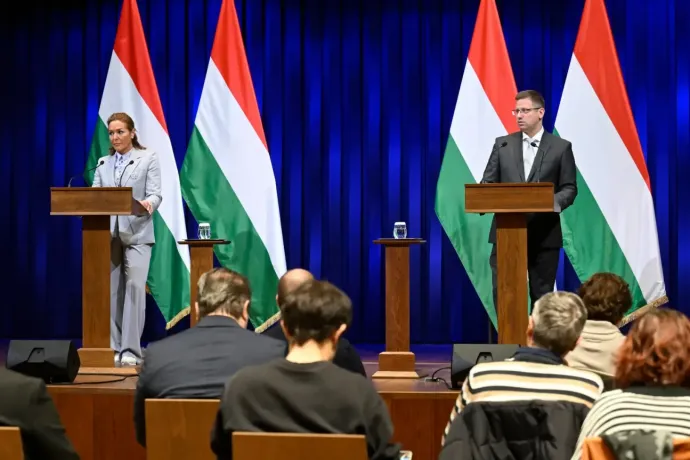

One of the subjects several members of the Hungarian press questioned Gergely Gulyás, Minister of the Prime Minister’s Office about at the government press briefing in Budapest on Thursday was that of the Slovak government’s recent legal amendment related to the Beneš decrees and the Slovak president’s communication about it.
The subject of the Beneš Decrees came to the forefront of Slovak politics recently, after the popular opposition party, Progressive Slovakia, called attention to the issue, demanding that the government resolve the issue of land confiscations that have taken place in recent years.
In early December, Slovakia passed a law that provides for a six-month prison sentence for anyone who questions the Beneš Decrees. The decrees were issued after World War II, when the Czechoslovak state applied the principle of collective guilt to the Hungarian and German inhabitants living within its territory, in many cases depriving them of their property, possessions, and homes. Having been elevated to the status of law, the decrees remain an unshakeable foundation of the Czech and Slovak systems of government to this day despite the fact that they would not stand up to scrutiny under human rights standards.
Gulyás now stated that "judicial practice in relation to this subject has been examined" and he stressed the need for “actions, not words". He pointed out that he believes that the concept of collective guilt is unacceptable in today's Europe, but the Slovak authorities continue applying the Beneš Decrees to this day, which is “discrimination based on origin". He added that – in keeping with the need for actions – the Hungarian government has promised legal assistance to those who have suffered a disadvantage as a result and opined that the Slovak amendment “represents a crossing of boundaries to such an extent that we will certainly be able to count on the support of European human rights forums".
Until now, the Hungarian government hasn’t said much about this. In mid-December, Orbán only saidthat they were “in talks with Slovakia to clarify the meaning of the law” and then early this year added that he was “trying to understand the legislation” and added that once he had a clear understanding of the situation, he would discuss it in depth with the Slovak president. He said that until that happened, he could confirm two things: that Hungarians in Slovakia will continue to have Hungary's support, and that he condemns all expressions of collective guilt.
Gulyás also reflected on the comments made by Slovak President Peter Pellegrini, in which he described Péter Magyar’s use of the name Felvidék (the historic name of the northern part of what was once the Kingdom of Hungary, and is now mostly present-day Slovakia) to describe the part of Slovakia where the majority of its Hungarian minority lives as offensive. The Tisza Party’s leader had sent an open letter to Robert Fico concerning Slovakia’s recently passed amendment which proposes a six-month prison sentence for anyone who questions the Beneš Decrees.
"The question is not whether Slovakia is Felvidék (literally: Uplands) but whether Slovakia is part of Europe," said Gulyás.
On the subject of the good Slovak-Hungarian relationship, Gulyás said that good neighborly relations alone mean nothing if they are not accompanied by respect for the Hungarian minorities living in neighboring countries. In his opinion, the current situation is obviously detrimental to everyone, including Slovakia, because it is "erroneous and bad politics," and added that the Beneš Decrees should not even have been considered.
For more quick, accurate and impartial news from and about Hungary, subscribe to the Telex English newsletter!