The church that received a lavish dedication, only to be blown up in a WWII battle
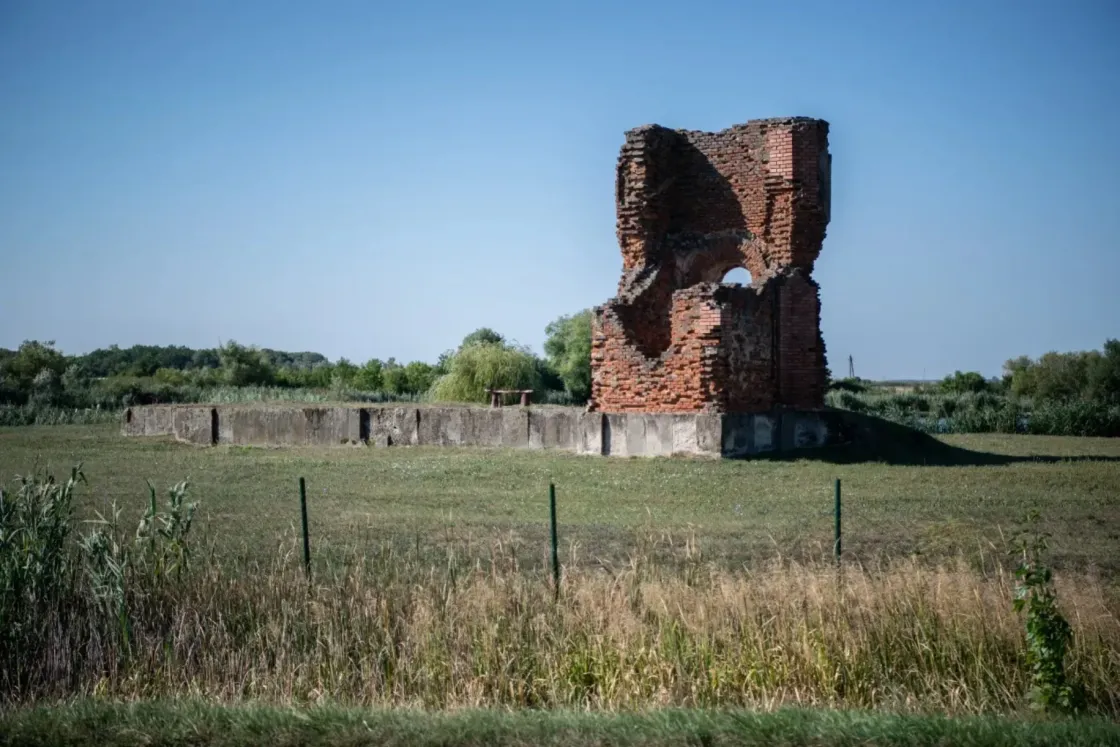

"This tower used to be about thirty metres high, you could see far from it. That eventually became its downfall,"
Márton Kövér and Mihály Horváth told us near the fish pond in the village of Folyás. Located about 60 kilometres from Debrecen, the area around Folyás, with a population of just under 300, is best known for its fish ponds, of which there are plenty. This is not surprising given its name (folyás = flow, stream): the 1894 edition of the Pallas Lexikon writes the following about the origins of the name of the village that once belonged to the town of Polgár: “In spring, there are flowing streams in the swamps here, where pike and tench live and can be caught with a net."
One pond stands out from the rest: the Church Pond, an artificial fish pond created from a clay pit, where people come not only to catch carp and catfish, but also to see the ruins of the church that was blown up by the retreating German army during World War II. Allegedly, because it offered too good a view, and they did not want the Russians to take advantage of this.
A tall tower
Folyás only became an independent municipality after the change of regime in 1992. It was one of the smallest villages in the country. Little of its architectural heritage remains, mainly due to World War II: the front line passed through Folyás twice, and not only did the Hungarian front reach it, but it was also the site of one of the biggest tank battles of World War II. The Hortobágy tank battle, also known as the Debrecen tank battle, began on October 9, 1944, and destroyed much of Folyás's heritage. The local church also fell victim to this destruction.
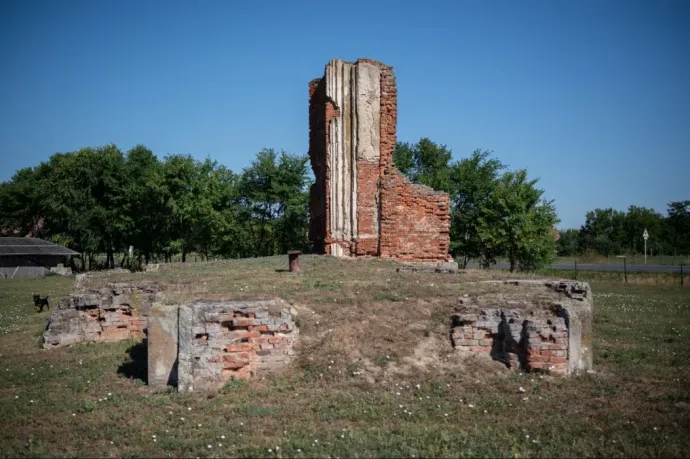
The church, which was blown up by the Nazis, was built in 1894, but today only its ruins remain beside the Church Pond. As we enter the privately owned are around the lake, we find a small wooden shed on the left, where bait is sold and fishing rods wait to be rented. Looking towards the lake, it is impossible not to notice the ruins of the church in the distance, on top of a small hill: looking at the outlines of the remaining, crumbling walls, one can only imagine what the church in Folyás looked like.

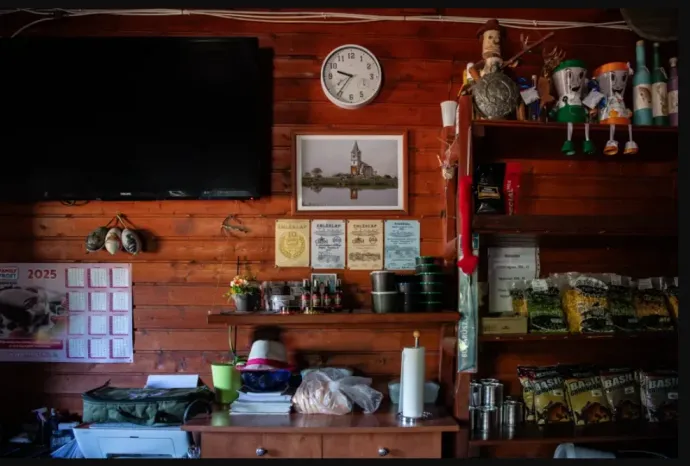
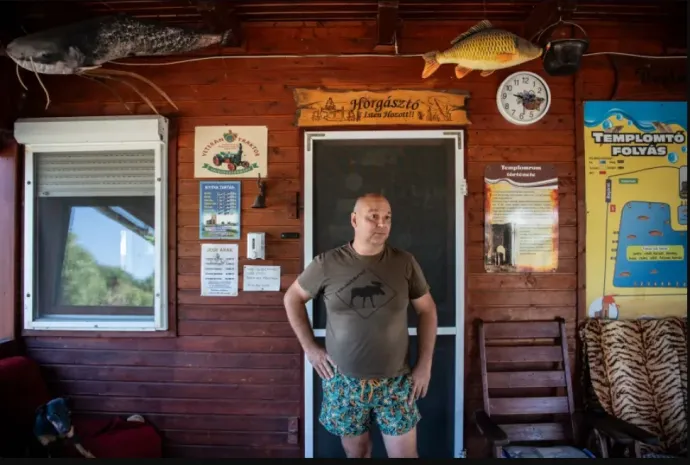
Behind the cash register in the shed, Márton Kövér and Mihály Horváth welcome us and tell us about the church. It could accommodate about 70 people, and its tower was so tall that the Germans, who were fighting alongside the 1st Hungarian Royal Armoured Division, fired at Görbeháza from here. "The cannons were here, the schoolyard was just opposite, and the officer monitored the terrain from above. From here, they were able to shoot accurately enough to destroy the tanks," say the two men. It is immediately apparent that the ruins of the church in Folyás are an important part of the local heritage: as they say, they know so much about it because generations have passed on their war stories to each other, and everyone here knows the history of Folyás.
“The locals say the tower was so tall that one could see all the way to Debrecen from it,” claims a sign on the side of the booth, which tells the brief history of the church ruins. According to local legend, this is what eventually caused the church's demise: on October 9, when the Germans retreated, they blew up the entire building so that the enemy wouldn't be able to use it. "They kept taking a lot of territory, kept going back and forth, and the Germans didn't want the Russians to take advantage of the tower", the locals explain.
Scattering money and roasting oxen
In the 19th century, Folyás was still an estate owned by the local ecclesiastical chapter, but given the region's agricultural opportunities and the river regulation, the village began to expand steadily. A school was built in 1869. According to contemporary records, the chapter considered building a church next to it unnecessary, and found establishing a church and a parish impractical and undesirable from an ownership perspective. In addition to archival newspapers and local accounts, the research and the book of the former mayor, Sándor Magyar, provide further insight into the village. In it, Magyar writes that after the school was built, the economic centre continued to develop, and the railway network was also expanded. Consequently, in 1892, Bishop Endre Pánthy began construction of the church in Folyás to provide a place of worship for Catholics living in the area around Folyás.
“Pánthy was the chief administrator of the chapter’s estates, and according to the surviving ecclesiastical records, he had the church erected as ‘a memorial of reverence for his long-deceased mother that would stand for centuries.’ One of Pánthy’s letters reveals that the church was not only erected in memory of his mother, but also to celebrate himself. Essentially, he used it to commemorate the 50th anniversary of his first mass as a member of the chapter.” According to a contemporary issue of the Vasárnapi Újság newspaper, the dedication of the church was also accompanied by great festivities:
"Three to four thousand people gathered from three to four counties, Borsod, Heves, Szabolcs, and Hajdú, for the dedication of the church in Folyás. Not only did the people of the land turn out on foot, in carts, and by rail, but the authorities and intellectuals of the same counties and several towns were also in attendance."
Pánthy was also the parish priest of Törökszentmiklós (he built the Pánthy Girls' School in Törökszentmiklós from his first savings), so according to the article, many people from Törökszentmiklós also came to attend the church dedication. The Törökszentmiklós newspaper from those days writes of Pánthy as someone who built the church "generously and single-handedly." The article also mentions that the dedication ceremony featured gingerbread, gypsy music, wine, and even roasted ox and cannon fire. "To complete the festive atmosphere, following the dedication, they threw money among those gathered." The church dedication was followed by a feast and dancing.
So the cassock wouldn't get muddy
"This is where the congregation entered; you can still see where they would walk," Márton Kövér says, pointing to a narrow path that runs alongside the church ruins. He says he regularly mows the grass there so he can show interested visitors the path that runs from the asphalt road in the village to the artificial mound that remains from the past.
We are standing near the part of the church ruins closer to the lake, which was originally the back of the church. The parishioners, therefore, made a semicircle from the path to reach the entrance, explains Kövér. The path used to be covered with gravel, which is still there under the ground today, he says. Then he adds with a smile: This was necessary "so the cassock wouldn't get muddy."
From the surviving correspondence of the chapter, we also know that the church had three bells, although there is little evidence of this in the ruins. In its article on the dedication, Vasárnapi Újság writes that the Romanesque-style "ornate building was built on an artificially created mound, five minutes from the manor," between a small bunch of trees and the railway tracks. According to the Egri Egyházmegyei Közlöny (Eger Diocese Gazette), the church was "worthy of the holy cause it represented in its noble conception, artistic design, and generous provision." And it was built in Folyás because, according to the article, the village "suffers from a lack of faith and the means of grace through no fault of its own."
The fuse
Not much is known about the building in the years following the dedication of the church. There is a record of it from 1941, but only because its organ was damaged. Then, in 1944, German troops mobilised their forces near Folyás, and the battle began, with German and Hungarian forces attempting to hold the Soviet troops back. When this failed, they blew up the Tisza bridge and planted mines under the church in Folyás.
Horváth and Kövér tell us how much they regret that we cannot speak to the woman who was alive when the church exploded. They say she would tell us about the force of the explosion: according to locals, it was so powerful that pieces of the church flew as far as Örvényszög, one of the more distant parts of the village. Doors and windows in the buildings nearby were smashed. "Rumour had it that locals would have only had to cut the fuse to prevent the church from exploding, but they were too scared to do anything," Magyar wrote, based on the wartime memories of a local woman.
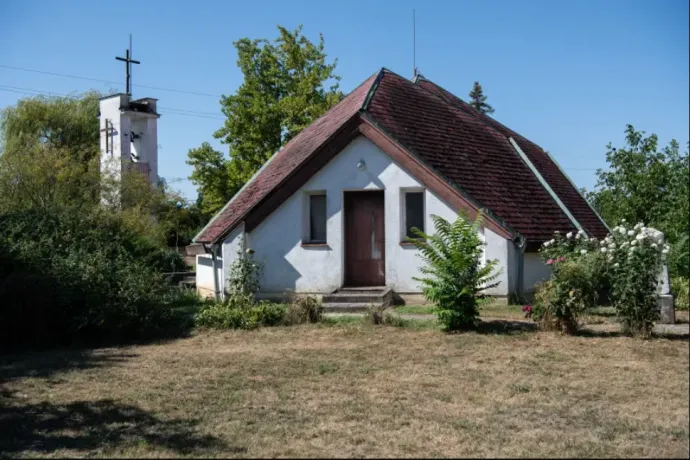
The explosion destroyed the church, leaving only the statue of Our Lady of Lourdes intact, although with its hand broken off. It was restored later, when, nearly forty years after the old church in Folyás exploded, the village was given a new church in 1983. According to letters written by the local parish priest at the time, not much else remained of the church: he managed to bury the parish registers, documents, and chalices before the Germans arrived, but the locals did not dare to hide the vestments, so they were lost in the explosion. The church in Folyás "was not very fortunate," as the letter subtly puts it. We also know from the letter that the Russians built a bridge from the pieces of wood that remained from the church, destroyed the roof of the rectory with their guns, drove their tanks across the fence, and the "drunken soldiers smashed the windows."
Hardly anything remained of the church. Parochial letters from 1945 still mention the broken altar and pews. After the destruction, the locals carried away the bricks of the church to rebuild their houses, and what remains of it is what can be seen today. After the war, Folyás essentially fell back by decades: not only was there no church left, but there was no railway or post office in the village either. According to a letter from the local priest, it was impossible to know the exact time in the village, only what day of the month it was.
It cannot be rebuilt, but it can be preserved
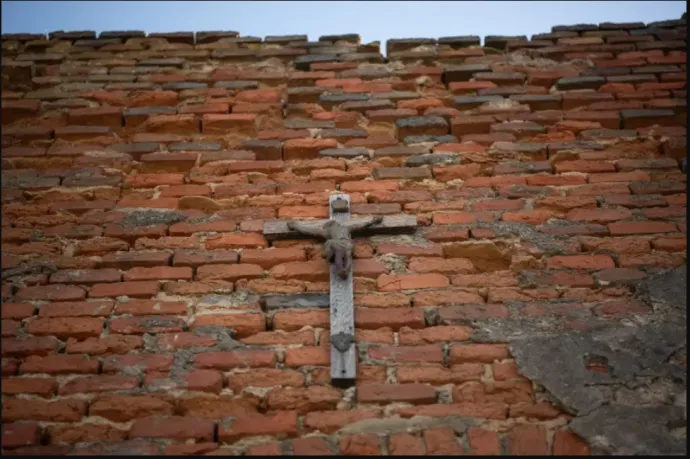
“There were plans to rebuild it, but the entire foundation was destroyed,” Horváth and Kövér explain. As far as they know, the explosion tore the foundation of the church into several pieces, "it could not be restored; it would have had to be demolished in order to be rebuilt." In the end, no one undertook this task, so the ruins of the church remained. Kövér placed an old cross on one of the walls to remind visitors of what once stood here. He did not change anything else in the ruins, except for placing an old wooden bench in the middle of the ruins because, according to him, many energy hunters have come here recently. He doesn't explain what that means, but I do learn that according to energy hunters, the St. George line runs through here, which is supposedly great for a little clearing of one's space and for recharging one's aura. "For those who believe in it," Kövér quickly adds.
The idea of rebuilding the church had already been rejected in 1947. At that time, for the faithful from the two farms in the area, mass was celebrated in the former steward's house in the village – for lack of a better option. In a letter from the archdiocese in 1948, the local assistant minister wrote that "the church in Folyás lies in complete ruins and rebuilding it is not possible." The letter also mentions that St. Ladislaus should replace St. Andrew as the patron saint of the village: this was accepted by the diocese, and forty years later, the new church in the village was named after St. Ladislaus. The pond near the church ruins, which we are now walking along, was created much later, only after the change of regime, in the area previously used for cob making.
Kövér points to the other side, where a cross stands today, saying that the school used to be there. It was demolished long ago, but at least the old rectory remains, he says. He's the one who lives there now and has even renovated it, just as he has been trying to preserve the church ruins for years. He says he tried to apply for funding, but was unsuccessful: "That's how it is, I'm trying to preserve what I can. Even though it's a church, winter and rain still take their toll," he says with a shrug. He adds that as long as he has the money, he will try to take care of the church. Let the tourists come and admire it. Or, if it so happens, the energy hunters.
Sources: Vasárnapi Újság (1894), Egri Újság (1894), Törökszentmiklós Hírlap (2017), church letters, Magyar Sándor: Úton… Folyás felé (On the way ... towards Folyás)