Tears, Arguments, and Liberation: A behind-the-scenes look at the transition of the Hungarian public service media
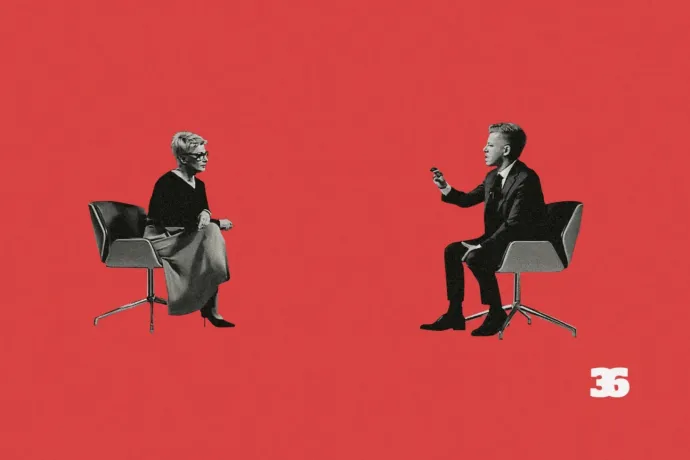

A tense, loud scene—one that, according to several witnesses, would have been right at home in a bar—unfolded three days after the parliamentary election, on the afternoon of Wednesday, April 15, at the “Adásszünet” café on the ground floor of MTVA’s (Media Service Support and Asset Management Fund) headquarters on Kunigunda Street.
At least twenty people witnessed a burly man raising his voice to confront a petite, frail woman. The man was Attila Császár, a reporter for public television who openly sympathizes with Fidesz—and who became known for comparing the 2006 “TV siege” to the 1956 Revolution during a live broadcast on Hír TV. The woman was a longtime political reporter for the Hungarian News Agency (MTI).
Császár yelled at her, shouted that she did not know who she was and warned her to think carefully about where she gets her paycheck from. He insisted she look at her employee ID card and stated bluntly that if she disliked something, she could simply go work for 444 (an independent news site critical of the Orban governments). Harsher, vulgar expressions were also used; multiple eyewitnesses recalled Császár yelling at his female colleague, “You shit where you eat.”
The attacked MTI employee stood up for herself and took issue with his behavior, but the man did not back down. Császár eventually left the room, but he continued to grumble outside, with his friends.
Császár’s anger was triggered by the staff meeting that had just ended in the event hall behind the cafeteria.
Meetings like this were unusual at MTVA headquarters. This time, the employees had been called together because Fidesz had suffered a catastrophic defeat in the April 12 parliamentary election. As a result, everyone within the organization was concerned about how the impending change in government would affect the future of public service media.
News Director Zsolt Németh—known to his colleagues simply as “Pitbull”— tried to defuse heightened tensions caused by the election results during the meeting. When some employees wanted to know whether the self-censorship seen so far would continue after the election and if they would continue to receive “instructions”, things became tense. The news director referred to the previous practice as “editorial freedom” and added that everything would continue exactly as before.
Among those who asked critical questions was the MTI employee whom Császár later attacked in the cafeteria. Németh’s responses outraged several people.
Help us tell the truth in Hungary! Become a supporter now and you’ll get insight into our work!
The events at the staff meeting and the subsequent scene in the cafeteria clearly demonstrated the tensions that had developed on Kunigunda Street in the period following April 12.
Over the past few months, Direkt36 has spoken with more than ten employees—who requested anonymity due to the sensitivity of the situation—about what had unfolded in the Hungarian public service media during the weeks following the elections and leading up to the July blackout, as well as how they are coming to terms with the years they spent within the propaganda machine.
The conversations showed that in the days following the election, several public service media employees—depending on their current party allegiances—turned on one another. Although many experienced the end of direct control—which happened almost overnight—as a liberation, they were now forced to confront the pressing question: if the propaganda-like operations bothered them, why didn’t they quit? The transition to working according to professional standards is not going smoothly either; many lack the necessary skills, or find it intimidating that they must take responsibility for the content they produce.
We posed several questions relating to this article’s content to the public service media’s press office, which repeatedly stated: “Answering this question is the responsibility of the public service media’s former leadership.” We also contacted former news director Zsolt Németh, but he has not yet responded to our questions. Those involved in the argument that took place at the cafeteria, including Császár, did not wish to comment.
Chapter I: Internal Tension
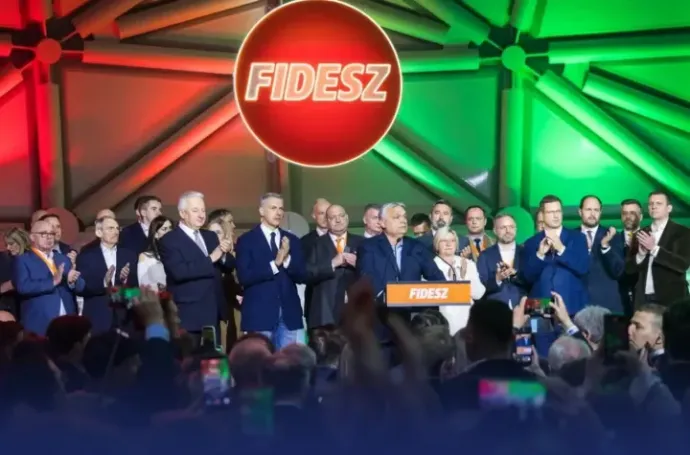
Viktor Orbán concedes Fidesz's election defeat – Source: Szilárd Németh’s Facebook page
One of the most memorable moments of election night was when Viktor Orbán acknowledged his party’s defeat in a brief speech at Fidesz’s election HQ and bid his supporters good night. Shortly afterward, the crowd that had gathered to await the results quickly dispersed.
Something similar happened at Kunigunda Street as well. After Orbán’s announcement, the executives vanished from the public service television station. They didn’t even wait for the broadcast to end. Finally, a lower-ranking employee—a simple editor—thanked those present for their work. “I guess this means we are to fly solo, ” said one public service media employee.
Some of the staff cried in grief that evening, while others were confused and didn’t know how to make sense of what had happened. According to one editor, the reason for this was that many had not realistically assessed the election odds, so Tisza’s landslide victory came as a shock to them.
Even in the days following the election, strong emotions continued to run high among employees sympathetic to Fidesz. There was one anchor who was so disheartened by Fidesz’s defeat that he decided he no longer wanted to appear on screen and instead withdrew to the background.
There were also instances of criticism in the hallways directed at Tisza’s president, Péter Magyar, who was elected prime minister in the days that followed. “There are colleagues of mine who call Péter Magyar a ‘faggot.’ That’s how they refer to him in private conversations, making no secret of their antipathy,” said a source working in the public service media’s online division.
However, there were also many who were filled with hopeful anticipation. They were confident that under the Tisza government, the public media service might regain some of its independence.
Some were already preparing for Tisza’s victory by changing their behavior before the election. According to an MTI source, this was true, for example, for some deputy editors-in-chief who had served as enforcers of censorship at the state news agency during the Orbán government. As long as the previous system lasted, they “casually discarded material,” the source noted, referring to how these mid-level managers had blocked numerous news stories. Their attitude was, “This cushy job is good for me; I don’t care about my conscience,” the source said of them.
“When it became clear that Tisza was going to win, their attitude started to change a bit. They began to be more affable, they weren’t so arrogant any more,” he said.
In the days following the election, Fidesz supporters and those celebrating Tisza’s victory clashed with one another on several occasions.
News Director Zsolt Németh himself brought this up at the staff meeting on the afternoon of April 15: people need to be able to get through the coming period side by side—both those who are happy and those who are sad. Or, if they can’t, they should take time off. “I think that even in a less civilized community, it’s not appropriate for colleagues to turn into enemies in a quarter of an hour or 20 minutes, when they’ve been working together for 10, 15, or 20 years,” Telex quoted Németh as saying, based on an audio recording it obtained.
According to one participant in the staff meeting, Németh’s remarks essentially boiled down to this:
“People started teasing each other, saying, ‘They’re going to fire you,’ or ‘No, they’re going to fire you.’”
Of course, the tension didn’t disappear at the push of a button, but the employees’ attention was increasingly drawn to other issues.
Chapter II: Censorship Comes to an End
“According to The Guardian, private planes leaving from Vienna are transporting the assets of those who grew wealthy under the Orbán government”—this was the headline of an MTI piece published on Sunday, April 26, at 9:37 p.m.
The state news agency examined a report by the British daily that had sparked significant controversy. The report claimed that members of a business circle close to Orbán were attempting to move the wealth they had accumulated during the Fidesz government’s tenure abroad.
The press review was intended as a sort of test: if this could reach the public, then censorship would truly be over, and anything could be written in MTI. The test was successful. The press review was published and was subsequently picked up by several independent news sites. Moreover, the MTI news story about this was not edited after submission, and the author did not face any reprisals.
This was considered a significant step forward, because even just a few weeks earlier, there were still signs of censorship at MTI. This happened, for example, during Péter Magyar’s appearances on public service media on April 15. Although Antal Rogán’s name was mentioned during the live broadcast, and the first draft of the MTI news story covering the interview also mentioned the former minister, his name was subsequently removed from the text. “It was completely nonsensical and also extremely humiliating,” said an MTI source, who added that he and his colleagues only noticed the omission after the story had already been published.
The gloomy mood was further worsened when News Director Zsolt Németh dismissed their concerns during a staff meeting later that day.
Infuriated, employees drafted a letter—which became infamous as the “Peasants’ Uprising”—demanding the restoration of their editorial autonomy.
With a few exceptions, most MTI employees added their names to the letter, which gathered about a hundred signatures. Some of those who stayed away feared for their livelihoods, while others opposed the move because of their sympathy for Fidesz. According to sources familiar with the events, one of the latter even mocked the letter, while another colleague noted: “until now there has been free journalism at MTI, and now oppression and occupation by the liberals are coming.”
The email got its name because it was sent with “Peasant Uprising” in the subject line to the heads of public service media, including Dániel Papp, —who had become known as a purveyor of fake news—the then-CEO of MTVA. The letter demanded that MTI’s “independent, impartial, and professionally grounded news service” be restored immediately and that Németh’s supervisory authority be revoked.
Management issued a diplomatic, neutral response calling for patience, but the letter caused a stir among the public. The document was leaked to the press the same day, prompting many on social media to criticize MTI employees, asking them why they hadn’t taken action sooner and why they had waited until now to protest.
Several MTI employees claim that they tried to take a stand against political censorship on an individual level.
“I tried to push the boundaries; I sometimes spoke up, there was a bit of shouting from time to time, and there were times when I was afraid I’d be fired—but then they didn’t fire me after all,”
said an MTI employee covering foreign policy. And there were attempts at rebellion at the community level as well; for example, in 2012, an open letter was written “to restore MTI’s professional and organizational independence,” but it amounted to nothing more than a cry in the wilderness.
The news agency plays a unique role in the Hungarian public sphere. Thanks to their extensive network of correspondents, they supply news content to most Hungarian newsrooms. Although MTI has also become part of the Fidesz propaganda machine, it has nonetheless functioned as a sort of enclave within the public media service.
While M1, for example, has seen a significant turnover in staff in recent years, at MTI—despite painful layoffs and voluntary departures—the majority of the staff has remained the same. At the beginning of the Fidesz government’s tenure, there were attempts at rebellion; on several occasions, they defiantly wrote news stories even when they knew their superiors would not publish them due to self-censorship. Most employees resented that the news agency—founded in 1881 and having survived two world wars and a regime change—had lost its independence and had been absorbed into a state media conglomerate, which many employees referred to as a “monstrosity.” “I never thought of myself as working in public service media. I’m an employee of MTI,” said one of them.
One result of this frustration was that, behind the scenes, written evidence of censorship, manipulation, and direct control had been collected for more than ten years. The group, calling itself the Pro Domo Task Force, approached the new leadership of public service media this summer and handed over a 482-page document. The sheer size of this collection—consisting mainly of internal correspondence—was a surprise, but the existence of such incriminating material was already known; some of it had already been reported on by Direkt36 in a 2022 article series.
Despite these efforts, many are forced to face the question: if they were bothered by the fact that they couldn’t work with integrity in the public service media, why did they stay there?
Beyond mere fears about making a living, various explanations have emerged for this moral dilemma. We spoke with an MTI employee who explained that he stayed out of a sense of professional duty. “You do your job even when conditions are very bad, just like a doctor,” he said. In his view, since the tricks of the trade in news agency journalism aren’t taught anywhere—they can only be learned from colleagues—if all the experienced staff had walked out, there would have been no one left to pass on that knowledge to the younger generation once they could work freely again. Another factor that contributed to his decision to stay was that he had always expected the Orbán regime to collapse at any moment.
Many compared themselves to a frog slowly boiling to death instead of jumping out of the water. And many viewed the takeover of public service media as a kind of occupation, which led them to conclude, “We were here first; they should be the ones to leave.”
In some cases, it was easier to stay on if one focused solely on one’s own work. “You won’t find any articles that I wrote and didn’t take responsibility for. I’ve always tried to be fair to everyone,” said an MTI employee who writes primarily about culture, though he also struggles with the fact that he was there during the past 16 years—a period that, incidentally, caused him constant frustration. “There were many times when I wasn’t proud of myself,” he said.
Others are also wrestling with their conscience.
“It will take me a long time to come to terms with why I stayed until now. I don’t have any unsavory political material, but I still worked there and contributed to the work,”
said one of MTVA’s television staff members.
Help us tell the truth in Hungary! Become a supporter now and you’ll get insight into our work!
After their letter titled “Peasant Uprising,” the MTI staff continued its work increasingly on a professional basis. “We started publishing material on our own initiative, and there was no retaliation whatsoever—nobody was asking us what we were thinking when we published these things”—said one of the MTI editors, describing the situation in mid-April. Similar developments were also underway at public television.
From that point on, however, MTI staff and television journalists had to face numerous other problems.
Chapter III: The Weight of Freedom
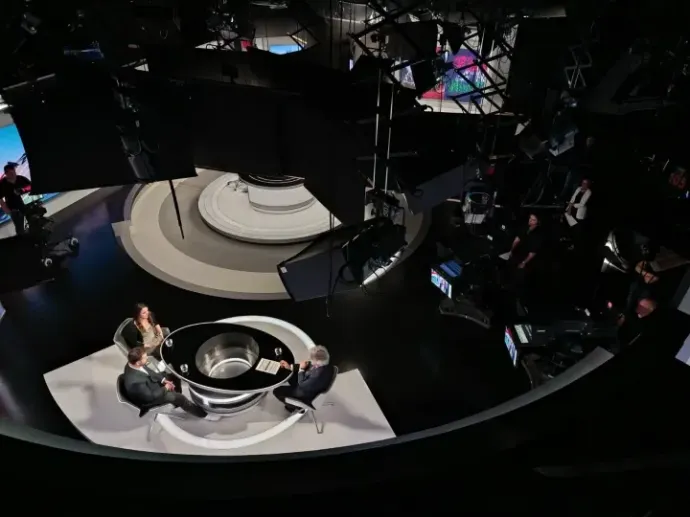
On April 29, Márton Gulyás, the channel’s founder and then-editor-in-chief, appeared on Partizán’s live broadcast wearing a striped shirt and carrying a paper shredder. He also brought an invitation with him: he had been invited to appear on one of M5’s programs. After a monologue lasting several minutes in which he harshly criticized the public media service, Gulyás theatrically shredded the invitation.
He stated that “no living person with any kind of backbone” – that is, professional integrity or civic consciousness -“can accept an invitation to ‘this public media service’ until substantive reforms are made there.” Before feeding the paper into the shredder, he added that he recommends this approach to everyone else as well.
Even if they did not follow Gulyás’s example to the letter, several public figures rejected requests from the public media service. According to one editor, those involved generally explained this by saying that if they had not been invited to appear on any program for 16 years, they would not sit in the studio now either.
Meanwhile, the public media service—which had been freed from direct political control but was still officially run by appointees of the Fidesz government—was also forced to confront the problem that it lacked staff who met professional standards.
At M1, for example, most of the staff has been replaced in recent years, and the young people who arrived to replace those who left were already socialized during the Fidesz era. Mastering the professional and ethical standards of journalism was not possible for them while the station operated as a propaganda outlet.
“Many young people are happy to be working here, to be on TV, to be working as journalists, and they have no idea that what has been going on here under the guise of journalism isn’t actually journalism,”
said a source at the public broadcaster.
This lack of preparation led to numerous awkward situations. In the weeks following the change in government, several reporters of the state TV’s news program simply did not dare to film the Tisza administration or ask Péter Magyar any questions. There were also problems with questioning techniques at MTI, because according to our information, during the Orbán administration, news agency reporters were prohibited from asking questions at press conferences or government briefings. (In relation to this, the public media service’s press office also said that answering this question is the responsibility of the former leadership of the public media service. We tried to contact former news director Zsolt Németh, but received no response from him.)
The lack of expertise also presented difficulties. As sources reported, those who failed to meet the performance standards in various sections of the propaganda media were transferred to MTI, regardless of their abilities. The reasoning behind this was to ensure that loyal people had some kind of job. This is how, for example, staff members who spoke no language other than English ended up in MTI’s foreign affairs section, where they translated materials using Google Translate.
The challenge for those who were professionally qualified for their task was in taking on responsibility. Before the April election—according to one MTI employee—“for those who like comfort, it was very comfortable that there was no responsibility in the system.” By this, he implied that censorship also served as a safety net. Since management decided on the final form and publication of the news, MTI staff may have felt that their own responsibility was effectively reduced to zero. “But now, if you’re the one publishing the material, you’re the one editing it, you’re the one deciding what goes in it, and you’re the one pressing the ‘publish’ button, then that’s your responsibility. And that’s a role one has to grow into,” he noted.
Cowardice still lingers in the system though—according to employees at the public media service, there’s a radical shift needed in mindset for this reflex to fade away in everyone.
“A lot of people don’t believe—or don’t dare to believe—that it’s possible to publish certain things. Or that you can say things out loud,”
said an editor at MTI. By this, he meant that even after direct control ended, many still work under self-censorship, driven by their old, ingrained fears.
“There’s no fear of the phone ringing off the hook, no worrying about what will happen if I publish the news, thinking that I’ll surely get fired. What I’m afraid of is that when the restructuring takes place, they’ll throw the baby out with the bathwater,” said our source, who fears that, alongside the actual propagandists, professionals like himself might also be let go.
So fear mingled with anticipation when, at the beginning of the summer, the new leaders appointed by the Tisza government appeared in the public service media.
Chapter IV: A historic gesture
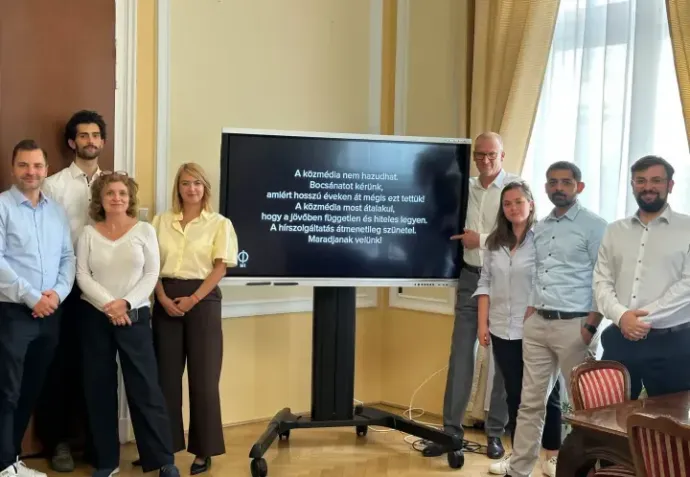
One day in mid-July, three people were sitting in an office at the headquarters at Kunigunda Street, discussing the past and future of public service media.
One of them was Zsófia Mészáros, the former editor-in-chief of Index and 444. Sitting next to her was Júlia Boros, a former journalist and video reporter for 444 who had been working with Mészáros for quite some time. Across from them sat a staff member from the website hirado.hu, who described how the news site had operated in recent years.
The reason for the meeting was that Mészáros had been appointed a few weeks earlier to lead the public service media’s online division on an interim basis, and, among other things, she was trying to assess the department by sitting down with each of the employees there individually. In doing so, she sought to learn not only about the people under her supervision and their professional backgrounds, but also about the inner workings of the propaganda machine. Mészáros was assisted in this by Boros, who took notes throughout the meetings.
Although the conversation with the hirado.hu staff member remained relatively subdued, Mészáros did ask some tough questions. At one point, for example, she asked: “Didn’t it occur to anyone working here that what they were doing was wrong, that this isn’t what public service is about?” To which the public service media employee replied: “Even if there were such realizations, in the workplace environment at the time, these issues could not be openly addressed.” (We contacted Mészáros about this, and she said that her contract with the public media service prevents her from commenting on the matter.)
Interim leaders were appointed to various divisions of the public media service after Parliament’s Culture Committee nominated András P. Horváth – a lawyer with no background in public media service – as the institution’s interim CEO on July 2. It soon became clear that Mészáros would be responsible for online content, while György Kerényi – who had previously headed Kossuth Rádió – took over the radio stations. The appointment of Balázs Bodacz as head of the news division sparked the most controversy. András Pikó, mayor of Józsefváros, recalled that Bodacz had previously produced a smear piece about his daughter for Hír TV – part of the Fidesz propaganda machine – for which he eventually apologized.
Against this backdrop, public service media experienced a tumultuous day on July 7.
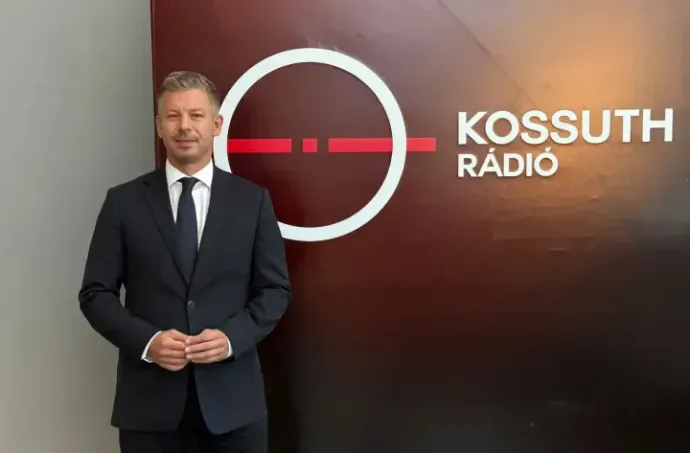
First, reports emerged that several iconic figures at the institution had been forced to leave. For example, the news director—Zsolt Németh, known as “Pitbull”—was relieved of his duties the day before and disappeared without a farewell letter or a proper goodbye. Attila Császár, one of M1’s iconic reporters, was also sent home on the 7th. At the same time, the new leadership took office and arrived at Kunigunda Street. (The press office of the public media service stated that a comprehensive organizational and professional audit is part of the renewal process, and it was within this framework that the dismissal of certain employees had taken place.)
That day also saw a communication gesture of historic significance. “Public service media cannot lie. We apologize for having done just that for many years! Public service media is now undergoing a transformation to ensure it remains independent and credible in the future. News coverage is temporarily suspended. Stay with us!”—this message appeared on the darkened screen of M1 at 4:00 p.m. On social media, the number of views of the message approached 2 million.
The timing of the blackout and the message came as a surprise even to the employees of the public media service we interviewed; according to them, the text—written in the first-person plural—had not been discussed with the staff in advance. (In response to our question about whether there had been any prior consultation with employees of the public media service on the matter, the MTVA press office replied: “The text was written, the graphic elements were designed, and the caption was prepared. All necessary coordination took place.”)
For example, one source working in the online division of the public media service had mixed feelings when he saw the announcement. Although he considered it an uplifting and appropriate gesture, another thought also crossed his mind. “It’s always a show in Parliament, isn’t it? Now, in a way, we’ve become part of the spectacle in this game,” he said. The source was referring to the fact that Péter Magyar has popularized a theatrical style in Parliament, and this move may have been modeled after that.
According to a source at the public television, however, no one really objected to the announcement; “it didn’t cause much of a stir.” “We were surprised, but it’s perfectly fine,” the source said. Amidst all that had unfolded, this particular manner of apology felt entirely appropriate to them.
This article is part of a partnership between Telex and Hungarian investigative journalism center Direkt36.